










Divgi TorqTransfer Q2 Profit Rises 146% on Export Surge
Key highlights
- Divgi TorqTransfer reported Q2 FY27 revenue from operations of ₹143.1 crore, up 72.4% year-on-year.
- Q2 FY27 net profit rose 146.7% year-on-year to ₹26.4 crore.
- EBITDA increased 99% year-on-year to ₹43.8 crore, with a 29.5% margin.
- H1 FY27 total income was ₹290.5 crore, up 76% year-on-year.
powered by IRIS
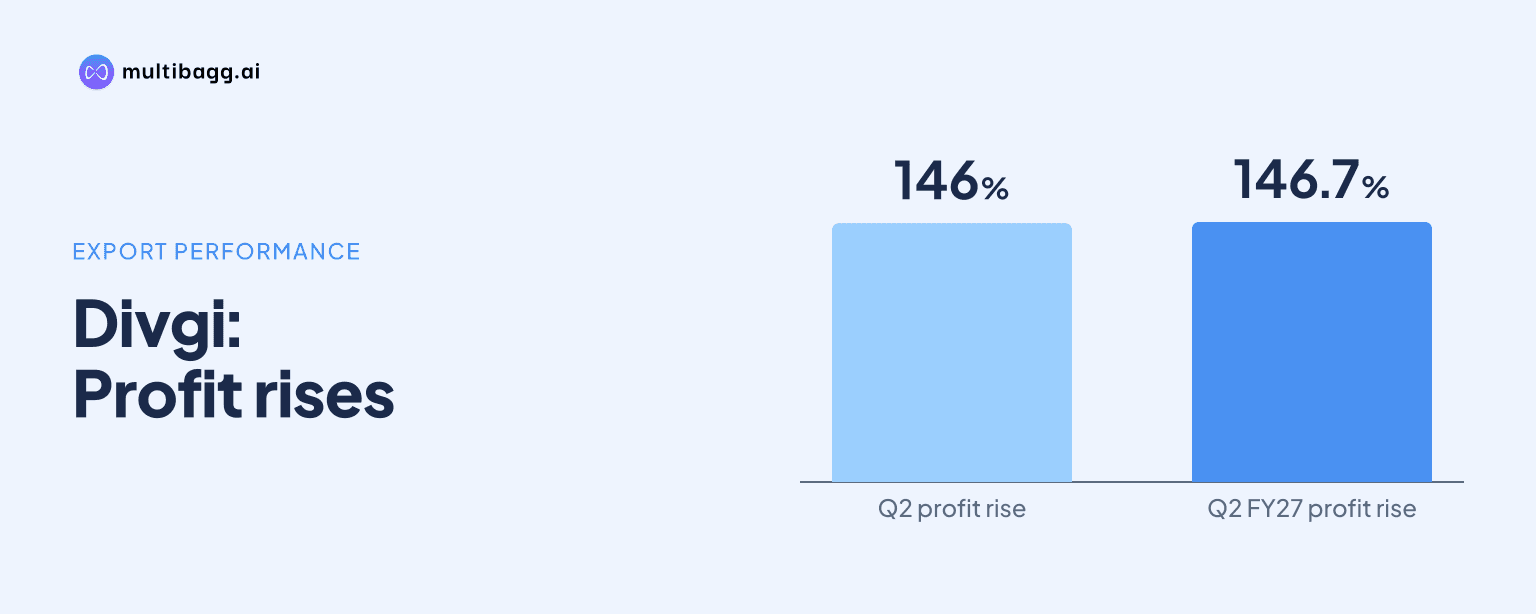
Divgi TorqTransfer Systems Limited reported a 146.7% year-on-year increase in Q2 FY27 net profit to ₹26.4 crore, while revenue from operations rose 72.4% to ₹143.1 crore. The quarter was supported by stronger sales across product lines and an Indonesia export-order surge described in the available earnings-call material as non-recurring.
Know Divgi Torqtransfer Systems inside out
Results, valuation, peers and who's buying, in one view.
What did Divgi TorqTransfer report in Q2 FY27?
Divgi TorqTransfer reported consolidated revenue from operations of ₹143.1 crore and profit after tax of ₹26.4 crore for the quarter ended September 30, 2026. Total income, including other income, was ₹148.7 crore, while profit before tax stood at ₹35.4 crore. Basic and diluted earnings per share were ₹8.63, compared with ₹3.51 reported for Q2 FY26 in the supplied results material.
The company’s quarterly operating performance showed substantial year-on-year improvement. EBITDA increased 99% year-on-year to ₹43.8 crore, and the EBITDA margin was 29.5%. Revenue growth was reported across transfer cases, EV transmissions, components and exports. The available presentation also set out a FY27 revenue target of around ₹500 crore.
Why did Divgi TorqTransfer's quarterly revenue rise sharply?
Divgi TorqTransfer's revenue rose sharply because sales improved across transfer cases, EV transmissions, components and exports, with the supplied earnings-call takeaway highlighting a large Indonesia export order. That material characterises the export surge as massive but non-recurring, which is important when comparing the quarter with the company’s longer-term revenue base.
On a standalone basis, revenue from operations rose from ₹83.0 crore in Q2 FY26 to ₹143.1 crore in Q2 FY27. It was also 4.3% higher than ₹137.1 crore in Q1 FY27. Standalone net profit increased 5% sequentially from ₹25.2 crore in Q1 FY27 to ₹26.5 crore in Q2 FY27, based on the figures supplied with the results coverage.
The company did not disclose the value of the Indonesia order in the provided material. Nor does the available information establish that similarly sized export orders will recur. The quarterly outcome should therefore be read alongside the stated FY27 revenue target rather than treated as evidence of a confirmed recurring run rate.
How did costs and margins change during the quarter?
Divgi TorqTransfer improved margins as revenue grew faster than reported expenses during Q2 FY27. Consolidated total expenses were ₹113.3 crore, while the company reported an EBITDA margin of 29.5% and a profit after tax margin of about 18% based on reported revenue and net profit.
Cost of materials consumed was ₹59.8 crore, employee benefit expense was ₹10.7 crore, and depreciation and amortisation was ₹8.3 crore. Finance costs remained low at ₹0.1 crore. The year-on-year increase in standalone total expenses was 53.9%, lower than the 72.5% increase in standalone revenue from operations cited in the supplied results data.
The margin expansion was a central feature of the quarter. However, the source material does not provide a full product-level bridge for EBITDA improvement or quantify the profitability of the export order separately. Investors therefore have limited disclosed information on how much of the margin gain came from mix, operating leverage, exports or other factors.
Got a follow-up? Ask IRIS
What do the results mean for Divgi TorqTransfer investors?
Divgi TorqTransfer's results show that its reported Q2 FY27 profitability grew materially faster than revenue, but the durability of this growth remains linked to future programme execution and order flow. The company’s net profit of ₹26.4 crore was more than double the year-earlier ₹10.7 crore, while first-half total income reached ₹290.5 crore, up 76% year-on-year.
The supplied earnings-call summary states that longer-term growth depends on automatic-transmission localisation that remains unconfirmed. This makes future updates on localisation programmes, customer production schedules and export demand relevant to assessing whether the company can meet its approximately ₹500 crore FY27 revenue target.
The quarter also marked Divgi TorqTransfer's first consolidated financial disclosure after the incorporation of wholly owned US subsidiary Divgi Transmission Technologies and Systems Inc. on June 4, 2026. Consolidated revenue from operations was ₹143.1 crore, the same as the reported standalone revenue figure in the available data. The source does not provide a separate revenue or profit contribution from the US subsidiary.
What disclosures and data-quality issues should readers note?
Readers should rely on the financial results and investor-presentation figures because one supplied transcript carries a material business-description inconsistency. The transcript is labelled as relating to Divgi TorqTransfer Systems but contains commentary on radio, events, digital media and Gaana, which does not reconcile with Divgi TorqTransfer's automotive drivetrain business.
Accordingly, figures in that inconsistent transcript concerning advertising demand, radio revenue, digital losses or Gaana should not be used to interpret Divgi TorqTransfer’s automotive results. The valid corporate update confirms that the board approved unaudited standalone and consolidated results on November 2, 2026, and that an earnings-call audio recording held on November 4, 2026, was uploaded to the company website under Regulation 30 of the LODR Regulations.
Conclusion
Divgi TorqTransfer delivered a strong Q2 FY27 on the reported numbers, with revenue from operations rising to ₹143.1 crore, EBITDA reaching ₹43.8 crore and net profit increasing to ₹26.4 crore. The export-led sales increase and higher EBITDA margin explain the scale of the year-on-year improvement, while disclosed costs grew more slowly than revenue.
The next results update should clarify progress toward the approximately ₹500 crore FY27 revenue target, the repeatability of export demand and the status of automatic-transmission localisation. Investors will also need further company disclosures to determine the contribution of the US subsidiary and whether Q2 profitability can be sustained beyond a quarter described as benefiting from a non-recurring Indonesia order.