










Divgi US unit defers factory spending pending contracts
Key highlights
- Divgi said its Greenville subsidiary is initially a customer-engagement and RFQ-development operation, not an immediate factory project.
- Divgi reported Q2 FY27 revenue of Rs 148.7 crore, up 68% year on year.
- Divgi’s transfer-case revenue rose 88% year on year to Rs 80.4 crore in Q2 FY27.
- Management has set a FY27 revenue target of well over Rs 500 crore.
powered by IRIS
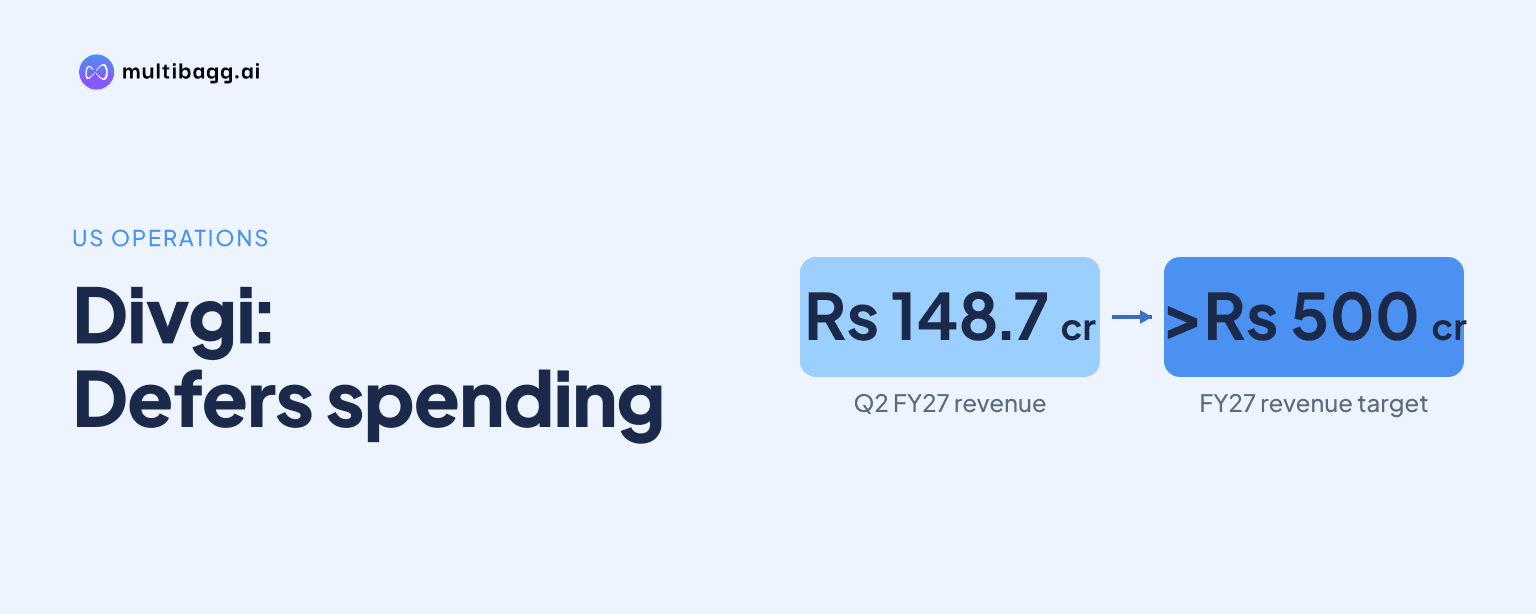
Divgi TorqTransfer Systems Limited said on November 4, 2026, that its Greenville, South Carolina subsidiary will initially focus on customer engagement and requests for quotation rather than an immediate US factory, with any manufacturing investment dependent on customer commitments, programme economics, tariffs, logistics, volumes and returns. Divgi reported Rs 148.7 crore of Q2 FY27 revenue.
Know Divgi Torqtransfer Systems inside out
Results, valuation, peers and who's buying, in one view.
Why did Divgi establish a Greenville subsidiary?
Divgi established a wholly owned subsidiary in Greenville, South Carolina, to build closer customer relationships and support its North American development pipeline, rather than to immediately establish production capacity. Management said the immediate work involves understanding customer requirements, progressing requests for quotation, or RFQs, and identifying suitable sourcing and manufacturing solutions.
Divgi also has an office at the Clemson University International Center for Automotive Research in Greenville. Management said local engagement can improve its understanding of technical requirements, response times to customer requests and coordination of engineering discussions across time zones. Initial team onboarding is under way, although management said a customer-facing operation requires sustained follow-through on each inquiry.
The US initiative is part of Divgi’s strategy to add adjacent geographies and products while scaling its established businesses. In Q2 FY27, Divgi generated total revenue of Rs 148.7 crore, up 68% year on year, while management described the US as an adjacent geography for future drivetrain opportunities rather than a stated near-term revenue source.
Will Divgi build a US factory now?
No, Divgi said that setting up a US presence does not amount to an immediate commitment to a large manufacturing investment. Management said any future investment will be evaluated against customer commitments, programme economics, operating risk and long-term strategic value, while retaining the flexibility provided by its balance sheet.
Divgi’s stated sequence is to serve opportunities from its Indian manufacturing base where that is commercially viable, then consider local value addition if customer commitments and programme economics support it. That approach allows the Greenville operation to pursue commercial and technical discussions without requiring factory capital expenditure before a programme is secured.
The company’s current growth has been supported by its existing operations. In H1 FY27, Divgi reported total income of Rs 290 crore, up 76% year on year, while earnings before interest, tax, depreciation and amortisation, or EBITDA, reached Rs 85 crore, up 108%. Management’s framework indicates that a US manufacturing project would need to satisfy its own commercial conditions.
What would make Divgi invest in US manufacturing?
Divgi said it would assess tariff exposure, logistics, customer requirements, technology content, expected volumes and returns before deciding whether to invest in US manufacturing. Management said a market opportunity alone is not a sufficient reason for major capital expenditure, making specific customer commitments and programme economics central to the next phase.
Product mix would also matter because Divgi’s businesses have different demand and production timelines. Transfer-case revenue rose 88% year on year to Rs 80.4 crore in Q2 FY27, whereas electric-vehicle, or EV, transmission revenue rose to Rs 11.4 crore from Rs 6.2 crore. A local-production decision would therefore require a defined customer programme, product application and volume case.
Management referred to evaluating sourcing and manufacturing solutions, rather than committing only to a wholly owned greenfield factory. Divgi can initially use Indian production for commercially viable North American orders before considering further local value addition. The call did not disclose a US capital-expenditure amount, construction timetable, production start date or signed Greenville manufacturing award.
Got a follow-up? Ask IRIS
How does the US plan fit Divgi’s wider growth strategy?
Divgi is using the US presence to expand geographically while growing transfer cases, EV transmissions and precision components. Management described two connected growth paths: scaling businesses with established customer relationships and industrial capabilities, and developing adjacent products and geographies, including all-wheel-drive systems, power take-off units, or PTUs, and the US market.
Transfer cases were the largest disclosed growth driver in Q2 FY27. Revenue from the product rose to Rs 80.4 crore from Rs 42.7 crore a year earlier, supported by the Indonesia pickup-programme ramp-up, domestic demand for four-wheel-drive systems and upgraded vehicle launches. This Indian manufacturing base is relevant to management’s plan to supply overseas opportunities before localising production.
Divgi’s components business provides a separate international operating reference. Component revenue was Rs 35.9 crore in Q2 FY27, compared with Rs 29.1 crore a year earlier, and exports exceeded Rs 23 crore during the quarter. Management said global programmes have progressed to stable production, but did not state that a comparable production outcome is assured for the US operation.
What does the plan mean for Divgi’s FY27 execution?
For FY27, Divgi said it is focused on transfer-case execution, EV-programme ramp-ups, deeper export relationships and technical and commercial milestones for emerging transmission opportunities. Management’s presentation set a revenue target of well over Rs 500 crore for FY27, following Rs 290 crore of total income in H1 FY27.
The EV pipeline illustrates the importance of programme milestones. Management said the Sigma EV transmission programme has received customer approval for production supplies and is ready for series production in H2 FY27. Divgi also received a prototype order from an Indian-China joint venture, but management said that order is not a production award and remains subject to validation, commercial alignment and sourcing decisions.
Management also stated revenue aspirations of around Rs 1,000 crore by FY30 and around Rs 2,000 crore beyond FY32 and FY33. It described those figures as targets and aspirations rather than assured outcomes, dependent on customer programmes, market demand, validation, sourcing decisions and execution. The Greenville subsidiary supports customer access within that strategy but does not alter the conditions set for US manufacturing.
Conclusion
Divgi’s North American entry is structured as a staged commercial effort: the Greenville subsidiary and office will support customer engagement, engineering dialogue and RFQ activity, while production investment remains conditional on a specific programme meeting operational and financial tests. The approach keeps open the option of serving US customers while existing growth is driven by transfer cases, EV transmissions, components and exports.
The next disclosed milestones are initial team onboarding in Greenville, conversion of inquiries and RFQs into customer commitments, and an assessment of tariffs, logistics, volumes and returns for potential local value addition. In the nearer term, Divgi’s execution against its well-over-Rs 500 crore FY27 revenue target and Sigma series production in H2 FY27 will indicate the progress of its existing Indian manufacturing base.