










TANFAC record Q2 sales coincide with 32.5% gross margin
Key highlights
- TANFAC reported record Q2 FY27 revenue of Rs 230 crore, up 37% from Rs 169 crore in Q2 FY26.
- TANFAC’s Q2 FY27 gross margin was 32.5%, versus 39% in Q2 FY26 and 37% in Q1 FY27.
- TANFAC increased solar-grade DHF capacity by 25% to 25,000 metric tonnes per annum.
- Management expects about 18% EBITDA margin in H2 FY27 and around 16% for FY27.
powered by IRIS
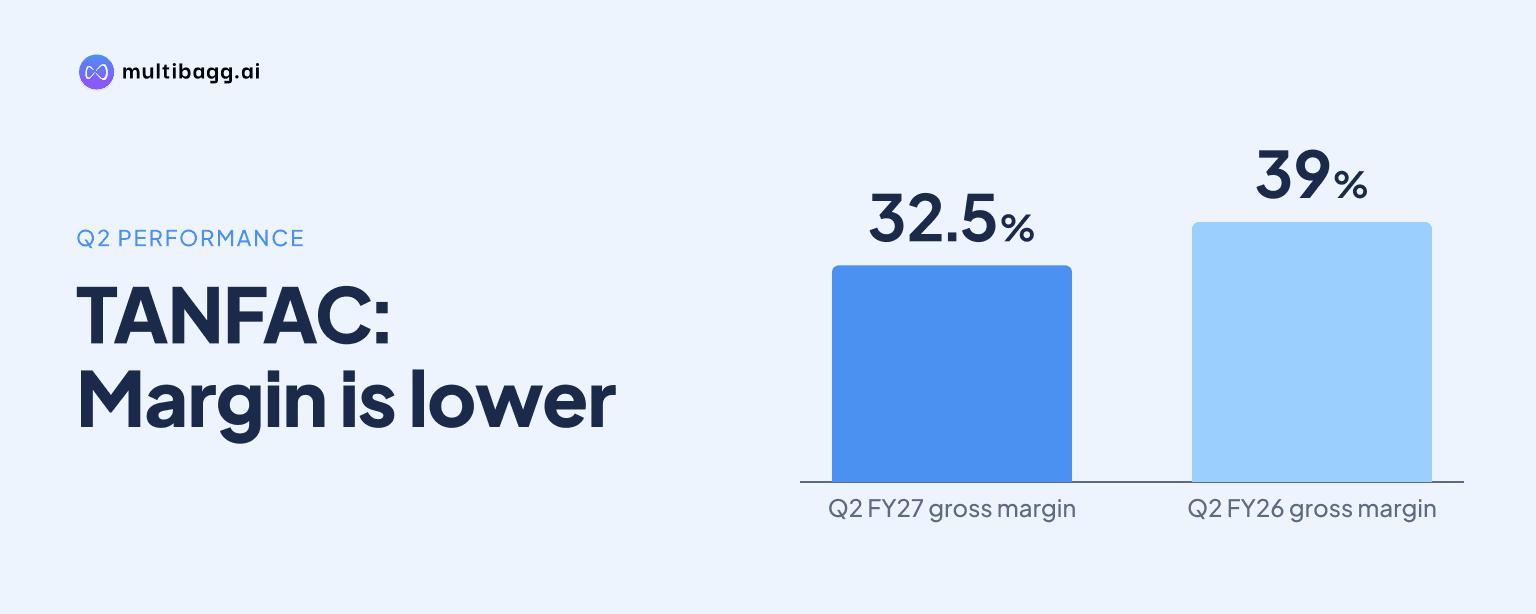
TANFAC Industries Limited reported record Q2 FY27 revenue of Rs 230 crore, up 37% year on year, while gross margin fell to 32.5% from 39% as sulphur costs rose and new products remained in early commercialisation. Management expects stronger H2 FY27 performance, including about 18% earnings before interest, tax, depreciation and amortisation margin.
Know Tanfac Industries inside out
Results, valuation, peers and who's buying, in one view.
Why did TANFAC’s gross margin decline in Q2 FY27?
TANFAC’s gross margin declined to 32.5% in Q2 FY27, from 39% in Q2 FY26 and 37% in Q1 FY27, even as gross profit increased to Rs 75 crore from Rs 66 crore a year earlier. Management said gross profit per tonne in the anhydrous hydrogen fluoride, or AHF, business was largely stable, but higher AHF realisations expanded revenue and therefore reduced the gross-margin percentage.
Sulphur prices raised input costs in Q2 FY27, while some recently introduced value-added products were at an initial commercialisation stage with relatively lower gross margins, management said. It has begun to see signs of sulphur-price moderation and expects margins on these products to improve as volumes increase, operations stabilise and cost pass-through improves.
How did TANFAC reach record Q2 FY27 revenue?
TANFAC reached Rs 230 crore of revenue from operations in Q2 FY27 through higher realisations and contributions from newly introduced products. Revenue was Rs 169 crore in Q2 FY26 and Rs 187 crore in Q1 FY27, making the quarterly increase 37% year on year and about 23% sequentially.
For H1 FY27, revenue rose 21% to Rs 418 crore from Rs 345 crore in H1 FY26. Q2 profit after tax increased to Rs 19 crore from Rs 17 crore a year earlier, but H1 profit after tax remained Rs 36 crore, unchanged from H1 FY26, as higher input costs and working-capital requirements affected profitability and operating cash flows.
Solar-grade DHF was one contributor to the company’s capacity and product strategy in Q2 FY27. TANFAC increased its solar-grade DHF manufacturing capacity by 25% to 25,000 metric tonnes per annum from 20,000 metric tonnes per annum through debottlenecking, which management said involved nominal capital expenditure; demand remained robust during the quarter.
What margin recovery does TANFAC management expect in H2 FY27?
Management expects H2 FY27 EBITDA margin of about 18%, compared with its stated full-year FY27 average expectation of around 16%. It attributed the anticipated second-half improvement to lower raw-material prices, higher volumes of new value-added products and a contribution from HFC-32 in the final quarter of FY27.
Management also said EBITDA margin should return to a 15% to 16% range from the current quarter, supported by better demand in solar-grade DHF and AHF, the scaling up of two to three products introduced in Q2, and anticipated easing in raw-material prices. These are management expectations rather than reported results, and EBITDA margin is not directly comparable with the 32.5% Q2 gross margin because the measures capture different cost levels.
For FY28, management gave a conservative overall EBITDA-margin estimate of 24% to 26%, based on a full year of HFC-32 production. The estimate depends on commissioning and commercialisation of the refrigerant-gas project, alongside the stated assumption that newer products move beyond their early ramp-up phase.
Got a follow-up? Ask IRIS
When will TANFAC’s HFC-32 project contribute to results?
TANFAC expects to commission its HFC-32 refrigerant-gas project in Q3 FY27 and begin receiving revenue contribution from Q4 FY27. As of the end of September 2026, management said 90% of the project work was complete and Rs 360 crore had been committed, equivalent to about 90% of the total project cost.
Management initially said it expected roughly 20% utilisation during the last quarter of FY27 because the plant would contribute only late in the year. In a later response, it estimated HFC-32 volumes of about 2,000 to 3,000 tonnes in FY27, with the outcome depending on whether operations stabilise in 10 days or 20 days after start-up.
For FY28, management gave utilisation expectations that varied between about 85% to 90% and about 95% in separate responses during the call. It said HFC-32 utilisation could be in a 90% to 100% range in subsequent years, while describing commercialisation of the value-added capacity as a source of further margin expansion.
What changed in TANFAC’s working capital and funding?
TANFAC’s working capital rose above normal levels near the end of Q2 FY27 because it bought critical raw materials, primarily fluorspar, in bulk. Management said the procurement was a precaution against potential international supply-chain disruption linked to geopolitical developments in West Asia and was intended to protect continuity of operations.
TANFAC raised about Rs 350 crore through equity issues in H1 FY27, including a Rs 250 crore qualified institutional placement completed in June 2026 and a preferential issue of about Rs 100 crore completed in September 2026. Promoter Anupam Rasayan invested about Rs 61 crore in the preferential issue, according to management.
Management said the capital raised supports expansion plans and reported adjusted return on equity of about 18% and adjusted return on capital employed of about 19% for H1 FY27. Both measures excluded net proceeds from the two equity issues, while annualised fixed-asset turnover increased to about 3.5 times in H1 FY27 from 3.4 times in FY26.
Conclusion
TANFAC combined record Rs 230 crore Q2 FY27 revenue with a 650-basis-point year-on-year decline in gross margin to 32.5%. Higher realisations lifted sales and gross profit rose by Rs 9 crore, but sulphur costs, lower initial margins on new products and precautionary fluorspar purchases limited the conversion of revenue growth into H1 profit growth.
The next disclosed milestones are HFC-32 commissioning in Q3 FY27 and its commercial contribution from Q4 FY27. Management’s H2 FY27 outlook relies on sulphur-price moderation, higher scale in newly introduced products and solar-grade DHF and AHF demand, while its longer-term plans include expanding AHF capacity from 30,000 to 45,000 metric tonnes and doubling solar-grade DHF capacity from 25,000 to 50,000 metric tonnes.