










TANFAC doubles HF capacity to 30,000 MTPA for integration
Key highlights
- TANFAC doubled HF capacity from 15,000 MTPA to 30,000 MTPA in October 2024.
- TANFAC reported 95% hydrofluoric-acid capacity utilisation in FY26 after the approximately Rs 100 crore expansion.
- HF contributed 75% of TANFAC revenue in H1FY27, versus 25% from sulphuric acid and other value-added products.
- TANFAC plans a Rs 495 crore, 20,000-MTPA HFC-32 project targeted for Q3FY27 commissioning.
powered by IRIS
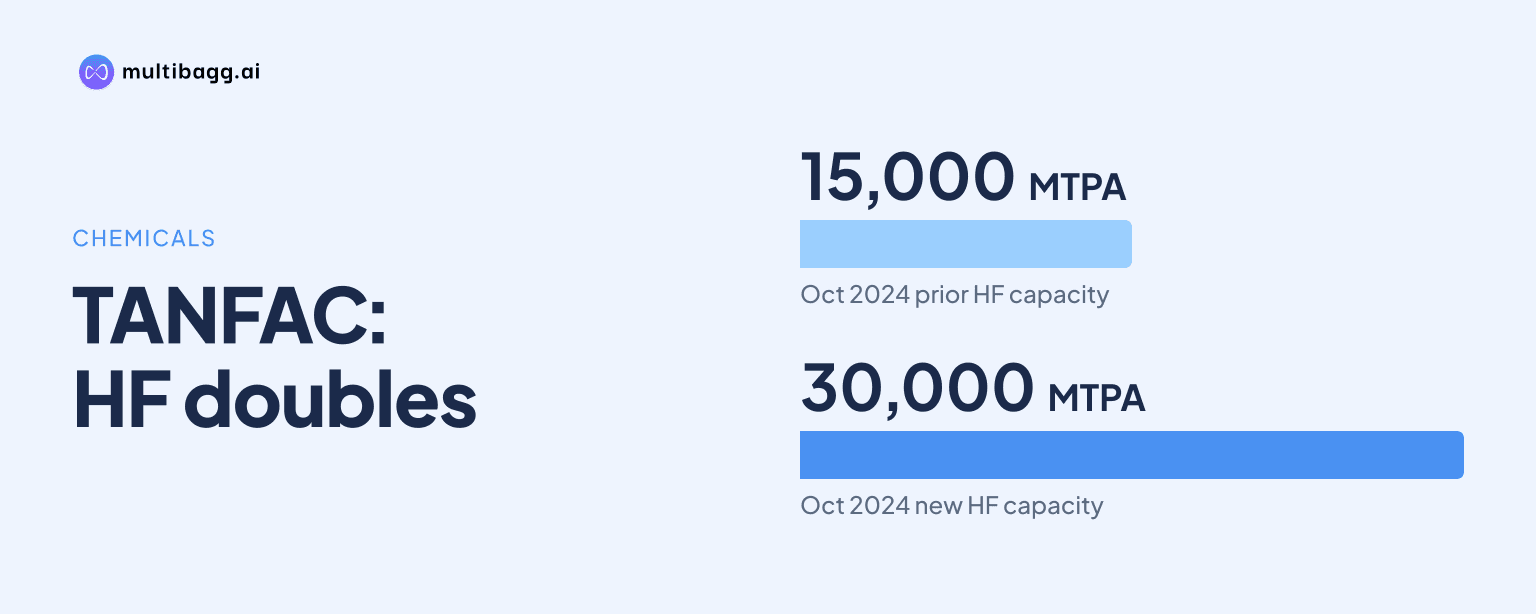
TANFAC doubled hydrofluoric-acid capacity from 15,000 to 30,000 metric tonnes per annum (MTPA) in October 2024, creating a larger captive feedstock base for solar-grade diluted hydrofluoric acid (DHF), specialty fluorides and planned refrigerant products. The approximately Rs 100 crore Cuddalore brownfield project reported 95% hydrofluoric-acid capacity utilisation in FY26.
Know Tanfac Industries inside out
Results, valuation, peers and who's buying, in one view.
What hydrofluoric-acid capacity did TANFAC add?
TANFAC commissioned a hydrofluoric acid (HF) unit at Cuddalore in October 2024, increasing HF capacity to 30,000 MTPA from 15,000 MTPA. The brownfield expansion involved capital expenditure of approximately Rs 100 crore, and TANFAC describes the resulting facility as among India’s largest HF facilities.
The expansion added 15,000 MTPA, equal to TANFAC’s entire pre-expansion HF capacity, rather than a small incremental line. TANFAC reported 95% utilisation of hydrofluoric-acid capacity in FY26, showing that the enlarged capacity base was substantially used during the financial year following the October 2024 commissioning.
How does TANFAC use HF in its fluorochemical value chain?
TANFAC makes anhydrous hydrofluoric acid (AHF) from fluorspar, or calcium fluoride, and concentrated sulphuric acid, then uses AHF as the feedstock for downstream fluorochemical products. Its commercial products include solar-grade DHF, dilute hydrofluoric acid, sulphuric acid and specialty inorganic fluorides such as potassium fluoride, potassium bifluoride, aluminium fluoride and sodium silico fluoride.
The larger HF base gives TANFAC more in-house availability for derivatives instead of treating HF only as a final product. TANFAC identifies solar-grade DHF, specialty fluorides, HFC-32 refrigerant gas and other fluorochemical products as linked to this captive supply, while electronic-grade DHF was shown as under development or planned as of 30 September 2026.
TANFAC also links potassium fluoride and fluorination capabilities to fluorinated organic intermediates. Its research and development operation has a pilot plant for vapour-phase fluorination for refrigerants and fluoromonomers, and the company says it has developed refrigerants, fluoropolymers and fluoromonomers at laboratory scale.
Which downstream products can use TANFAC’s added HF supply?
TANFAC identifies fluorocarbons and refrigerant gas, lithium batteries, electronic grades and fluorinated organic products as key applications for the 30,000-MTPA HF platform. These applications extend the role of HF beyond direct sales to supply inputs for TANFAC’s commercial specialty products and planned downstream projects.
Solar-grade DHF is an immediate downstream outlet because TANFAC says it is derived from high-purity AHF and used for high-purity etching and cleaning. TANFAC completed the first 10,000-MTPA solar-grade DHF phase in June 2025 and the second 10,000-MTPA phase in October 2025, then enhanced capacity to 25,000 MTPA through debottlenecking.
TANFAC has signed two long-term solar-grade DHF supply agreements valued at Rs 1,068 crore through FY29, with orders to be executed within 3.5 years. The company lists solar cells and wafers, flat-panel displays, advanced electronics and semiconductors as applications, and says an Indian solar wafer manufacturer certified the product after quality trials.
Got a follow-up? Ask IRIS
What does the HF expansion mean for TANFAC’s revenue mix?
TANFAC reported that HF accounted for 75% of revenue in H1FY27, compared with 25% from sulphuric acid and other value-added products. The mix shows that HF remained TANFAC’s principal revenue contributor while the company was expanding downstream products that use HF as a feedstock.
TANFAC reported FY26 revenue of Rs 711 crore, earnings before interest, tax, depreciation and amortisation (EBITDA) of Rs 112 crore, and profit after tax (PAT) of Rs 70 crore. From FY21 to FY26, it reported compound annual growth of 37% in revenue, 28% in EBITDA and 32% in PAT, alongside return on capital employed of 20% in FY26.
The operating base changed from 15,000 MTPA before October 2024 to 30,000 MTPA afterward. TANFAC says captive HF availability improves supply assurance, strengthens backward linkage for solar-grade DHF and specialty fluorides, and provides better value-chain control; the presentation does not quantify resulting cost savings.
How does TANFAC’s HF expansion support its refrigerant plan?
TANFAC says in-house AHF availability supports its planned entry into HFC-32 refrigerant gas. The company announced Rs 495 crore of investment for a 20,000-MTPA HFC-32 refrigerant-gas and other value-added-products plant at Cuddalore, with project commissioning targeted in Q3FY27.
The disclosed refrigerant arrangements are scheduled to start in January 2027. They comprise a seven-year contract for 7,500 MTPA valued at Rs 337.5 crore a year, a five-year memorandum of understanding for 5,000 MTPA valued at Rs 250 crore a year, and an agreement with an air-conditioning and commercial-refrigeration company valued at Rs 61 crore a year for an indefinite duration.
Together, TANFAC lists arrangements exceeding 12,500 MTPA with approximate annual value of Rs 649 crore, excluding goods and services tax. The doubled HF platform provides an upstream input source for this planned project, but the presentation does not state that the HFC-32 plant has commenced commercial production.
Conclusion
TANFAC’s October 2024 HF expansion doubled capacity to 30,000 MTPA and increased its captive feedstock availability for solar-grade DHF, specialty fluorides and planned refrigerant products. With 95% HF utilisation in FY26 and a 75% contribution to H1FY27 revenue, HF remains both TANFAC’s main operating platform and the upstream link in its downstream integration strategy.
The next disclosed milestone is targeted Q3FY27 commissioning of the Rs 495 crore, 20,000-MTPA HFC-32 project. Execution of solar-grade DHF agreements worth Rs 1,068 crore through FY29 and the January 2027 commencement dates for refrigerant-related supply arrangements are also the disclosed matters to watch.