










TANFAC targets Rs 250 crore AHF and DHF expansion
Key highlights
- TANFAC plans to increase AHF capacity from 30,000 to 45,000 metric tonnes a year.
- TANFAC plans to double solar-grade DHF capacity from 25,000 to 50,000 metric tonnes a year.
- TANFAC has guided to minimum FY28 capital expenditure of Rs 250 crore for AHF and solar-grade DHF.
- TANFAC expects HFC-32 to consume 13,000 to 15,000 tonnes of HF annually.
powered by IRIS
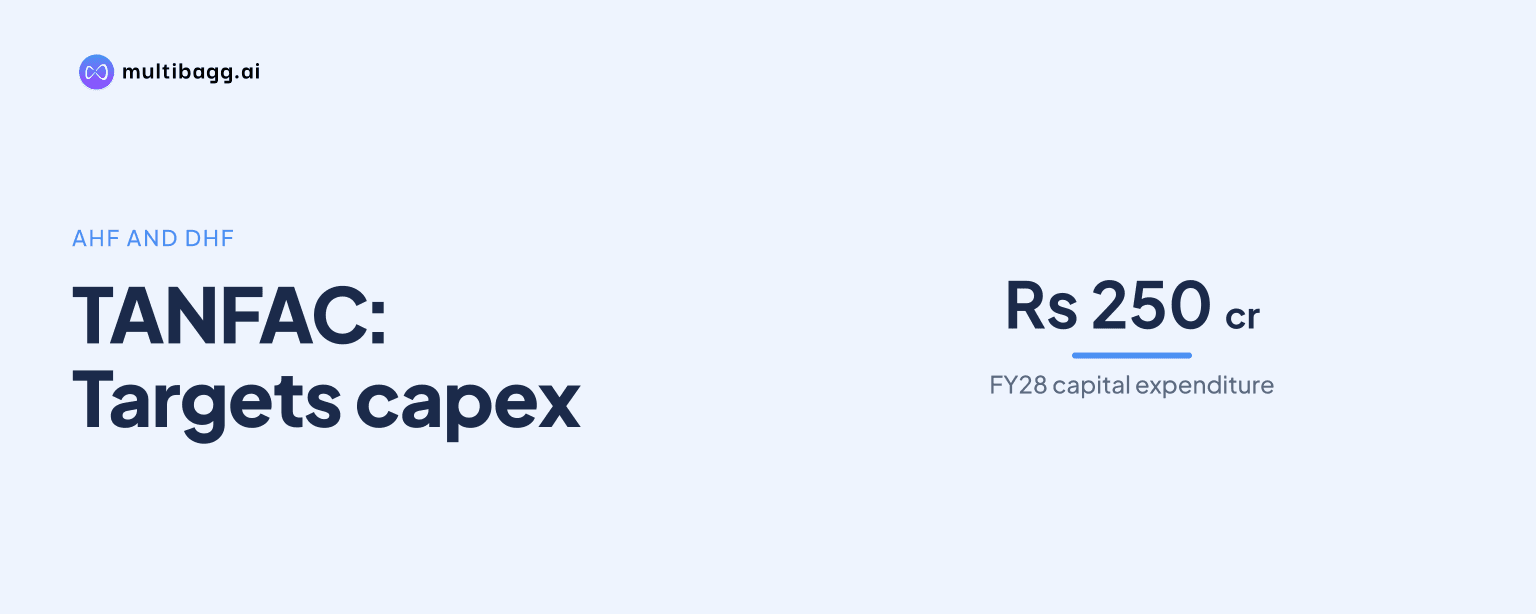
TANFAC has outlined a minimum Rs 250 crore FY28 expansion plan to increase annual AHF capacity by 15,000 metric tonnes and double solar-grade DHF capacity to 50,000 metric tonnes, after estimating that its HFC-32 plant will consume 13,000 to 15,000 tonnes of HF internally. Management described upstream AHF and solar-grade DHF as its immediate capital priorities.
Know Tanfac Industries inside out
Results, valuation, peers and who's buying, in one view.
Why is TANFAC adding a third AHF plant?
TANFAC is adding a third AHF plant because HFC-32 is expected to consume almost 13,000 to 15,000 tonnes of HF, creating a need to preserve external AHF sales while supplying its captive requirement. TANFAC currently has two AHF plants with annual capacity of 15,000 metric tonnes each, for a combined 30,000 metric tonnes, and plans to increase that total to 45,000 metric tonnes.
Captive use is already significant within the existing AHF base. TANFAC previously used about 10,000 metric tonnes of AHF for solar-grade production and said that requirement would rise to around 12,500 metric tonnes after debottlenecking. Adding the expected HFC-32 requirement to the 12,500-tonne solar-grade requirement explains management's statement that it would otherwise face an HF shortage.
The proposed AHF addition is therefore intended first to support TANFAC's product chain rather than being presented as a stand-alone external-sales project. In the call, an analyst said the capacity could aid margins rather than absolute revenue, and management agreed that bolstering AHF output was the first priority. TANFAC did not disclose a commissioning date or separate capital cost for the third AHF plant.
How will TANFAC double solar-grade DHF capacity?
TANFAC plans to double solar-grade DHF capacity from 25,000 to 50,000 metric tonnes after first raising it from 20,000 to 25,000 metric tonnes through debottlenecking. Management said utilisation rose from about 80% to 85% in Q1 FY27 to 90% to 95% in Q2 FY27, and expected the extra debottlenecked capacity to be fully used in the second half of FY27.
Management based the expansion on its view that Indian solar-cell manufacturing capacity could rise from 30 gigawatts currently to 100 gigawatts over the next three years. It said solar-grade demand could consequently increase from 25,000 metric tonnes to 1 lakh metric tonnes when the planned solar capacity is operating. The planned 50,000-tonne DHF capacity would represent half of that management demand estimate.
TANFAC had not signed another contract with its existing solar-grade customer at the time of the call. Management said demand was not currently an issue and that it could enter a back-to-back agreement before proceeding with the next capital expenditure, potentially when the project is announced. It also said a competing solar-grade facility would require about Rs 90 crore to Rs 100 crore, technology and around one year of project time, which was management's assessment.
What does TANFAC's Rs 250 crore FY28 capex cover?
TANFAC's minimum Rs 250 crore FY28 capital-expenditure guidance covers the planned AHF and solar-grade DHF expansions, excluding other value-added projects not yet announced. Management called the figure a conservative estimate and said additional spending would depend on decisions on forward integration expected in the coming months.
This follows a larger FY27 spending programme dominated by the HFC-32 project. TANFAC said it had incurred about Rs 360 crore out of approximately Rs 395 crore of HFC-32 project cost, with Rs 40 crore of balance spending plus Rs 30 crore to Rs 40 crore for debottlenecking and fluorinated value-added products. It therefore expected total FY27 capital expenditure of Rs 440 crore to Rs 450 crore.
TANFAC said the Rs 395 crore HFC-32 project was funded by Rs 350 crore of equity and around Rs 50 crore of debt. The equity funding comprised Rs 250 crore from a qualified institutional placement and Rs 100 crore from preferential allotment. Management also said Rs 157 crore of unutilised fund-raise proceeds had been committed to ongoing projects and would be used by FY27-end.
Got a follow-up? Ask IRIS
How does HFC-32 set TANFAC's expansion sequence?
HFC-32 sets the expansion sequence because TANFAC expects it to begin consuming HF and contributing revenue from Q4 FY27 following planned commissioning in Q3 FY27. At September 2026-end, the project was 90% complete and about Rs 360 crore had been committed, equivalent to around 90% of the stated Rs 395 crore project cost.
Management estimated HFC-32 sales volume of 2,000 to 3,000 tonnes in FY27, depending on whether plant stabilisation takes 10 or 20 days. For FY28, it gave an expected utilisation range of 85% to 90% in one response, while another response referred to about 95% utilisation next year. These are management projections rather than reported production figures.
TANFAC said customer qualifications had begun, with some customers approved and samples under evaluation elsewhere. Management said approvals generally take two to three months, trade-segment sales could start from December, and sales to original equipment manufacturers could start from January. It also expected a 5,000-tonne memorandum of understanding to convert into a contract within one to one-and-a-half months.
What projects could follow TANFAC's AHF and DHF expansion?
TANFAC has identified electronic chemicals, fluoropolymers and next-generation gases as medium-term greenfield opportunities after the AHF and solar-grade DHF priorities. Management said its capital-expenditure pipeline extends over the next five years, but it did not disclose investment amounts, capacities or commissioning dates for these three product areas.
Management said it expected to decide within three to four months which downstream area should come first. It identified laboratory development and commercialisation, customer tie-ups and technology tie-ups as the variables that would determine the order. Until that decision, Rs 250 crore for AHF and solar-grade DHF remains TANFAC's disclosed minimum FY28 capex.
TANFAC revised its FY27 revenue-growth guidance to 35% to 40%, from its earlier 30%, citing stronger second-half demand for solar-grade DHF and AHF plus HFC-32 revenue from Q4 FY27. For FY28, management indicated revenue growth of 55% to 60% over FY27, based on a fuller HFC-32 contribution. Revenue from operations in H1 FY27 was Rs 418 crore, up 21% from Rs 345 crore in H1 FY26.
Conclusion
TANFAC's Rs 250 crore FY28 plan links a 15,000-tonne AHF capacity addition to expected HFC-32 consumption of 13,000 to 15,000 tonnes of HF, while lifting solar-grade DHF capacity from 25,000 to 50,000 tonnes. The strategy follows Q2 FY27 solar-grade utilisation of 90% to 95% and management's expectation of rising solar-industry demand.
The next disclosed milestones are HFC-32 commercial sales expected from December in trade and from January for original equipment manufacturers, subject to approvals, and the expected conversion of the 5,000-tonne memorandum of understanding. Management also plans to decide within three to four months whether electronic chemicals, fluoropolymers or next-generation gases should follow the AHF and solar-grade DHF projects.