










Lenskart maps 25% margin path through ownership and automation
Key highlights
- Lenskart's Q2 FY27 pre-Ind AS EBITDA margin rose to 13.8% from 11.1% a year earlier.
- India pre-Ind AS EBITDA margin reached 16.0% in Q2 FY27, up from 13.4%.
- In-house frame output rose 72% year on year and in-house lens output increased 52% in Q2 FY27.
- The Hyderabad facility is designed for annual production capacity of 5 crore pairs.
powered by IRIS
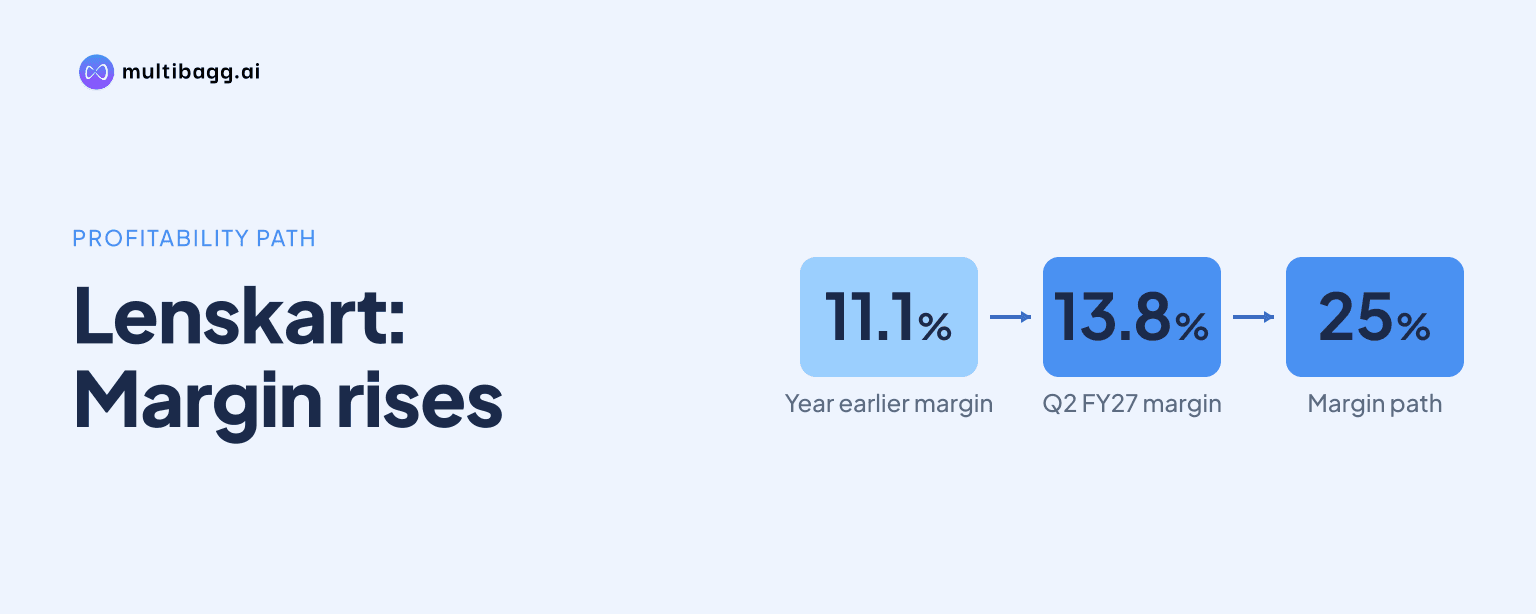
In Q2 FY27, Lenskart said its long-term pre-Ind AS earnings before interest, tax, depreciation and amortisation (EBITDA) margin could reach 25%, after the reported margin rose 2.7 percentage points year on year to 13.8%, supported by in-house brands, manufacturing, central fulfilment, store leverage and proprietary operating systems.
Know Lenskart Solutions inside out
Results, valuation, peers and who's buying, in one view.
Why does Lenskart believe a 25% pre-Ind AS EBITDA margin is possible?
Lenskart says a 25% pre-Ind AS EBITDA margin is possible because it owns seven parts of an eyewear transaction: the brand, frame manufacturing, lens manufacturing, edging and fitting, retail sales, materials research and development, and operating systems. Management said this end-to-end model retains profit pools that might otherwise sit with suppliers or retailers, while giving Lenskart responsibility for the complete customer experience.
The financial starting point was Q2 FY27 revenue of Rs 2,845 crore, up 32.5% year on year, while pre-Ind AS EBITDA rose 65%, or twice the rate of revenue growth. That lifted the group margin to 13.8% from 11.1% a year earlier. In the first half, revenue reached Rs 5,559 crore and pre-Ind AS EBITDA was Rs 753 crore, rising 1.3 times and 1.8 times year on year, respectively.
Management did not set a deadline for reaching 25%. It said quarterly margins can vary with campaigns, product mix and comparison bases, and that performance should be assessed over years rather than quarters. Management also said profitability is ahead of its expectations, but growth remains the priority because Lenskart has a small share of the global eyewear market.
How are brands and in-house manufacturing supporting margins?
Lenskart says its owned brands and in-house production are major parts of the margin plan. The portfolio includes Vincent Chase, John Jacobs, OWNDAYS and Meller, while licensed collections are exclusive in its markets. Management said some of the increase in India's Q2 average selling price came from customers choosing OWNDAYS premium lenses, although it does not manage the business to an average selling price target.
In-house frame production increased from 44 lakh units in FY23 to 78 lakh units in FY26, which management described as a 20% compound annual growth rate. Frame manufacturing in Q2 FY27 was 72% higher year on year. Lenskart has frame factories in India, China and Thailand, and management said India-based moulding reduces dollar-linked exposure while higher in-house tooling and plating can reduce mould cost per piece as production volumes rise.
In-house lens production rose from 21 lakh units in FY23 to 56 lakh units in FY26, while Q2 FY27 output was 52% higher year on year. Lenskart said it is increasingly making progressive lenses, complex-power lenses, premium coatings and OWNDAYS premium lenses in India. Some India-made lenses already reach international markets, and management identified sun-lens production and further overseas supply as additional opportunities.
The segment data showed different product-margin movements in Q2 FY27. India product margin rose to 64.0% from 63.4%, but management said much of the gain from in-house manufacturing was consumed by rupee depreciation. International product margin increased to 77.1% from 75.5%, which management attributed to deeper integration of OWNDAYS and Meller supply chains and a higher sunglasses mix.
Got a follow-up? Ask IRIS
How can central fulfilment and store leverage improve margins?
Lenskart says central fulfilment can improve consistency and unit economics because nearly every India pair is made centrally in Bhiwadi or Manesar instead of being assembled in a store. Bhiwadi operates at 75% automation, while fitting, quality control and packaging remain largely manual. Management identified those processes as the remaining automation headroom in the current production model.
Management said scale, robotics and bulk pre-production of frequently ordered pairs are further levers because its data identifies what customers are likely to order. The Hyderabad facility is designed to make 5 crore pairs a year under one roof. Management said that around 12 months after commissioning, the facility should take automation, robotics and pre-making of common pairs to the next level, supporting its longer-term aim to make 10 crore pairs annually.
Store economics provide another mechanism. India same-store sales growth was 20.8% in Q2 FY27, ahead of management's estimate of roughly 5% annual cost escalation. India rent declined to 5.7% of revenue from 6.1%. Management said store-team costs and rent are largely fixed, so a large part of same-store sales growth can flow through to profit, subject to investment levels and product mix.
Lenskart continued to add capacity while citing that leverage. It added 143 net new India stores in Q2 FY27, including 94 in Tier 2-plus towns, taking the India network to 2,868 stores as of September 30. Globally, it added 165 net new stores to reach 3,624 locations. First-half operating cash flow of Rs 388 crore funded Rs 187 crore of store capital expenditure for 297 net new stores.
What role do software, eye tests and growth spending play?
Lenskart says proprietary systems should enable a larger network to run on common infrastructure rather than proportionately adding support functions. Its stores use its point-of-sale system, eye-test machines use internal software, factories run on NEX, replenishment uses Argus and site selection uses GeoIQ. During FY27, customer relationship management, call handling and talent acquisition also moved in-house after having been outsourced.
The company linked the software model to eye testing and lens adoption. Remote optometry was live in 934 India stores in Q2 FY27, up from 303 a year earlier, and India eye tests rose 44% to 70 lakh. Drysh, its artificial intelligence-assisted eye test, remains in pilot. Management said more eye-test records train its technology, while digitised progressive-lens measurement is intended to improve consistency in the customer journey.
Management said margin expansion will also finance growth investments rather than solely increase reported profitability. Its stated uses include marketing, expansion in Bharat and international scaling as unit economics develop. The Rs 500 Hustlr Club complete-pair offer is part of this market-building strategy. Separately, Lenskart Gold reached 1 crore active members in India and collected Rs 73 crore in fees during Q2 FY27, up 55% year on year.
Management said it expects annual margins to expand as volumes grow, but declined to provide a near-term annual margin target. It instead highlighted India eyewear-unit growth of 26.5% in Q2 FY27 and about 26% over the prior 12 months. International revenue grew 29.5% to Rs 1,201 crore, and management said growth and supply-chain integration should bring EBITDA into line over time without specifying a margin level.
Conclusion
Lenskart's 25% pre-Ind AS EBITDA aspiration is a structural plan, not a dated forecast. Its Q2 FY27 results showed group margin at 13.8%, India margin at 16.0% and international margin at 10.6%. The proposed route combines retained brand and manufacturing economics with central fulfilment, higher store productivity and systems shared across retail, factories and international operations.
The next points to watch are the Hyderabad facility's progress toward its 5-crore-pair annual design capacity around 12 months after commissioning, further automation beyond Bhiwadi's current 75% level, and the balance between margin gains and spending on marketing, Bharat expansion and international scale. Management has not set a timetable for 25% and continues to prioritise volume growth.