










Lenskart Q2 in-house frame output rises 71.7%, lens 52.2%
Key highlights
- Lenskart produced 36 lakh in-house frame units in Q2 FY27, up 71.7% from 21 lakh units in Q2 FY26.
- Lenskart produced 20 lakh in-house lens units in Q2 FY27, up 52.2% from 13 lakh units a year earlier.
- Annual in-house frame production rose from 44 lakh units in FY23 to 78 lakh units in FY26.
- Lenskart reported Rs 297 crore of plant and other capital expenditure in H1 FY27.
powered by IRIS
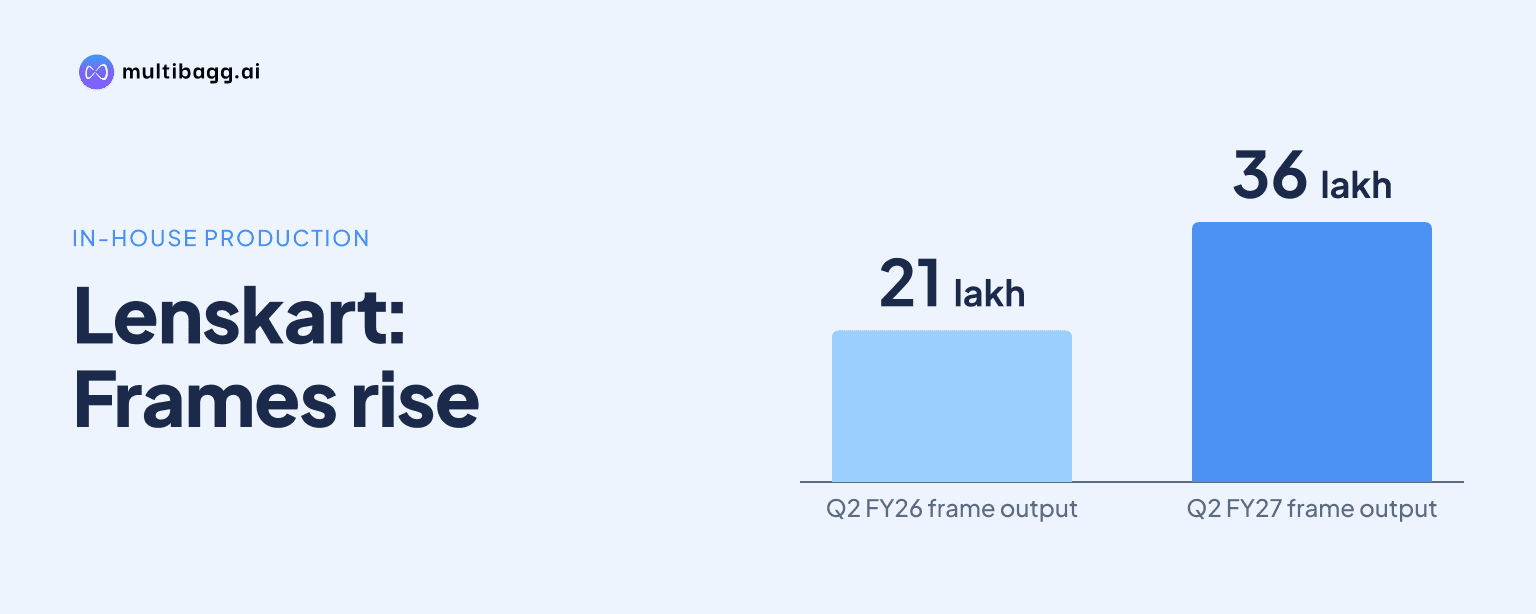
Lenskart increased in-house frame production to 36 lakh units in Q2 FY27, a reported 71.7% year-on-year rise, while in-house lens production reached 20 lakh units, up 52.2%. The disclosed gains show higher output in both manufacturing categories within Lenskart’s factory-to-face operating model.
Know Lenskart Solutions inside out
Results, valuation, peers and who's buying, in one view.
How much did Lenskart’s in-house output grow in Q2 FY27?
Lenskart manufactured 36 lakh frame units in Q2 FY27 versus 21 lakh units in Q2 FY26, an increase of 15 lakh units and 71.7% year on year. In-house lens output rose to 20 lakh units from 13 lakh units over the same period, adding 7 lakh units and increasing 52.2%.
Frames recorded the larger increase in both absolute units and reported percentage growth in Q2 FY27. Frame output increased by 15 lakh units, compared with a 7 lakh-unit increase in lenses, while the respective growth rates were 71.7% and 52.2%.
Lenskart identifies India, China and Thailand as the locations for its in-house frame manufacturing. The lens-production disclosure reports aggregate in-house lens output of 20 lakh units for Q2 FY27 but does not provide a country, facility or product-category split.
How has Lenskart’s frame manufacturing changed since FY23?
Lenskart’s annual in-house frame output rose from 44 lakh units in FY23 to 78 lakh units in FY26, with the presentation reporting a compound annual growth rate, or CAGR, of 20.5%. Output increased in every disclosed fiscal year, reaching 53 lakh units in FY24 and 65 lakh units in FY25 before reaching 78 lakh units in FY26.
The FY26 annual total was 34 lakh units above the FY23 level. The latest quarterly figure of 36 lakh units in Q2 FY27 is not directly comparable with the FY26 full-year total of 78 lakh units, but it shows a higher quarterly output than the 21 lakh units recorded in Q2 FY26.
The presentation does not disclose frame-production capacity, factory utilisation, inventory, manufacturing cost or the proportion of frames sold that were made in-house. As a result, the 36 lakh-unit Q2 FY27 figure establishes output growth but does not show the extent of available capacity or manufacturing economics.
How quickly has Lenskart expanded in-house lens manufacturing?
Lenskart increased in-house lens production from 21 lakh units in FY23 to 56 lakh units in FY26, reporting a 39.0% CAGR over the disclosed period. Annual lens output was 25 lakh units in FY24 and 41 lakh units in FY25 before rising by 15 lakh units in FY26.
Lens manufacturing expanded at a faster stated FY23-to-FY26 CAGR than frame manufacturing, at 39.0% compared with 20.5%. In the Q2 FY27 year-on-year comparison, however, frame output grew faster at 71.7%, while lens output rose 52.2%.
The presentation does not state why the growth pattern differs between frames and lenses. It also does not disclose lens capacity, prescription mix, production locations or the share of lens sales supplied from internal manufacturing, despite reporting Q2 FY27 output of 20 lakh units.
Got a follow-up? Ask IRIS
What does Lenskart mean by its factory-to-face model?
Lenskart describes its factory-to-face model through seven pools of profit: brands, frame manufacturing, lens manufacturing, edging and fitting, channels, research and development and innovation, and a tech-first operating model. The Q2 FY27 manufacturing figures of 36 lakh frame units and 20 lakh lens units relate to two of those seven pools.
The brands listed by Lenskart include John Jacobs, Owndays, Lenskart Air, Hustlr, Hooper, Vincent Chase, Meller, Le Petit Lunetier Paris and Aqualens. The presentation does not allocate Q2 FY27 frame or lens output among these brands, so the production data cannot be tied to a specific brand portfolio.
For edging and fitting, Lenskart identifies an upcoming centralised manufacturing facility in Hyderabad. The disclosure gives no commissioning date, capital cost, capacity target or expected output contribution for the Hyderabad facility.
Lenskart’s innovation slide refers to Night Driving, Lenskart Air PRO-FIT and Hooper, with Hooper described as having unbreakable lenses and flexible frames. The presentation does not state whether these products are manufactured in-house, so they cannot be linked directly to the Q2 FY27 output totals.
How does Lenskart’s H1 FY27 spending relate to manufacturing?
Lenskart reported Rs 297 crore of plant and other capital expenditure in H1 FY27, compared with Rs 187 crore of store capital expenditure. Operating cash flow before store capital expenditure was Rs 388 crore, but the presentation does not divide the Rs 297 crore plant and other category between manufacturing plants, equipment, technology or other uses.
After store capital expenditure of Rs 187 crore, Lenskart reported operating cash flow of Rs 201 crore. After Rs 108 crore of other items and Rs 297 crore of plant and other capital expenditure, net cash flow before mergers and acquisitions was Rs 12 crore.
Lenskart reported a cash balance of Rs 3,855 crore after considering foreign-currency translation reserve and excluding an initial public offering-related payable. It also reported Rs 82.2 crore of mergers and acquisitions investment in H1 FY27, including Rs 25.5 crore for Onwards and Rs 15.5 crore for Dimension NXG, known as Ajna.
Lenskart reported return on capital employed of 22.5% in H1 FY27, compared with 19.0% in H1 FY26. Return on capital employed, or ROCE, is defined in the presentation as EBIT divided by capital employed, but Lenskart does not attribute the 3.5 percentage-point increase to manufacturing, stores, brands or another individual operating pool.
Conclusion
Lenskart’s Q2 FY27 disclosure shows output growth across both internal manufacturing categories, with frames rising to 36 lakh units and lenses reaching 20 lakh units. The annual record through FY26 also shows expansion in both areas: frames increased from 44 lakh units in FY23 to 78 lakh units, while lenses rose from 21 lakh units to 56 lakh units.
The next disclosed manufacturing milestone is the planned centralised edging and fitting facility in Hyderabad. Lenskart has not given a timetable, capacity target or investment figure for that facility, while the Rs 297 crore of H1 FY27 plant and other capital expenditure remains undisclosed by manufacturing use.