










Lenskart reports 90% prescription uptake for smart glasses
Key highlights
- Lenskart has placed smart glasses in 500 stores after demand ran slightly above its expectations.
- About 90% of Lenskart smart-glasses buyers have purchased prescription lenses with an eye test.
- Lenskart first launched the glasses around April through a signup list that drew a few hundred thousand people.
- Lenskart said it has issued software and firmware releases almost every two weeks.
powered by IRIS
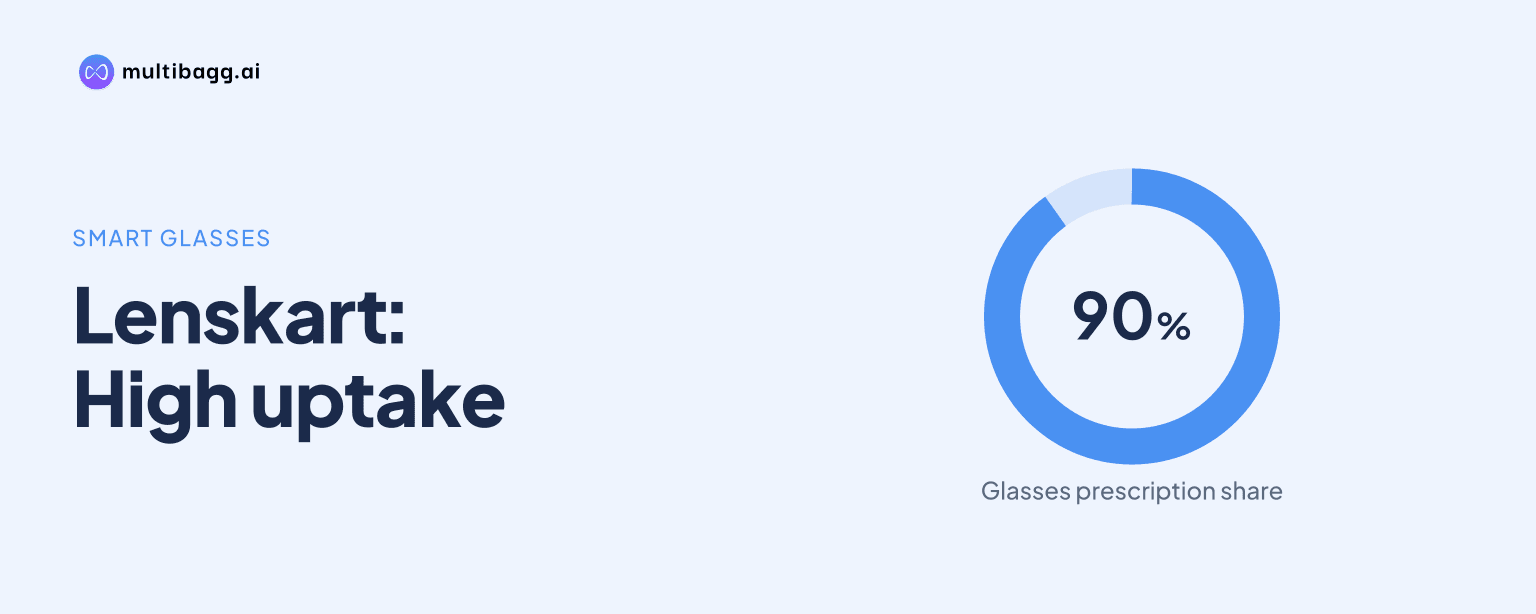
Lenskart reported that about 90% of early smart-glasses buyers chose prescription lenses after the product, first launched around April, reached 500 stores following demand above expectations and a production increase. Management said the early pattern supports its view that smart glasses will be a prescription-led product, while it continues iterative development rather than price-led expansion.
Know Lenskart Solutions inside out
Results, valuation, peers and who's buying, in one view.
How far has Lenskart rolled out its smart glasses?
Lenskart has placed its smart glasses in 500 stores, with availability across those outlets beginning about one or two weeks before the call. Store training was still under way, according to management, making the 500-store deployment an early operating phase rather than a fully mature national rollout. The company said it had received somewhat higher demand than it anticipated and had returned to increase production before expanding availability.
The rollout followed an initial launch around April this year through a signup list that attracted a few hundred thousand people. Lenskart used those early signups to collect feedback before moving the product into its physical network. That sequence matters because the company is using stores not only as sales points, but also for eye tests, prescription ordering and service after purchase, rather than treating the smart glasses as a conventional online electronics launch.
Why are prescription lenses central to Lenskart's smart-glasses plan?
Prescription use is central because about 90% of people buying Lenskart smart glasses so far have bought them with a prescription and an eye test. Management said this result supports its original thesis that smart glasses will ultimately be glasses first. In that model, the ability to fit prescription lenses and provide post-order service is a core part of the offer, alongside the device's software and hardware features.
The early purchase mix also distinguishes Lenskart's approach from a rollout focused only on electronic functions. Management linked prescription fitting to its store distribution and described both as part of the company's advantage in the category. With 500 stores now carrying the product, Lenskart can connect an eye test and lens order to product discovery in the same network, while the 90% figure indicates that early users are largely adopting the device as vision correction rather than as a standalone accessory.
How is Lenskart changing the smart-glasses product?
Lenskart has been making software and firmware releases almost every two weeks since the April launch to refine the smart-glasses experience. Management said customers had requested nutrition tracking, daily reminders, calendar integration and health integration, and that it had begun rolling out some of these software-as-a-service features. The company is therefore using feedback from its early signup base and store customers to shape the product after launch.
Battery life has been another customer request, and Lenskart said it is continuously optimising the relevant algorithm while developing a better battery case. Management described the programme as capability building across software, firmware and hardware, with further pilots planned. The faster iteration cycle, rather than a disclosed sales-volume target, is the current measure of progress: the company wants to establish a loop in which it can release changes, gather feedback and make further changes.
Got a follow-up? Ask IRIS
Will Lenskart cut smart-glasses prices to gain share?
Lenskart is not currently trying to undercut rivals on smart-glasses pricing, management said in response to an analyst's question about the product's position against other offerings. Management characterised the category as a multi-year journey and said it was too early to rush into price-led expansion. Its stated priority is learning about the form factor, building the software layer and creating features that customers value.
That position contrasts with an immediate volume-first strategy, even though demand ran ahead of the company's initial expectations and required more production. Lenskart said it wants to operate at a quality level it has set for the product and to build its own ecosystem. It expects smart glasses to reach more stores over time, but management did not disclose a store-count target beyond the current 500 locations or a timetable for completing a wider rollout.
What does the early adoption data mean for Lenskart?
The key early signal is that the 90% prescription attachment rate validates, but does not yet prove at scale, Lenskart's prescription-led thesis. The 500-store rollout gives the company a larger setting in which to test that thesis after the April signup launch, while its eye-test process and post-order service address needs that are specific to prescription eyewear. This is an analytical interpretation of management's stated strategy, not a disclosed revenue forecast.
Important operating measures remain undisclosed. Lenskart did not provide smart-glasses unit sales, average selling price, repeat purchases, revenue, gross margin or a profitability target for the product during this discussion. The company instead described demand as slightly above its expectations and cited ongoing training, production expansion, software releases and battery improvements. As a result, the available evidence establishes early customer behaviour, but not the commercial scale or economics of the category.
Conclusion
Lenskart's smart-glasses rollout has moved from an April signup launch involving a few hundred thousand people to availability in 500 stores, and the reported 90% prescription attachment rate places vision correction at the centre of the early proposition. Rather than seeking immediate price leadership, management is combining eye tests, prescription lenses, distribution and post-order service with continuing work on software, firmware and hardware.
The next evidence point will be whether Lenskart can expand beyond 500 stores while maintaining training and the customer experience it described. Management plans further pilots, software and firmware updates almost every two weeks, a better battery case and wider store availability, but has not set a numerical smart-glasses sales, margin or rollout target. Those disclosures would clarify whether early demand converts into a scalable prescription-led ecosystem.