










Lenskart International Margin Reaches 10.6% on 29.5% Growth
Key highlights
- Lenskart International revenue rose 29.5% year on year to Rs 1,201 crore in Q2 FY27.
- Lenskart International pre-IndAS 116 EBITDA margin was 10.6% in Q2 FY27, up from 7.3% in Q2 FY26.
- International eyewear units increased 29.7% year on year and customer accounts rose 22.7% in Q2 FY27.
- Lenskart added 22 net international stores in Q2 FY27, including 12 in Southeast Asia.
powered by IRIS
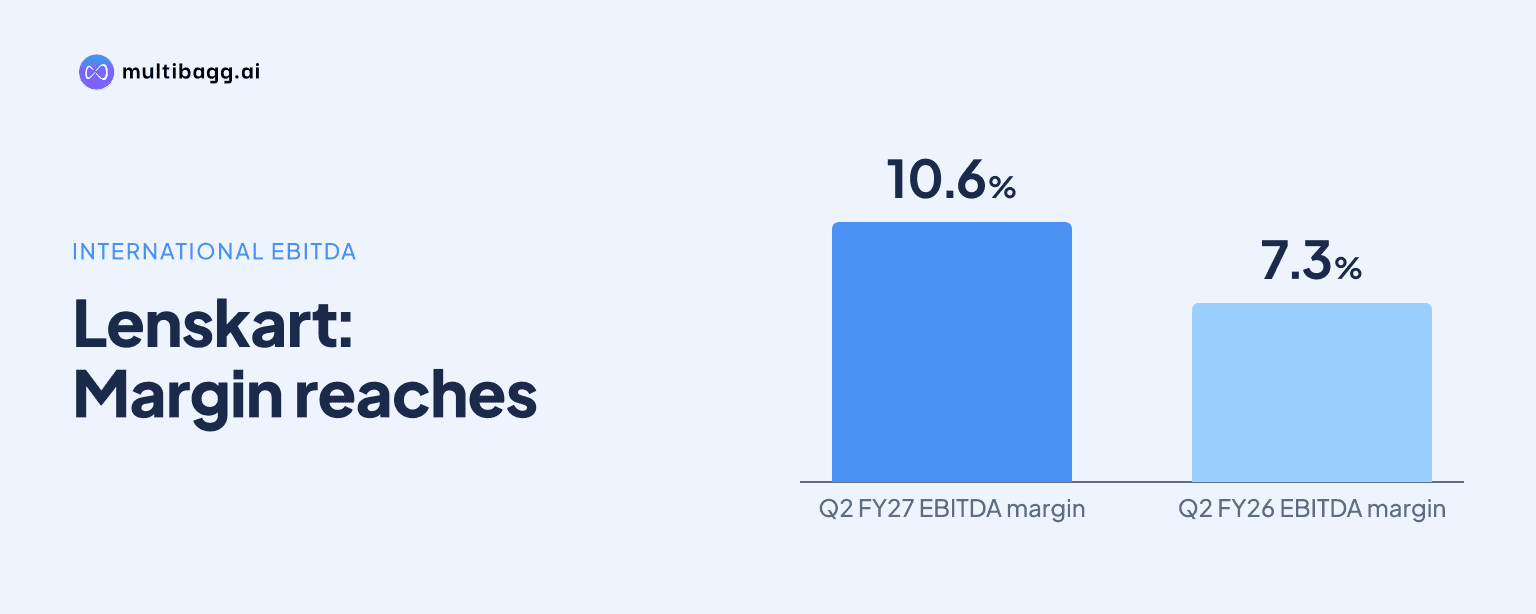
Lenskart’s International segment recorded a 10.6% pre-IndAS 116 EBITDA margin in Q2 FY27, unchanged from Q1 FY27, as revenue increased 29.5% year on year to Rs 1,201 crore. Pre-IndAS 116 EBITDA, or earnings before interest, tax, depreciation and amortisation before the IndAS 116 rent adjustment, rose 86.8% year on year to Rs 127 crore.
Know Lenskart Solutions inside out
Results, valuation, peers and who's buying, in one view.
How did Lenskart International perform in Q2 FY27?
Lenskart’s International segment grew revenue 29.5% year on year to Rs 1,201 crore in Q2 FY27, with contributions from Japan, Southeast Asia, the Middle East and other geographies. Management said favourable currency movements aided reported growth, while constant-currency revenue growth was about 23% year on year.
Eyewear units increased 29.7% year on year and Quarterly Transacting Customer Accounts rose 22.7% in Q2 FY27. Lenskart said its omnichannel investments were contributing to results, with online channels accounting for more of sales each quarter, while the company continued brand-building investment in international markets.
International average selling price, or ASP, was broadly flat year on year at Rs 5,833, although it rose 10.7% sequentially in Q2 FY27. Lenskart attributed the sequential increase to the normalisation of sunglasses as a share of units after the season, while identifying Meller as the driver of strong sunglasses unit growth.
What drove Lenskart International’s 10.6% margin?
Lenskart’s International pre-IndAS 116 EBITDA margin increased to 10.6% in Q2 FY27 from 7.3% in Q2 FY26, an expansion of 3.3 percentage points. The Q2 result matched the 10.6% margin in Q1 FY27, making this the second consecutive quarter above 10%, despite management describing Q2 as seasonally softer than Q1.
Product margin rose to 77.1% from 75.5% in Q2 FY26 and remained unchanged from Q1 FY27. Lenskart attributed the year-on-year increase to further integration of Meller and Owndays into its supply chain and to a structurally higher-margin sunglasses mix.
Employee cost declined to 27.3% of revenue from 28.9% a year earlier, even as 22 net new international stores were staffed in Q2 FY27. Management linked the lower ratio to same-store growth on a cost base that is largely fixed in the short term, while marketing rose to 10.3% of revenue from 9.5% as Lenskart continued investment in Japan, Southeast Asia and Saudi Arabia.
Why did same-store growth matter more than store openings?
Lenskart added 22 net international stores in Q2 FY27, comprising 12 in Southeast Asia, three in the Middle East, two in Japan and five in other markets. Management said same-store performance carried most of the quarter’s growth and that future additions would be made at a deliberately measured pace rather than ahead of store-level performance.
The measured opening pace contributed to the IndAS 116 rent adjustment declining to 11.4% of international revenue from 12.2% in Q2 FY26. The ratio was 11.3% in Q1 FY27, meaning it increased by 0.1 percentage points sequentially as the network added stores during Q2 FY27.
Management said this cost relationship may reverse temporarily if openings accelerate. New stores bear full rent before reaching their full revenue potential, and Lenskart said both rent and employee cost as a share of revenue could increase for a few quarters before new stores mature.
Got a follow-up? Ask IRIS
Which investments is Lenskart continuing to fund internationally?
Lenskart continued to invest in marketing as International pre-IndAS 116 EBITDA margin rose from 7.3% to 10.6% year on year. Marketing represented 10.3% of Q2 FY27 International revenue, compared with 9.5% in Q2 FY26, and funded brand-building campaigns across Japan, Southeast Asia and Saudi Arabia.
The campaigns included Thailand’s “Clear Vision Comfort” initiative with actress LingLing Kwong and Malaysia’s “OWN your DAYS” campaign with actress Mira Filzah. In Singapore, Lenskart ran the “61.61” campaign, offering a pair at S$61 and 61% off a second pair, alongside its “Beat the AIR” promotion for lightweight frames.
Other expenses excluding marketing were 17.7% of revenue in Q2 FY27, compared with 17.5% a year earlier and 17.8% in Q1 FY27. Management said International growth remained the priority, with investment directed to brands, technology and new markets rather than a programme focused on maximising near-term margin.
What do Singapore and Japan indicate for Lenskart International?
Lenskart cited Singapore’s market leadership and Japan’s rapid growth as evidence that its India playbook is transferring to overseas markets. The stated model is to expand eye tests, grow the customer base, build brands and let volume lead growth, with sunglasses adding to the product mix; Q2 FY27 unit growth of 29.7% supported that description.
The presentation did not provide country-level revenue, margin or store data for Singapore or Japan in Q2 FY27. The disclosed segment figures were Rs 1,201 crore of revenue and Rs 127 crore of pre-IndAS 116 EBITDA, so the financial contribution of any individual geography to the 29.5% revenue increase cannot be determined from the disclosure.
Management also said quarterly International performance can vary because its markets are at different stages of maturity. It identified seasonality, campaign timing, store-expansion phases and product mix as factors affecting results, and said trailing 12-month performance is a more suitable measure than a single quarter.
Conclusion
Lenskart’s International segment combined 29.5% revenue growth, 29.7% eyewear-unit growth and a 10.6% pre-IndAS 116 EBITDA margin in Q2 FY27. Compared with Q2 FY26, a 1.6-percentage-point improvement in product margin, lower employee cost and a lower rent adjustment ratio outweighed the increase in marketing investment.
The next development to watch is the pace of international store openings after the 22 net additions in Q2 FY27. Management has said it intends to remain led by same-store performance, but has also cautioned that faster expansion may temporarily raise rent and employee cost ratios before new stores reach maturity.