










Lenskart ROCE Reaches 22.5% as Operating Cash Funds Capex
Key highlights
- Lenskart reported ROCE of 22.5% in H1 FY27, up from 19.0% in H1 FY26.
- Lenskart generated Rs 388 crore of operating cash flow in H1 FY27, exceeding Rs 187 crore of store capex.
- Lenskart added 297 net stores in H1 FY27, compared with 225 in H1 FY26.
- Lenskart ended Q2 FY27 with Rs 3,855 crore of net cash, excluding initial public offering-related payables.
powered by IRIS
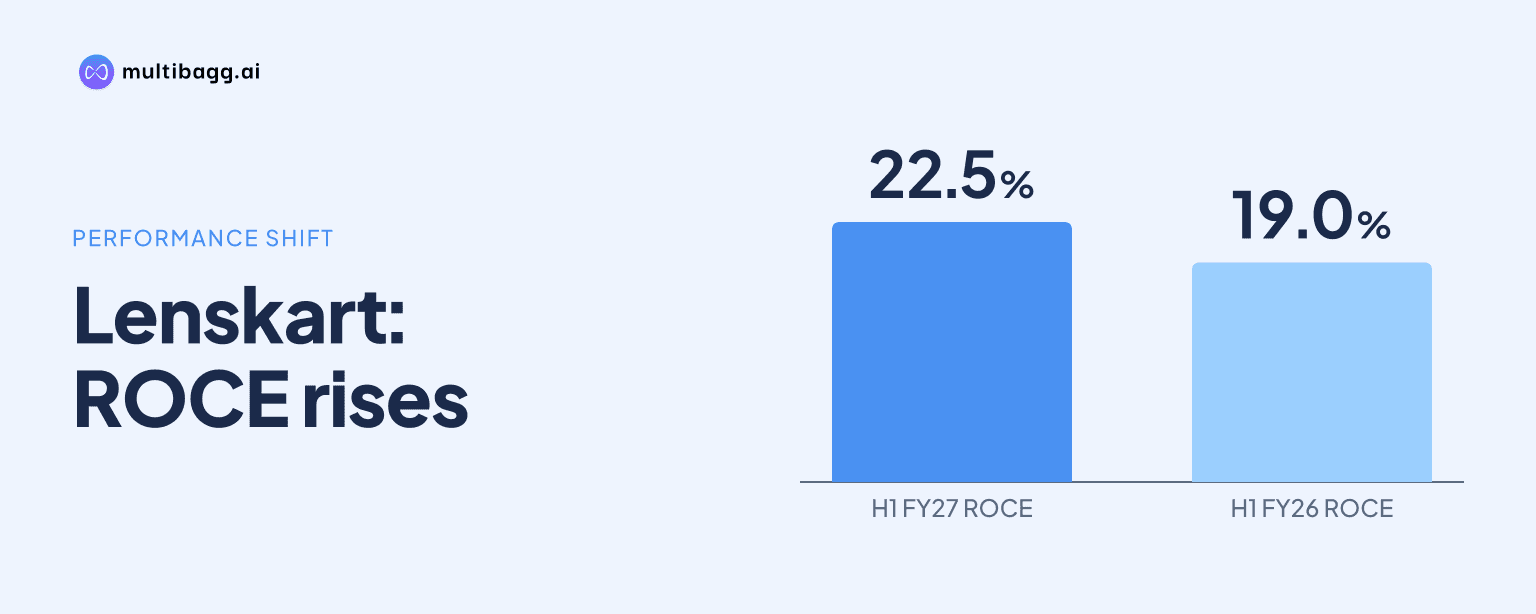
Lenskart reported Return on Capital Employed of 22.5% in H1 FY27, up from 19.0% in H1 FY26, while Rs 388 crore of operating cash flow exceeded Rs 187 crore of store capex. The company also spent Rs 297 crore on plant and other capex, led by Hyderabad, and ended Q2 FY27 with Rs 3,855 crore of net cash.
Know Lenskart Solutions inside out
Results, valuation, peers and who's buying, in one view.
How did Lenskart’s ROCE reach 22.5% in H1 FY27?
Lenskart’s Return on Capital Employed, or ROCE, reached 22.5% in H1 FY27, increasing 3.5 percentage points from 19.0% in H1 FY26. Its reported ROCE had increased from 5.1% in FY24 to 13.8% in FY25 and 14.6% in FY26, placing the H1 FY27 result within a multi-year upward trend.
Management attributed the H1 FY27 movement to earnings before interest and tax growth and disciplined capital allocation. It said store payback periods remained attractive, central infrastructure was absorbing more revenue per rupee of capital, and operating leverage was increasing returns on the same asset base. Consolidated revenue rose 33.0% year on year to Rs 5,559 crore, while EBITDA before Indian Accounting Standard 116, or Ind AS 116, increased 78.2% to Rs 753 crore.
The half-year figure was below ROCE of 23.2% in Q1 FY27 but above 22.7% in Q2 FY27, according to Lenskart’s key metrics. Both quarterly readings exceeded the 21.6% reported in Q2 FY26, alongside the addition of 297 net stores in H1 FY27.
Did operating cash flow cover Lenskart’s store expansion spending?
Yes. Lenskart generated Rs 388 crore of operating cash flow in H1 FY27 and spent Rs 187 crore on store capex, leaving Rs 201 crore after store investment. The store-capex category included new openings, refurbishments and remote-optometry deployment.
Lenskart added 297 net stores in H1 FY27, compared with 225 in H1 FY26. Net additions were 165 in Q2 FY27, compared with 142 in Q2 FY26, while the active store base reached 3,624 at the end of Q2 FY27 from 2,949 a year earlier.
India accounted for 259 of the 297 H1 additions and International accounted for 38. At the end of Q2 FY27, India had 2,868 active stores and International had 756, showing that India represented most of the network expansion funded through the store-capex programme.
Why did Lenskart’s operating cash flow trail EBITDA in H1 FY27?
Lenskart converted Rs 753 crore of EBITDA before Ind AS 116 into Rs 388 crore of operating cash flow after Rs 148 crore of tax and a Rs 238 crore working-capital build. The company said inventory had returned to normalised levels and was rebuilt ahead of the festive season after being consumed faster than expected in prior quarters.
The H1 FY27 bridge also included Rs 21 crore of non-cash adjustments, comprising provisions, fair-value-through-profit-or-loss losses, employee stock-option costs, royalty income and unrealised foreign-exchange gains or losses. Consolidated net working-capital days were 13.1 in H1 FY27, down from 22.7 in H1 FY26, but above the 6.3 days reported in Q1 FY27.
Lenskart said it welcomed the Goods and Services Tax Council recommendation to make input services eligible for refund under the inverted-duty structure from 1 November 2026. Management said the proposed mechanism could provide future working-capital benefits, but the presentation did not quantify the possible amount or timing of any cash release.
Got a follow-up? Ask IRIS
Where did Lenskart allocate capital beyond its store network?
Lenskart spent Rs 297 crore on plant and other capex in H1 FY27, led by Hyderabad. This was Rs 110 crore more than the Rs 187 crore allocated to store capex, meaning plant and other investment represented the larger disclosed capital-spending category during the half year.
Other inflows totalled Rs 108 crore, including Rs 114 crore of fixed-deposit interest income, Rs 23 crore from the issue of employee stock-option shares, Rs 7 crore of unrealised mutual-fund gains and Rs 3 crore of dividend. These were partly offset by Rs 39 crore of loan repayments, resulting in net cash inflow of Rs 12 crore before mergers and acquisitions, or M&A.
Lenskart separately invested Rs 82.2 crore in M&A in H1 FY27. The disclosed amounts were Rs 52.5 crore in Owndays, Rs 15.5 crore in Dimension NXG, also called Aina, Rs 7.1 crore in the Marco joint venture, Sunrise Thailand, Rs 5.6 crore in Le-Petit Lunetier and Rs 1.5 crore in Visionsure.
What cash resources does Lenskart have for future deployment?
Lenskart’s net cash balance stood at Rs 3,855 crore at the end of Q2 FY27, excluding initial public offering-related payables and after considering the foreign-currency translation reserve. Management said this balance includes initial public offering proceeds intended for manufacturing, store expansion, technology and selected M&A.
The H1 FY27 cash deployment took place while the operating base expanded. Eye tests increased 40.1% year on year to 149.9 lakh, eyewear units sold rose 26.4% to 211.4 lakh, and transacting customer accounts grew 20.3% to 104.9 lakh. Consolidated revenue increased to Rs 5,559 crore from Rs 4,179 crore in H1 FY26.
Profitability rose in both reported geographic segments. India’s EBITDA before Ind AS 116 margin increased to 15.7% in H1 FY27 from 13.4% in H1 FY26, while International’s equivalent margin rose to 10.6% from 5.9%. India generated Rs 503 crore of pre-Ind AS 116 EBITDA and International generated Rs 254 crore, together equalling consolidated EBITDA of Rs 753 crore.
Conclusion
Lenskart’s H1 FY27 disclosures show that operating cash flow covered the Rs 187 crore required for store capex despite a Rs 238 crore working-capital build. The 22.5% ROCE result coincided with 33.0% revenue growth, 297 net store additions and a larger Rs 297 crore allocation to plant and other capex led by Hyderabad.
The next disclosures to watch are the pace of manufacturing, store, technology and selected M&A deployment from the Rs 3,855 crore net-cash balance, which management has identified as intended uses without giving category-wise amounts or timing. The potential working-capital benefit from the proposed input-services refund mechanism, effective 1 November 2026 if implemented as recommended, also remains unquantified.