










Dollar Industries plans 2%-3% price rise as cotton climbs
Key highlights
- Dollar Industries is considering a further 2% to 3% FY27 price increase after raising prices 4.5% in April and July.
- Cotton used by Dollar Industries rose from about Rs 60,000 per candy in Q1 FY27 to Rs 68,000 in October.
- Q2 FY27 gross margin was 31.8%, while operating EBITDA margin was 11.2% on operating income of Rs 539 crore.
- Dollar Industries retained FY27 operating EBITDA margin guidance of 11.5% to 12.5%.
powered by IRIS
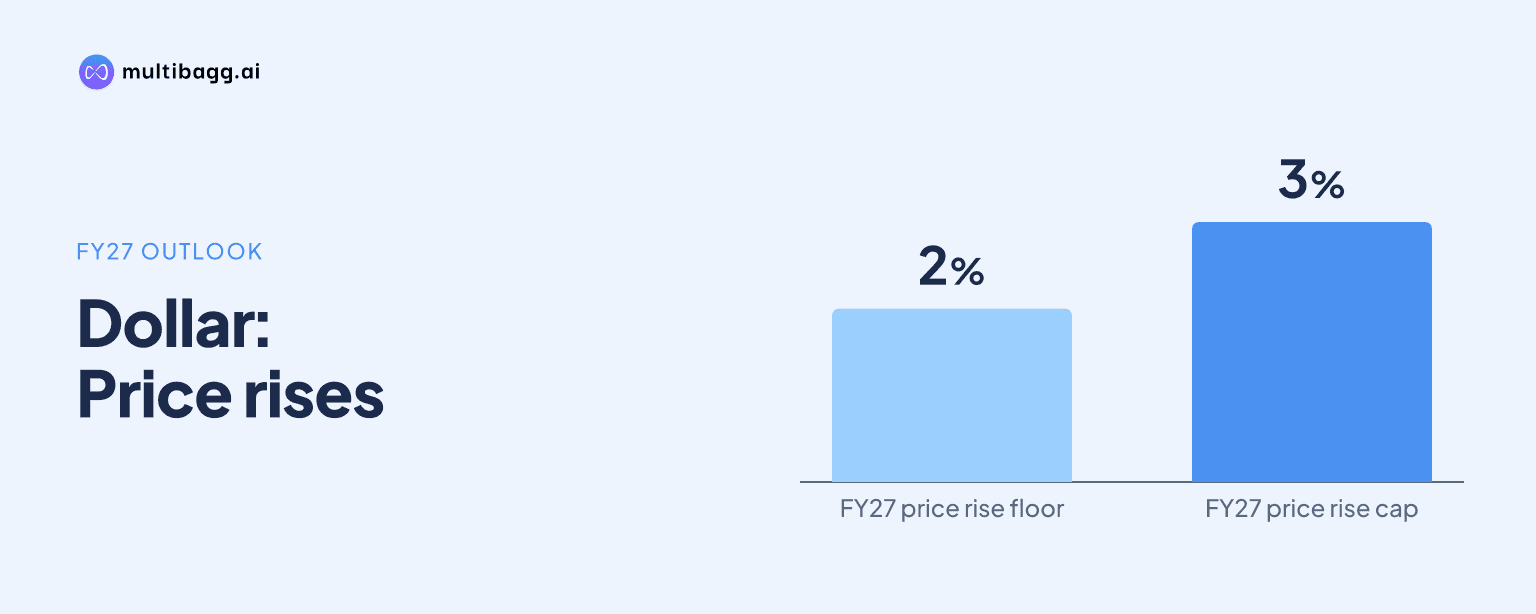
Dollar Industries Limited plans a third FY27 price increase of about 2% to 3% after cotton used in production rose from Rs 60,000 per candy in Q1 FY27 to Rs 68,000 in October. Management retained its FY27 operating EBITDA margin guidance of 11.5% to 12.5% despite Q2 gross margin declining to 31.8%.
Know Dollar Industries inside out
Results, valuation, peers and who's buying, in one view.
Why is Dollar Industries planning another FY27 price increase?
Dollar Industries is working on a further 2% to 3% price increase, potentially in December, because two earlier FY27 increases totalling 4.5% have not fully offset higher cotton and yarn costs. Management implemented a 2% increase in April and a 2.5% increase in July, while saying the proposed third increase depends on the broader industry environment.
Management said prevailing prices were not sustainable given raw-material inflation and that the company intends to pass added costs to consumers. Dollar Industries expects the full benefit of the initial 4.5% increase in Q3 or Q4 FY27 because Q1 had lower-cost cotton inventory procured in March, whereas Q2 carried higher-cost purchases from both Q1 and Q2.
Pricing has already contributed to sales growth, although it has not neutralised the input-cost effect. Q2 FY27 operating income rose 14.3%, comprising 8% volume growth and 6.3% value growth; management attributed about 4% of value growth to price increases and roughly 2% to product mix.
How did cotton inflation affect Dollar Industries' Q2 margins?
Cotton inflation reduced Dollar Industries' Q2 FY27 gross margin to 31.8%, as cotton for the quality it uses increased from around Rs 60,000 per candy in Q1 FY27 to Rs 68,000 in October. Management said cotton was then trading in a Rs 68,000 to Rs 72,000 range, citing a lower crop, yarn-industry demand and export demand at some companies.
Gross profit nevertheless increased 4.5% year on year to Rs 171 crore in Q2 FY27, but management said gross margin fell by 298 basis points. The decline reflected the movement of higher-cost inventory through production and sales after Q1 had benefited from lower-cost raw material bought in March.
The 2.4-percentage-point difference between the Q2 and H1 gross-margin readings illustrates the inventory timing management described. Dollar Industries said cost management, overhead controls and operating leverage cushioned part of the gross-margin pressure, resulting in Q2 operating EBITDA of Rs 61 crore and profit after tax of Rs 36 crore.
Can Dollar Industries maintain its FY27 growth and margin targets?
Dollar Industries retained FY27 operating EBITDA margin guidance of 11.5% to 12.5% and expects 8% to 9% volume growth for the full year. Management gave revenue-growth guidance of about 11% to 13% in the call, while also saying it was hopeful of achieving a previously stated 10% to 12% range.
H1 FY27 operating EBITDA was Rs 108 crore, up 5% year on year, with a margin of 11.5%, which is the lower end of the annual range. H1 operating income increased 8.4% to Rs 944 crore, while profit after tax rose 9.4% to Rs 62 crore and earnings per share increased to Rs 10.90 from Rs 9.96.
Management said H1 historically represents about 45% of annual sales, while H2 contributes about 54% to 55%. It expects the heavier second-half sales mix, higher volumes, benefits from the April and July increases, and a possible December increase to support FY27 targets, but it did not issue a fresh gross-margin forecast.
For the next two to three years, management targets an operating EBITDA margin of 13.5% to 14.5%. It identified an intended increase in the share of higher-EBITDA products to 35% from 28%, lower working-capital needs, finance-cost savings and operating leverage from higher turnover as the planned mechanisms.
Got a follow-up? Ask IRIS
Which segments and channels are supporting Dollar Industries' volumes?
Dollar Thermal, Dollar Industries' winterwear segment, grew 17.7% in value and 10.2% in volume in Q2 FY27, contributing 12.6% of revenue. Dollar Protect rainwear recorded strong traction during a favourable monsoon, adding seasonal categories to the core garment portfolio.
Quick commerce grew 58.5% in value and 52.4% in volume, raising its share of revenue to 5.4% in Q2 FY27 from 4% in Q2 FY26. Export value rose 57% and export volume rose 45.5%; management cited expansion into Asian, South Asian and African markets, but did not quantify a sustainable export growth rate because of geopolitical uncertainty.
The Eastern region recorded 25.6% value growth and 16.3% volume growth in Q2 FY27. The North, Dollar Industries' largest region, grew 14.6% in value and 6.2% in volume, while Dollar Always and Dollar Man together contributed about 78% of H1 garment sales.
How is Dollar Industries managing working capital and debt?
Dollar Industries reduced its cash conversion cycle to 157 days as of September 30, 2026, from 160 days in the previous quarter. Receivable days fell to 120 from 130 and inventory days declined to 109 from 124, while net debt stood at Rs 288 crore, or 1.33 times annualised operating EBITDA.
Management expects to reduce working capital by Rs 50 crore to Rs 60 crore in H2 FY27 as winter-product realisations arrive in Q3 and Q4. It said the debt-free objective remains FY28 or FY29, with borrowings consisting mainly of working-capital cash-credit facilities rather than long-term debt.
Project Lakshya is part of the working-capital plan because management said its distributor receivables are about 85 to 90 days, compared with 120 to 125 days for non-Lakshya distributors. Dollar Industries aims to reduce overall distributor receivable days to about 80 to 85 days over two to three years, but has paused entry into new states amid intense competition.
Conclusion
Dollar Industries is seeking another 2% to 3% price increase because cotton rose from Rs 60,000 per candy in Q1 FY27 to Rs 68,000 in October, while the first 4.5% of FY27 increases did not fully cover the cost movement. The pricing plan, sales volumes and overhead control underpin management's decision to retain FY27 operating EBITDA margin guidance of 11.5% to 12.5% after Q2 gross margin reached 31.8%.
The next disclosures to watch are whether Dollar Industries implements the proposed December price increase and whether cotton remains within the Rs 68,000 to Rs 72,000-per-candy range identified by management. Management also expects H2 to contribute 54% to 55% of annual sales, plans a Rs 50 crore to Rs 60 crore working-capital reduction, and may restart Project Lakshya expansion after competition normalises over the next one to two quarters.