










Dollar Industries delays Lakshya rollout to protect share
Key highlights
- Dollar delayed new-state Lakshya expansion because implementation can disrupt a market for 5 to 6 months.
- Lakshya distributor receivable days are 85-90 days versus 120-125 days for non-Lakshya distributors.
- Gujarat revenue rose from below Rs 25 crore annually to about Rs 60 crore to Rs 65 crore under Lakshya, management said.
- Dollar maintained FY27 guidance for 11% to 13% revenue growth and 11.5% to 12.5% EBITDA margin.
powered by IRIS
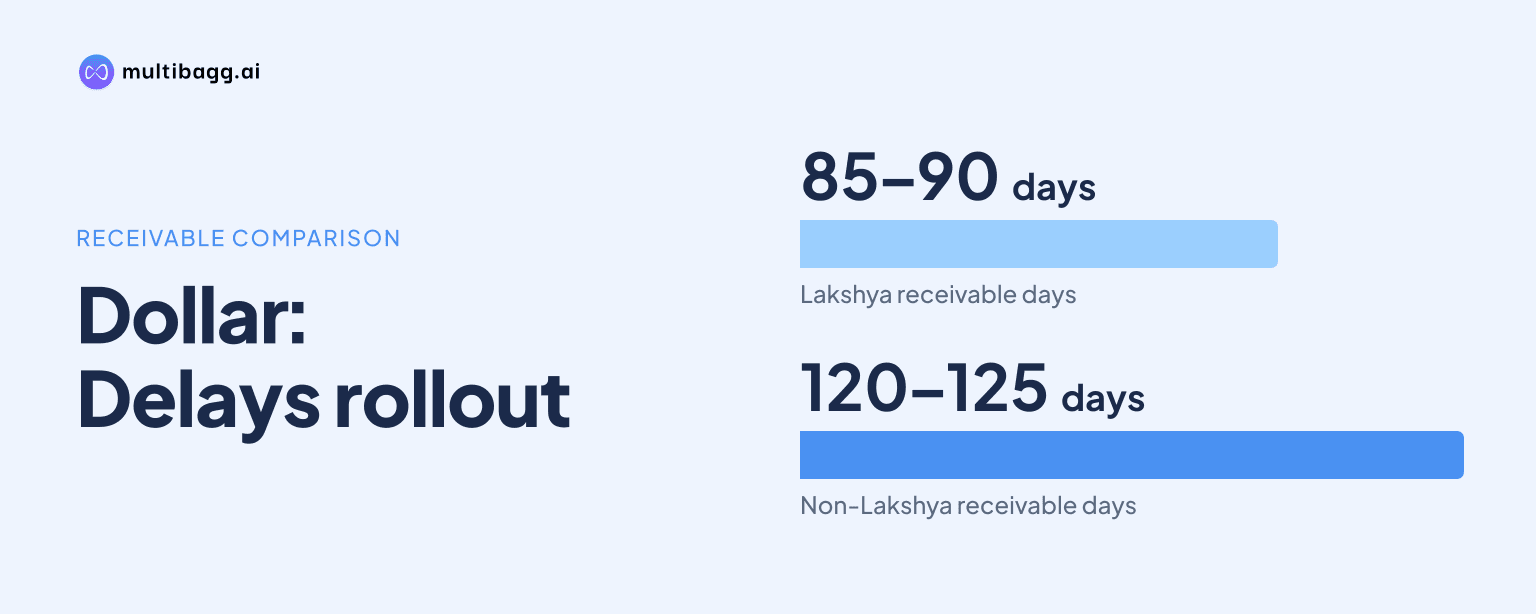
Dollar Industries has delayed Project Lakshya’s expansion into new states because management says its five-to-six-month market disruption could cost share during intense competition, despite Lakshya distributors reporting receivable days of 85 to 90 days versus 120 to 125 days outside the programme.
Know Dollar Industries inside out
Results, valuation, peers and who's buying, in one view.
Why has Dollar delayed Project Lakshya expansion?
Dollar has delayed new-state additions to Project Lakshya because management considers competitive conditions too risky for a distribution transition that can disrupt a market for at least five to six months. Management said competition had been intense for the past two to three years, while cotton and yarn-price fluctuations over the preceding six to seven months added to the execution risk. The company is focusing instead on areas where Lakshya is already operating.
The decision is a delay rather than an abandonment of the programme. Dollar said it does not want to lose market share while converting a new geography, as existing industry participants have become more aggressive in its economic and mid-market segments. Management said competitive intensity improved somewhat in the latest quarter but was still not at a normal level, and it may take another one to two quarters for conditions to settle.
Management identified existing competitors, rather than new players, as the source of the pressure. It said that after the competitive situation becomes clearer, it can resume Project Lakshya and other initiatives that have been held back. Dollar did not give a fixed date for restarting new-state rollout, instead linking the decision to favourable industry conditions.
What working-capital benefits has Lakshya delivered?
Lakshya has delivered lower distributor receivable days than Dollar’s non-Lakshya network. Management said receivable days in Lakshya were 85 to 90 days, compared with 120 to 125 days for non-Lakshya distributors, giving the programme a collection-cycle difference of about 30 to 40 days. Dollar aims to reduce overall distributor debtor days to 80 to 85 days in two to three years, with 75 days described as the ideal level.
The programme uses exclusive sales representatives and a distributor-management system to capture retailer-level data by pin code, product and purchase frequency. Dollar said this information supports product development, production planning and inventory optimisation, while also giving visibility into inventory held by channel partners. Its operating procedure requires Lakshya distributors to maintain retailer-order fill rates above 90%.
Dollar said Lakshya had helped deepen market penetration in Haryana, Rajasthan, Gujarat, Mumbai and surrounding areas, Karnataka and Odisha. In Gujarat, annual revenue had previously not exceeded Rs 25 crore but was now about Rs 60 crore to Rs 65 crore, according to management. It cited similar progress in Rajasthan and Haryana, though it did not provide equivalent revenue figures for those states.
How much of Dollar's network is under Lakshya?
Dollar has not converted any zone fully, and management said Lakshya’s revenue contribution has remained around 28% to 30% for the past two to three years. South has the greatest coverage but excludes Tamil Nadu and Kerala; West and Central are about 50% covered; North is about 30% covered; and East is about 20% to 25% covered. Haryana and Rajasthan are covered in the North, while Gujarat and Mumbai and surrounding areas are among the western markets covered.
Without adding states, Lakshya’s overall revenue contribution may increase by only about 2% to 4%, management said. Uttar Pradesh and West Bengal, which together contribute 30% of Dollar’s total sales, are major unconverted states and therefore matter to the next phase of the programme. Their conversion has no announced timetable because Dollar is waiting for competition to moderate.
Lakshya’s contribution declined slightly in H1 FY27 because of delayed payments, according to management. Dollar said it strictly enforced its standard operating procedures and withheld supplies from distributors that did not comply, after which those distributors did not supply retailers. The company therefore accepted a near-term effect on Lakshya revenue to maintain payment discipline.
Got a follow-up? Ask IRIS
How do costs and competition affect Dollar's FY27 plan?
Dollar’s rollout caution coincides with higher cotton and yarn costs. Management said the cotton quality used in production was about Rs 60,000 per candy in Q1 FY27 and about Rs 68,000 per candy in October, with the prevailing market range at Rs 68,000 to Rs 72,000 per candy. It attributed the increase to lower cotton production than the prior year, yarn-industry demand and some export demand.
Management said Q2 FY27 gross margin fell by 298 basis points because products sold in that period reflected higher-cost raw-material purchases made in Q1 and Q2. By comparison, Q1 benefited from lower-cost cotton procured in March. Dollar had taken two price increases totalling 4.5%, comprising 2% in April and 2.5% in July, and management said it intended a further 2% to 3% increase around December, subject to industry conditions.
Dollar maintained FY27 guidance for revenue growth of 11% to 13%, volume growth of 8% to 9% and earnings before interest, tax, depreciation and amortisation margin of 11.5% to 12.5%. Management said H2 generally accounts for 54% to 55% of annual sales, compared with about 45% in H1. It therefore expects the second half to be important for achieving the full-year targets.
What could restart Dollar's new-state rollout?
Dollar could restart Lakshya expansion when competition normalises and management sees a clearer market outlook over the next one to two quarters. Management separately said the programme’s Phase 2 may require another two to three quarters before tangible financial effects emerge, conditional on industry conditions improving. These are management expectations rather than a committed rollout schedule.
The company’s two-to-three-year revenue target is about 12% compound annual growth, consisting of 8% to 9% volume growth and 4% to 5% from price and value growth. Management expects e-commerce, exports and eventual Lakshya expansion to contribute to market-share gains. E-commerce accounted for about 11% of revenue, including 5% to 6% from quick commerce, according to management.
Dollar also plans to increase the share of higher-earnings-before-interest-tax-depreciation-and-amortisation-margin products from 28% to 35% over the next two to three years. Management cited new athleisure, women’s and kids’ products, alongside Force NXT, which it said was growing at a 25% compound annual rate. H1 FY27 volume growth was about 6% in men’s products and 3% to 4% in women’s products.
Conclusion
Dollar is retaining Project Lakshya as a distribution and working-capital tool while delaying its more disruptive geographic expansion. The 85-to-90-day Lakshya receivable cycle compares with 120 to 125 days outside the programme, and management cited Gujarat’s move from below Rs 25 crore in annual revenue to about Rs 60 crore to Rs 65 crore as evidence of the model’s potential. But the five-to-six-month transition period has led Dollar to prioritise market-share protection during elevated competition.
The next developments to watch are management’s assessment of competition over the one-to-two-quarter period it identified, and whether that permits rollout in Uttar Pradesh and West Bengal, which together account for 30% of sales. Dollar’s planned December price increase, FY27 guidance of 11% to 13% revenue growth and its two-to-three-year debtor-day target of 80 to 85 days will also indicate whether conditions are improving for Lakshya’s next phase.