










DreamFolks H1 revenue drops to Rs 70.1 crore as losses persist
Key highlights
- DreamFolks reported H1 FY27 revenue of Rs 70.1 crore, versus Rs 554.5 crore in H1 FY26.
- DreamFolks’ H1 FY27 loss after tax was Rs 24.6 crore and adjusted EBITDA was negative Rs 25.2 crore.
- DreamFolks’ Q2 FY27 loss after tax narrowed to Rs 10.7 crore from Rs 13.8 crore in Q1 FY27.
- DreamFolks held Rs 187.8 crore of bank balances and liquid investments as of 30 September 2026.
powered by IRIS
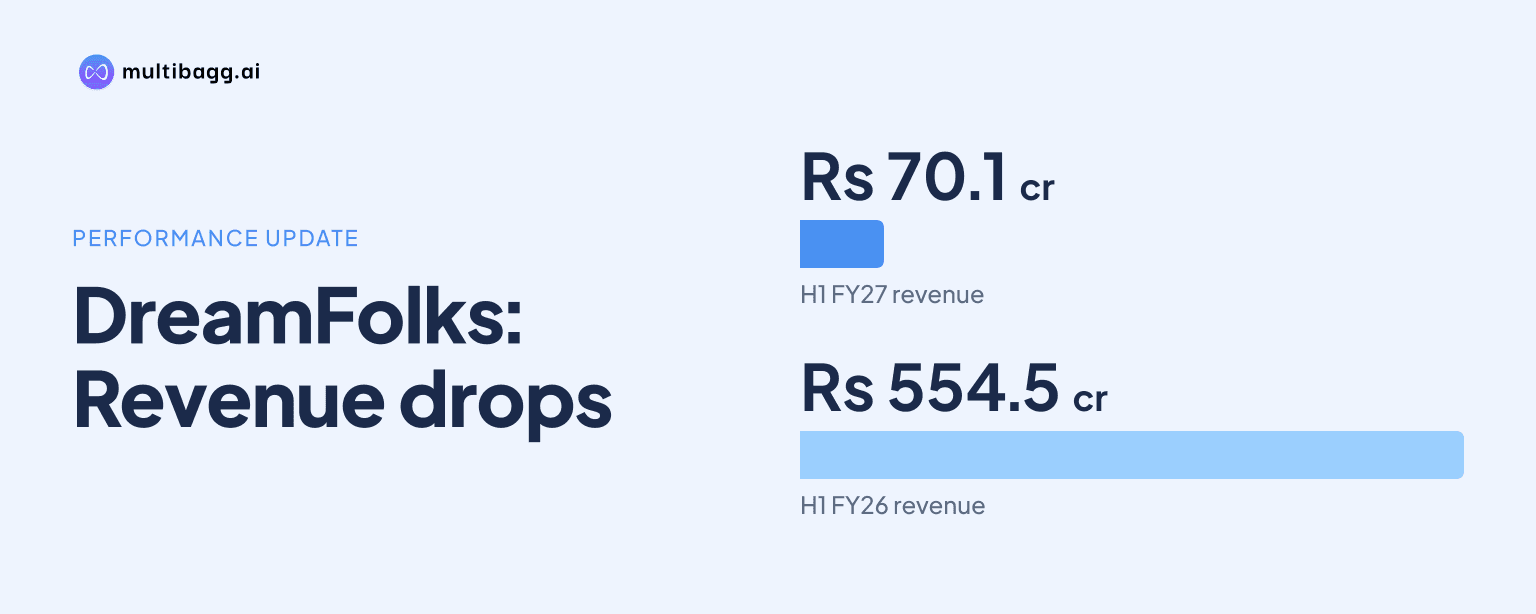
Dreamfolks Services Limited reported revenue of Rs 70.1 crore for the first half (H1) of fiscal year 2027 (FY27), down from Rs 554.5 crore in H1 FY26, while posting a Rs 24.6 crore loss after tax. Second-quarter (Q2) FY27 revenue was Rs 31.1 crore, and management said the narrower loss from the first quarter (Q1) partly reflected no repeat of a global-lounge payment.
Know Dreamfolks Services inside out
Results, valuation, peers and who's buying, in one view.
Why did DreamFolks’ first-half revenue decline?
DreamFolks’ H1 FY27 revenue was Rs 70.1 crore compared with Rs 554.5 crore in H1 FY26, marking the central financial change reported for the six months ended 30 September 2026. Management did not quantify specific reasons for the year-on-year revenue decline in the call, but described its current effort as building global, railway and lifestyle services alongside its traditional airport-lounge offering. The comparison below uses adjusted earnings before interest, tax, depreciation and amortisation (EBITDA), as reported by management.
The quarterly run rate was also lower than both comparison periods disclosed by management. Q2 FY27 revenue was Rs 31.1 crore, versus Rs 39.0 crore in Q1 FY27 and Rs 205.5 crore in Q2 FY26. Revenue therefore declined by Rs 7.9 crore sequentially in Q2, while the H1 total remained substantially below the Rs 554.5 crore reported a year earlier.
How did DreamFolks’ losses change in Q2 FY27?
DreamFolks’ Q2 FY27 loss after tax narrowed to Rs 10.7 crore from Rs 13.8 crore in Q1 FY27, while adjusted EBITDA improved to a loss of Rs 8.8 crore from a loss of Rs 16.4 crore. For H1 FY27, adjusted EBITDA was a loss of Rs 25.2 crore and loss after tax was Rs 24.6 crore.
Management said the sequential improvement was partly due to the absence in Q2 of a one-time upfront minimum-guarantee payment made in Q1 to support global-lounge expansion. No similar one-off expense was incurred in Q2 FY27, so the reduced quarterly loss occurred alongside that cost difference rather than solely a change in recurring operations.
DreamFolks also reported a positive gross profit margin of 8.7% for H1 FY27 after returning to positive gross profit during the period. Management attributed this development to efforts to improve the business mix and the economics of newer services, while the company continued to report a first-half loss after tax of Rs 24.6 crore.
What is changing in DreamFolks’ revenue mix?
DreamFolks said non-airport-lounge services contributed more than one-third of topline in Q2 FY27, led by golf, railway lounges and lifestyle services. This means more than one-third of the Rs 31.1 crore Q2 revenue came from offerings outside airport lounges, although management did not disclose the absolute revenue of each service line.
The company added a railway lounge at Nashik during Q2 FY27 and said it has coverage across 100% of railway lounges in India. Through subsidiary Ten11 Hospitality, DreamFolks owns and operates lounges in Chennai, Mumbai and Vadodara, and management said it is evaluating further direct operating opportunities to improve operational control, service quality and customer experience.
On the lifestyle side, DF Club Membership became live on the loyalty platforms of multiple major banks during the quarter. DreamFolks also cited Coffee buy-one-get-one (BOGO), members-only club access and Flight Cancellation for Any Reason as services being used in card propositions, while its Mastercard arrangement offers eligible cardholders cancellation flexibility subject to programme terms and conditions.
Got a follow-up? Ask IRIS
What financial resources did DreamFolks report at September-end?
DreamFolks reported bank balances and liquid investments of Rs 187.8 crore as of 30 September 2026, up from Rs 148.9 crore on 31 March 2026. Net worth, however, was Rs 290.1 crore at September-end, compared with Rs 313.8 crore at the end of the prior fiscal year.
Management said it was managing liquidity by monitoring service-level economics, phasing capital expenditure where appropriate and maintaining visibility on operating cash flows. That approach is relevant as DreamFolks reported an H1 FY27 adjusted EBITDA loss of Rs 25.2 crore while investing in new capabilities and programme expansion.
The balance-sheet figures place the first-half operating loss alongside a higher cash-and-liquid-investment balance than at 31 March 2026. Management did not provide a detailed reconciliation for the increase from Rs 148.9 crore to Rs 187.8 crore, but said its objective was to preserve financial flexibility while aligning investment pace with business development.
Which growth plans does DreamFolks have for FY27?
DreamFolks said its FY27 priorities are to deepen distribution and adoption of launched services, increase programme activity across its global network, scale railway operations through Ten11 and expand lifestyle offerings via banking and loyalty partners. The company has a network of more than 1,100 global lounges and identified South-East Asia as a market where it is seeing interest from multiple clients.
Management also described an effort to broaden distribution beyond conventional credit-card programmes. In September 2026, DreamFolks launched Flight Cancellation for Any Reason with Mastercard, a wellness-card partnership with Elixir that uses its premium spa-benefit layer, and a partnership with The Card Company for a premium prepaid metal card on the RuPay network.
A separate premium-experience initiative is DreamFolks Club Nagavalli Wilderness Estate, located on about 30 acres on the Odisha-Andhra Pradesh border. The site includes a 25-acre golf course, 37 cottages comprising 20 luxury and 17 eco cottages, a spa, swimming pool and restaurant; management described the property as part of its effort to create curated membership experiences beyond conventional access benefits.
Conclusion
DreamFolks’ reported figures show a substantial reset in scale: H1 FY27 revenue was Rs 70.1 crore against Rs 554.5 crore a year earlier, and the company remained loss-making with a Rs 24.6 crore loss after tax. Q2 losses improved from Q1, but management specifically linked part of that sequential movement to the absence of a one-time global-lounge minimum-guarantee payment.
The next measures to watch are whether the more than 1,100-lounge global network converts into programme activity, whether Ten11 expands railway operations beyond Chennai, Mumbai and Vadodara, and whether bank and loyalty distribution lifts use of lifestyle services. Management’s stated FY27 plan is to improve contribution and revenue absorption while investing in technology and operating capabilities.