










DreamFolks Returns to Positive Gross Profit, H1 Margin 8.7%
Key highlights
- DreamFolks reported Rs 31.1 crore of revenue in Q2 FY27, versus Rs 39.0 crore in Q1 FY27.
- Non-airport services contributed more than one-third of DreamFolks’ Q2 FY27 topline.
- DreamFolks reported an 8.7% gross-profit margin for H1 FY27 after returning to positive gross profit in Q2.
- Adjusted EBITDA loss narrowed to Rs 8.8 crore in Q2 FY27 from Rs 16.4 crore in Q1 FY27.
powered by IRIS
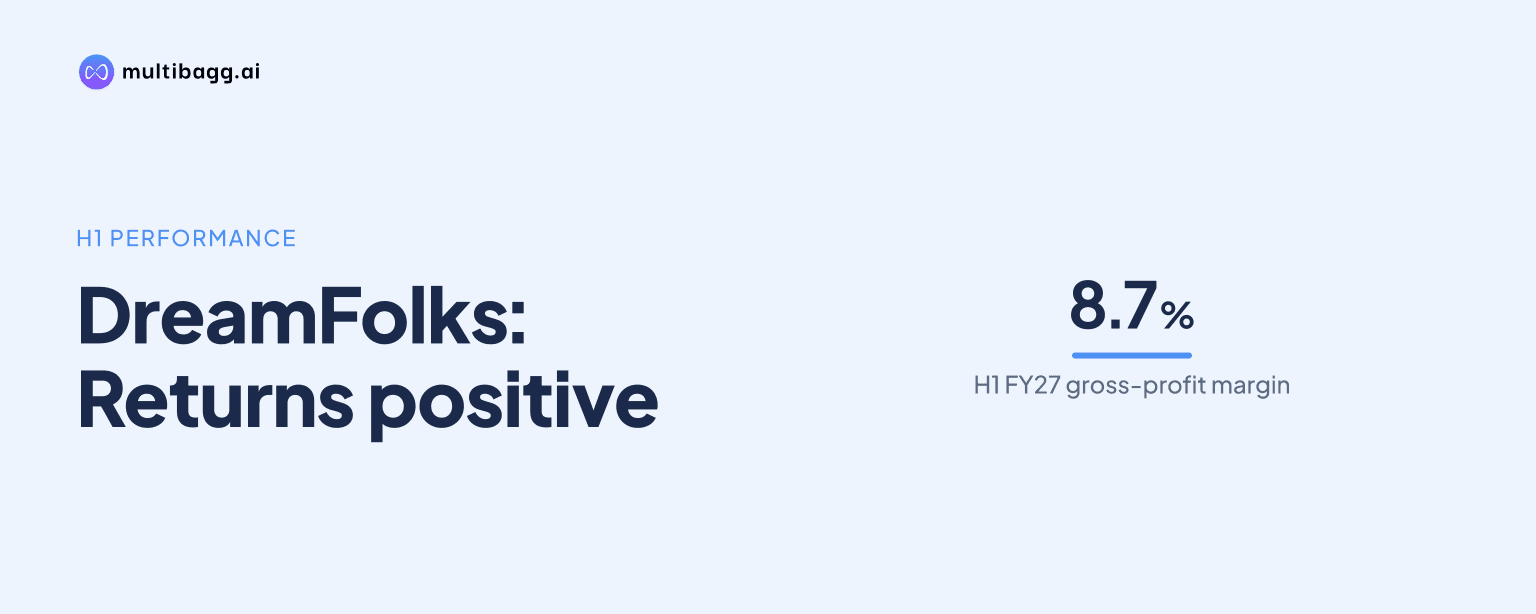
Dreamfolks Services Limited returned to positive gross profit in Q2 FY27, and its H1 FY27 gross-profit margin was 8.7%, as non-airport lounge services supplied more than one-third of Q2 revenue of Rs 31.1 crore for the quarter ended September 30, 2026. Management linked the result to a changing service mix.
Know Dreamfolks Services inside out
Results, valuation, peers and who's buying, in one view.
How did DreamFolks’ profitability change in Q2 FY27?
DreamFolks returned to positive gross profit in Q2 FY27, while its gross-profit margin reached 8.7% for H1 FY27. Management linked the improvement to its effort to change the business mix and improve the economics of newer service offerings, but did not disclose a quarterly gross-profit amount. The milestone came in a quarter with revenue of Rs 31.1 crore.
Profitability improved sequentially at the adjusted earnings before interest, tax, depreciation and amortisation, or EBITDA, level, although DreamFolks remained loss-making. Adjusted EBITDA, after non-cash adjustments, was a loss of Rs 8.8 crore in Q2 FY27, compared with a loss of Rs 16.4 crore in Q1 FY27. Loss after tax narrowed to Rs 10.7 crore from Rs 13.8 crore in Q1 FY27, partly because a one-time upfront minimum-guarantee payment for global-lounge expansion did not recur in Q2.
What share of DreamFolks revenue came from non-airport services?
Non-airport lounge services accounted for more than one-third of DreamFolks’ Q2 FY27 topline of Rs 31.1 crore. Management identified golf, railway lounges and lifestyle services as contributors to the diversified portfolio. DreamFolks did not provide a rupee amount or a precise percentage for each of those service lines.
The mix change matters because management specifically connected newer services with the improvement in gross-profit economics. DreamFolks reported H1 FY27 revenue of Rs 70.1 crore and an 8.7% gross-profit margin, compared with revenue of Rs 554.5 crore in H1 FY26. The reported margin development therefore occurred while revenue was substantially below the prior-year period, rather than alongside a recovery in topline.
Why did DreamFolks revenue remain below earlier periods?
DreamFolks reported Q2 FY27 revenue of Rs 31.1 crore, below Rs 39.0 crore in Q1 FY27 and Rs 205.5 crore in Q2 FY26. H1 FY27 revenue likewise declined to Rs 70.1 crore from Rs 554.5 crore in H1 FY26. The call did not quantify the operational causes of the year-on-year decline, so it does not support attributing it to a particular client, contract or service category.
Management instead focused its financial explanation on sequential cost and mix effects. The Rs 7.6 crore quarter-on-quarter reduction in adjusted EBITDA loss coincided with no repeat of the Q1 upfront minimum-guarantee payment related to global-lounge expansion. Management said that payment had supported the expansion of its global-lounge business, meaning the Q2 loss reduction was partly related to the absence of the one-off Q1 expense.
Got a follow-up? Ask IRIS
Which newer services are shaping DreamFolks’ business mix?
DreamFolks is expanding its banking, loyalty, payments and travel offerings through Coffee Buy One Get One, or BOGO, private-club access, flight-cancellation benefits and spa services. In September 2026, it announced Flight Cancellation for Any Reason with Mastercard, subject to applicable programme terms and conditions, and a wellness-focused credit-card partnership with Elixir in which DreamFolks powers the premium spa-benefit layer.
DF Club Membership was live on the loyalty platforms of multiple major banks by the Q2 FY27 call, creating another distribution channel for the membership product. Separately, DreamFolks supports the travel and lifestyle benefits layer for a premium prepaid metal card on the RuPay network through its partnership with The Card Company. Management described these arrangements as channels beyond conventional credit-card programmes, but gave no transaction or revenue figures for the launches.
How are railway and global lounges part of DreamFolks’ plan?
DreamFolks said it had network coverage across 100% of railway lounges in India and added a railway lounge at Nashik during Q2 FY27. Through subsidiary Ten11 Hospitality, it owns and operates railway lounges in Chennai, Mumbai and Vadodara. Management said it was evaluating further direct operations through Ten11 to increase operational control, service quality and the customer experience.
Global lounges remain another management priority, supported by a network of more than 1,100 lounges. Management said its focus was to convert this network reach into sustained programme activity and transaction volumes through deeper relationships with international banks and card networks. It identified South-East Asia as an encouraging market with interest from multiple clients, but did not disclose an international revenue target or transaction forecast.
Conclusion
DreamFolks’ Q2 FY27 results show that its economics improved sequentially even as revenue declined. Adjusted EBITDA loss narrowed to Rs 8.8 crore from Rs 16.4 crore in Q1 FY27, while the company reported positive gross profit and an 8.7% H1 gross-profit margin. The contribution of non-airport services, at more than one-third of Q2 revenue, indicates that golf, railway and lifestyle offerings are becoming more material to the reported mix.
The next measure of execution will be management’s FY27 plan to deepen adoption of launched services, increase programme activity across its network of more than 1,100 global lounges, scale railway operations through Ten11 and expand lifestyle benefits through banking and loyalty partners. Management has also said it will invest in technology and operating capabilities while focusing on contribution, revenue absorption and disciplined capital allocation.