










Ducol acquisitions build a broader specialty chemicals platform
Key highlights
- Ducol completed the 100% XChem acquisition for aggregate consideration of about Rs 75 crore.
- Bitumag’s capacity doubled to about 10 million square metres annually after a second line was commissioned.
- Bitumag reported H1 FY27 revenue of Rs 32.62 crore, while XChem reported Rs 31.84 crore.
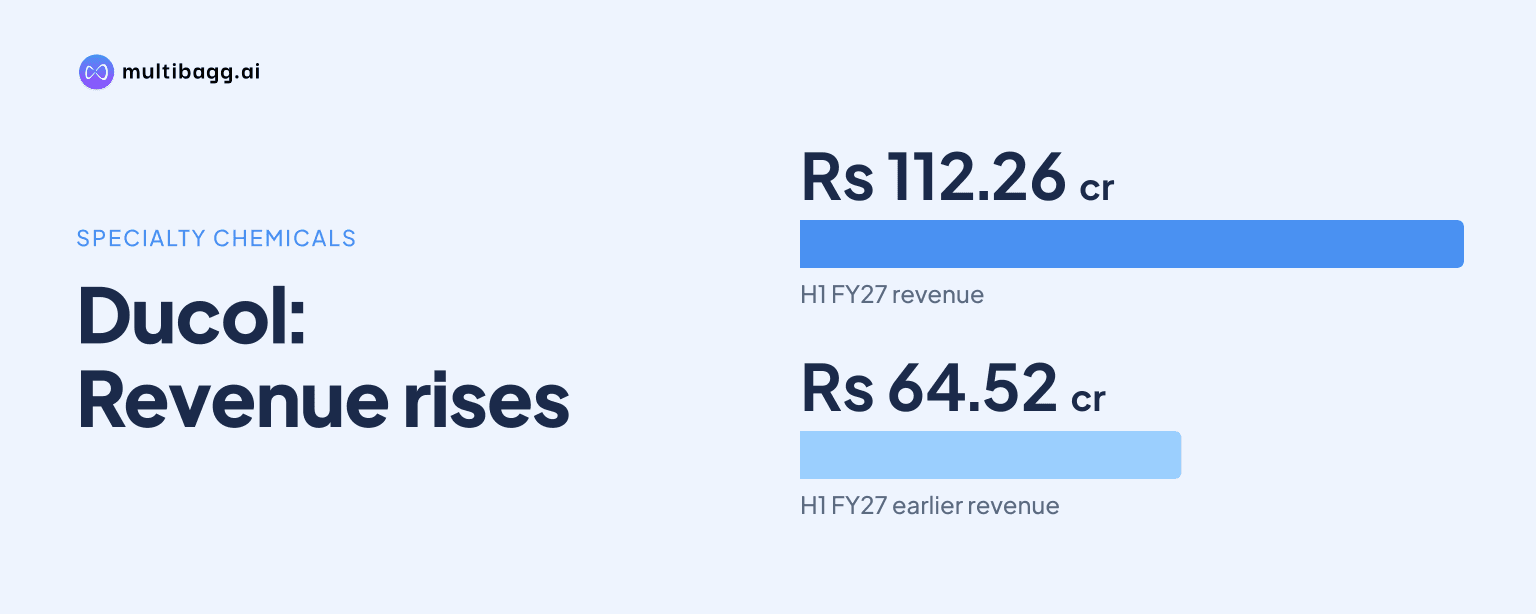
- Ducol’s consolidated H1 FY27 revenue rose 74% to Rs 112.26 crore from Rs 64.52 crore.
powered by IRIS
Ducol Organics & Colours Limited is building a broader specialty-chemicals platform through its full acquisitions of Bitumag and XChem, adding waterproofing, adhesives, sealants and construction chemicals alongside pigment dispersions. The largest disclosed transaction, XChem, involved aggregate consideration of about Rs 75 crore and brought 20,000 metric tonnes of annual capacity operating at 30% to 35% utilisation.
Know Ducol Organics & Colours inside out
Results, valuation, peers and who's buying, in one view.
Why did Ducol acquire Bitumag and XChem?
Ducol acquired Bitumag and XChem to diversify beyond pigment dispersions into complementary specialty-chemical categories for construction, infrastructure and industrial applications. Management described the approach as Ducol 2.0, under which waterproofing, adhesives, sealants and construction chemicals sit alongside a pigment-dispersion business developed over more than three decades.
Bitumag makes waterproofing membranes and elastomeric compounds for roofs, basements, bathrooms, terraces, podiums, decks, highways, bridges and tunnels. XChem supplies adhesives, sealants, waterproofing chemicals and performance chemicals for construction and industrial uses, including flooring, heating, ventilation and air-conditioning insulation, footwear soles and uppers, ethylene vinyl acetate applications, concrete, and commercial and industrial buildings.
Management said the acquisitions offered a faster route into these categories than creating the businesses internally. Ducol’s existing pigment products serve paints, coatings, inks, detergents, plastics, textiles, rubber and paper, while the acquired portfolios add construction-oriented products that management expects to offer through its existing customer and distribution relationships.
What did Ducol pay for Bitumag and XChem?
Ducol acquired 100% of Bitumag effective April 15, 2025, for a transaction value of about Rs 39.7 crore. Management said the deal included commissioning a second Bitumag manufacturing line, which doubled its waterproofing-membrane capacity to about 10 million square metres per annum.
Ducol signed XChem’s share purchase agreement on March 26, 2026, and said it had completed the acquisition of a 100% stake for aggregate consideration of about Rs 75 crore. The terms comprised Rs 35 crore in cash for an initial 50.67% stake, Rs 7 crore of cash payable within two years, and Rs 30 crore settled through a share swap.
Under the share-swap component, Ducol is issuing about 17.65 lakh shares to XChem’s promoters at Rs 170 per share. The call did not disclose an acquisition-level purchase-price allocation, expected revenue multiple or a timetable for each planned commercial synergy.
How much unused capacity do the acquired businesses have?
Ducol has scope to raise output at both acquired businesses before requiring significant near-term capacity expansion, according to management. Bitumag was operating at about 25% to 35% utilisation after the second line lifted its capacity to about 10 million square metres annually, while XChem was at about 30% to 35% utilisation of its 20,000-metric-tonne annual capacity.
The legacy pigment operations also have varying utilisation levels across product types. Wet-dispersion capacity is about 3,000 to 4,500 metric tonnes per annum and operating at around 55%, while dry-dispersion capacity is about 20,000 metric tonnes per annum at around 70% to 75% utilisation.
Masterbatch capacity is about 1,800 to 2,500 metric tonnes per annum, with utilisation of around 10% to 15%. Compared with dry dispersions at 70% to 75% utilisation, the lower operating levels at Bitumag, XChem and masterbatches explain management’s stated focus on increasing utilisation and expanding customer coverage.
Got a follow-up? Ask IRIS
How are the acquisitions changing Ducol’s financial mix?
Ducol reported Rs 112.26 crore of consolidated revenue from operations in H1 FY27, up 74% from Rs 64.52 crore in the corresponding prior-year period. Management said the half-year performance reflected contributions from the company’s existing operations and acquired businesses.
Bitumag reported H1 FY27 revenue of Rs 32.62 crore and earnings before interest, tax, depreciation and amortisation, or EBITDA, of Rs 3 crore. XChem reported revenue of Rs 31.84 crore and EBITDA of Rs 3.09 crore, taking their combined revenue to Rs 64.46 crore and combined EBITDA to Rs 6.09 crore.
Consolidated EBITDA was Rs 12.79 crore, equal to an EBITDA margin of 11.39%, while profit before tax was Rs 8.83 crore and profit after tax was Rs 6.47 crore. Ducol’s standalone revenue was Rs 48.71 crore, with EBITDA of Rs 6.70 crore, a 13.76% EBITDA margin, and profit after tax of Rs 2.15 crore in H1 FY27.
How will Ducol seek cross-selling and overseas growth?
Ducol plans to cross-sell waterproofing membranes, adhesives, sealants and construction additives to customers that already buy its pigment dispersions. Management named Asian Paints, Berger Paints, Kansai Nerolac, JSW, Birla Opus, ITC, Hindustan Lever, Bostik, Chryso and Tremco among its customers, and said several relationships extend beyond 20 years.
Bitumag’s international plan includes Qualibit in Malaysia, which management said has sourced from Bitumag for more than five years. About 20% of Bitumag’s capacity has been earmarked for Malaysia, subject to customer qualification and validation, while a distribution tie-up with Altek International is expected to support expansion in the Middle East, Africa and the subcontinent.
Ducol already exports to more than 30 countries, including the United States, China, South Korea, Bangladesh, the United Arab Emirates, Bahrain, South Africa, Ethiopia, Kenya and Tanzania. Management said it intends to use that export network, together with the acquired companies’ products, to widen domestic and international market access.
Conclusion
Ducol’s acquisition strategy changes its operating platform from one centred on pigment dispersions to one that also includes waterproofing, construction chemicals, adhesives and sealants. The H1 FY27 figures show the acquired businesses contributed Rs 64.46 crore of revenue and Rs 6.09 crore of EBITDA, while Bitumag and XChem each retained utilisation below 35%.
The next measures to watch are progress in lifting capacity utilisation, the Malaysia allocation that represents about 20% of Bitumag capacity and remains subject to qualification, and management’s margin plan. Management said the acquired businesses had EBITDA margin of about 9.5% in H1 FY27, targets at least 10.5% for the current financial year, and expects consolidated EBITDA margin to gradually reach 12% to 15% in the next financial year.