










Nupur Recyclers says export ban may cut LFP feedstock costs
Key highlights
- Nupur Recyclers targets Q4 FY27 hydrometallurgical operations at its 6,000-metric-tonne annual LFP plant.
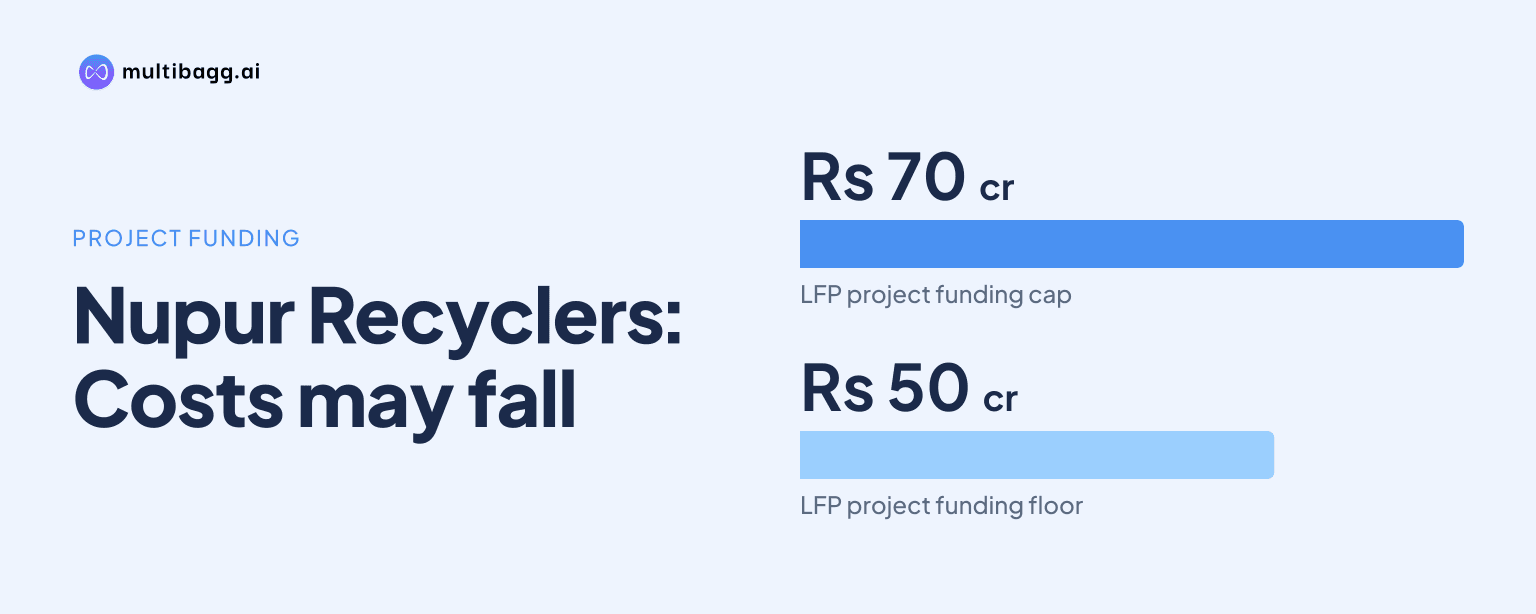
- Management estimates Rs 50 crore to Rs 70 crore of internal-accrual funding for the Sampla LFP project.
- Nupur Recyclers reported Q2 FY27 revenue of Rs 116.21 crore, up 124.86% year on year.
- Management said the LFP plant could eventually generate Rs 200 crore of revenue, subject to execution and ramp-up.
powered by IRIS
Nupur Recyclers Limited said a recent black-mass export ban may lower domestic feedstock costs for its 6,000-metric-tonne-a-year lithium iron phosphate, or LFP, recycling plant, which management targets to begin hydrometallurgical processing in Q4 FY27. Management also said it currently knows of no other domestic processor using its LFP black-mass recovery technology.
Know Nupur Recyclers inside out
Results, valuation, peers and who's buying, in one view.
How could the black-mass export ban affect Nupur Recyclers?
Nupur Recyclers said the export restriction could make black mass cheaper to procure because battery-opening operators that had exported it may instead need domestic buyers. Chairman and Managing Director Rajesh Gupta said the notification was issued “a few days back,” but the Q2 and H1 FY27 call provided no notification number, effective date, expected price reduction or estimate of black-mass volumes that could stay in India.
The potential benefit relies on processing capability rather than battery dismantling alone. Nupur Recyclers said its hydrometallurgical process uses chemicals rather than burning to recover lithium-bearing material, iron phosphate, graphite, copper, aluminium and sodium sulphate from used LFP batteries. Management estimated that LFP black mass contains roughly 3.5% to 4% lithium and said lithium carbonate was selling at about Rs 1,800 to Rs 2,200 per kilogram at the time of the call.
Management said it believes the restriction could also lower battery prices because there was no other facility available to process LFP black mass. Gupta said that, “as far as I know,” Nupur Recyclers was the only company using hydrometallurgy to extract lithium, iron phosphate, graphite and sodium-related products from LFP black mass. That is a management claim, not an independently substantiated industry finding, and management acknowledged that competing processors could emerge.
What LFP recycling capacity is Nupur Recyclers installing?
Nupur Recyclers is building a 6,000-metric-tonne-per-year LFP battery recycling plant at Sampla, Haryana, directly within the listed entity. Management said this structure would attribute the project’s revenue and profitability to Nupur Recyclers and its shareholders rather than to a subsidiary. The project occupies a 5-acre parcel and is planned to have about 1,35,000 square feet of covered area.
Management placed investment at Rs 50 crore to Rs 70 crore, funded entirely through internal accruals. During the Q2 and H1 FY27 call, it said machinery, tanks and boilers had been ordered and 60,000 square feet of the shed had been completed. It targeted battery cutting and opening by the end of December, with hydrometallurgical processing starting in Q4 FY27.
The target has moved from Q3 to Q4 FY27. Gupta attributed the revised timing to installation work for large boilers, tanks and other machines, while saying the company was trying to start in Q4. The shift makes equipment installation and commissioning relevant to whether Nupur Recyclers can process any additional domestic black mass resulting from the export restriction.
What approvals does Nupur Recyclers still need for the LFP plant?
Nupur Recyclers said it already has consent to establish, or CTE, but requires additional permissions before full operation. Management identified consent to operate, or CTO, hazardous-waste approvals, Ministry of Environment, Forest and Climate Change approvals, and an import-related approval. The call did not provide application dates, approval conditions or a detailed status for each authority.
Management said it expected the remaining approvals other than the import-related Ministry approval in Q4 FY27. Gupta said the Ministry approval for imports could take three to six months. Nupur Recyclers plans to buy batteries domestically and import batteries from overseas, while seeking extended producer responsibility, or EPR, business from LFP battery manufacturers in India.
The operating model is intended to link battery recovery with the group’s existing manufacturing activities. Management said recovered aluminium and copper could be used by subsidiaries, while lithium, iron phosphate, graphite and sodium products could be sold domestically. This proposed backward and forward integration depends on the 6,000-metric-tonne plant receiving approvals and starting both dismantling and hydrometallurgical processing as planned.
Got a follow-up? Ask IRIS
How material could the LFP plant be to Nupur Recyclers?
Management said the LFP plant could generate Rs 200 crore of revenue, compared with its expectation of about Rs 400 crore or more in consolidated FY27 revenue, within a plus or minus 5% range. This indicates that management views the plant as potentially material, but it did not disclose a first-year revenue target, ramp-up profile, expected margin or planned black-mass procurement volume.
Nupur Recyclers reported consolidated revenue of Rs 116.21 crore in Q2 FY27, up 124.86% from Rs 51.68 crore in Q2 FY26. Earnings before interest, tax, depreciation and amortisation, or EBITDA, rose 148.48% to Rs 15.73 crore, while profit after tax rose 103.06% to Rs 8.80 crore. Management attributed the growth to core-scrap volumes, a richer manufacturing-led mix, subsidiary contributions and integration.
For H1 FY27, revenue increased 90.27% to Rs 199.24 crore from Rs 104.71 crore in H1 FY26, while EBITDA rose 130.34% to Rs 28.59 crore from Rs 12.41 crore. EBITDA margin rose 250 basis points to 14.35%, and profit after tax increased 93.19% to Rs 16.18 crore. These results predate commercial LFP hydrometallurgical operations, meaning existing scrap and manufacturing activities generated the reported earnings.
Which existing operations support Nupur Recyclers’ expansion plans?
Nupur Recyclers operates through Frank Metals Recyclers, Nupur Extrusion and Tycod Autotech in addition to sourcing and sorting scrap. Frank Metals, in which Nupur Recyclers owns 80%, reported Q2 revenue of Rs 64.23 crore, and its 2,000-metric-tonne annual aluminium extrusion line was fully utilised. Management expects an additional 3,600-metric-tonne annual extrusion line to be commissioned in Q4 FY27.
Nupur Extrusion, which is 70% owned, reported Q2 revenue of Rs 13.48 crore and 50% utilisation, producing about 200 tonnes monthly on its five-inch press. Management said a second automatic four-inch press, expected in Q1 FY28, would add 150 tonnes a month and lift capacity to roughly 350 to 400 tonnes monthly. Tycod Autotech, which is 50% owned, reported Rs 15.83 crore of Q2 revenue and increased utilisation to 30% from 10% in Q1.
Management said existing infrastructure could eventually support more than Rs 1,000 crore of revenue and said it plans to reach that level in FY29. It cited potential monthly revenue of Rs 25 crore to Rs 30 crore at Tycod, around Rs 40 crore at Frank Metals, and Rs 200 crore each from the LFP plant and Nupur Extrusion. These are management targets rather than reported results and depend on capacity utilisation, new equipment and the LFP plant’s commissioning.
Conclusion
The export ban could create a domestic procurement opportunity for Nupur Recyclers if black mass that had been exported becomes available locally and the company’s 6,000-metric-tonne LFP plant begins processing it. Its stated distinction is hydrometallurgical recovery of lithium and other materials, but management’s claim of being the only available domestic LFP black-mass processor remains unverified within the call.
The next disclosed milestone is the targeted Q4 FY27 hydrometallurgical start, following planned battery opening by the end of December. Investors will need to watch the outstanding CTO, hazardous-waste and Ministry approvals, including the three-to-six-month import-permission timeline management cited, and progress toward the plant’s stated Rs 200 crore revenue potential.