










Nupur Recyclers targets Q4 FY27 LFP plant commissioning
Key highlights
- Nupur targets Q4 FY27 commissioning for a 6,000-MTPA LFP battery-recycling plant in Sampla, Haryana.
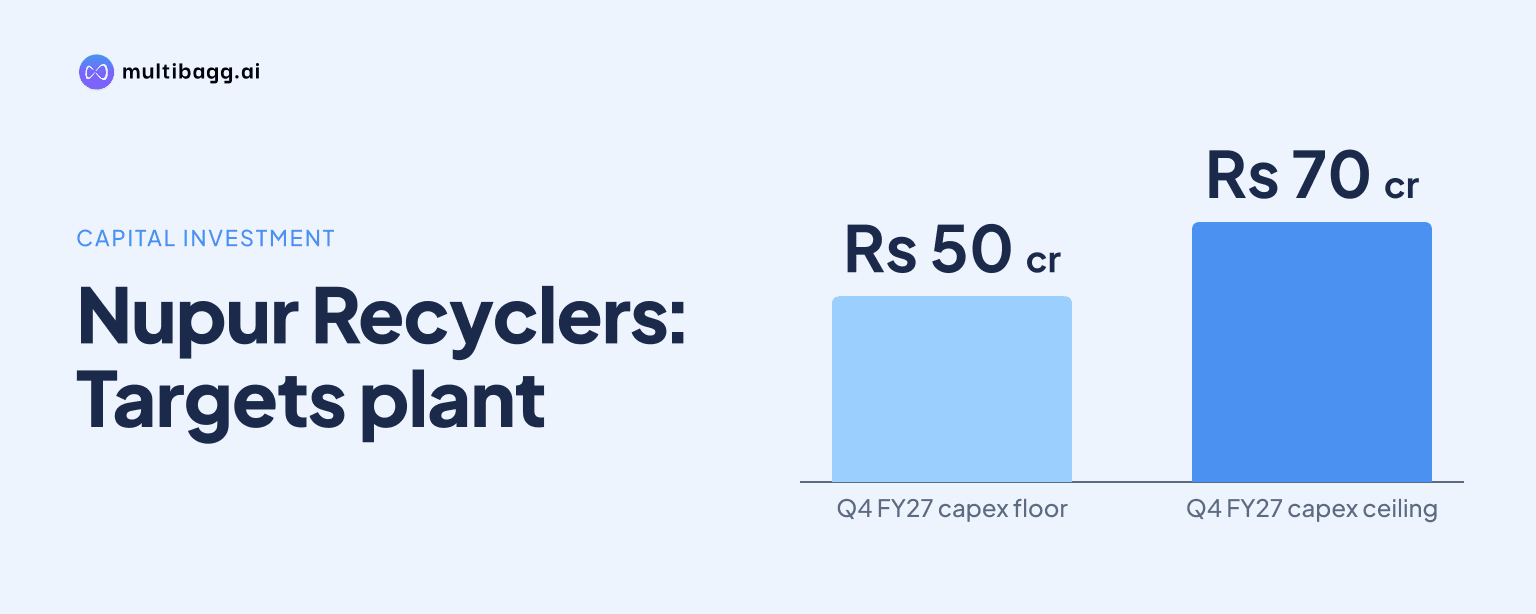
- The planned plant requires approximately Rs 50-70 crore of capital investment, funded through internal accruals without external debt.
- Nupur projects approximately Rs 100-125 crore of annual revenue and a 25-30% EBITDA margin at full capacity.
- H1 FY27 revenue from operations rose 91.4% year on year to Rs 190.91 crore, while EBITDA rose 130.3% to Rs 28.59 crore.
powered by IRIS
Nupur Recyclers is targeting Q4 FY27 commissioning of a 6,000-metric-tonnes-per-year lithium iron phosphate battery-recycling facility at Sampla, Haryana, financed from internal accruals without external debt. At full operating capacity, Nupur projects approximately Rs 100-125 crore of annual revenue and a targeted earnings before interest, tax, depreciation and amortisation margin of 25-30%.
Know Nupur Recyclers inside out
Results, valuation, peers and who's buying, in one view.
What is Nupur's LFP battery-recycling project?
Nupur's planned facility is a 6,000 metric tonnes per annum, or MTPA, lithium iron phosphate, or LFP, battery-recycling plant in Sampla, Haryana, with commissioning targeted in Q4 FY27. The project is an entry into a business line distinct from its core metals-recycling operations, and management presents it as a higher-margin activity. The stated capital investment is approximately Rs 50-70 crore, while the source identifies an additional roughly 10 acres of land secured beyond the initial 6,000-tonne installation.
The proposed process runs from collection and discharging through dismantling, shredding and separation to black mass, followed by hydrometallurgy and recovered materials. Nupur says hydrometallurgy uses controlled chemical reactions rather than heat and is designed to recover lithium, iron phosphate and graphite in usable forms. The source assigns black-mass material composition of 25% iron phosphate, 22% graphite, 12% aluminium, 8% copper and 4% lithium, with the remaining 29% classified as other material.
How will Nupur fund and scale the new plant?
Nupur says it will fund the approximately Rs 50-70 crore project entirely through internal accruals and use no external debt for the facility. That financing choice sits alongside the company's reported debt-to-equity ratio of 0.37 times in H1 FY27, compared with 0.25 times in FY26 and 0.11 times in FY25. The presentation also cites a customer payment cycle of about 30-45 days as part of the operating structure supporting internally funded growth.
The initial 6,000-MTPA capacity is not presented as the physical limit of the Sampla site. Nupur has secured approximately 10 additional acres beyond the land needed for the initial facility, creating room for a later expansion if the business is developed further. Management has also confirmed that the hydrometallurgical system is intended to run as a continuous process and that capacity can scale beyond the initial installed base, although the presentation gives no date or capital estimate for a second phase.
Why does Nupur see an LFP recycling opportunity in India?
Nupur identifies an estimated 1.25 lakh tonnes of LFP battery material generated annually in India as the underlying feedstock opportunity, stating that the volume is rising as the electric-vehicle fleet matures. The source lists end-of-life electric vehicles, e-rickshaws, three-wheelers, buses and telecom-tower storage batteries as supply channels. It also identifies manufacturing rejects, saying large battery plants may scrap 15-20% of new output because of minor defects.
The company's opportunity case also rests on LFP's expected share of battery demand. Nupur states that 85-90% of India's electric-vehicle battery demand is expected to use LFP chemistry. It further points to rising minimum recycled-content requirements under extended producer responsibility and India's critical-minerals strategy aimed at reducing import dependence for lithium and related materials. These factors explain the strategic rationale, but the presentation does not disclose supply contracts, contracted feedstock volumes or customer agreements for the planned plant.
Got a follow-up? Ask IRIS
How does the planned business compare with Nupur's current financial base?
Nupur's full-capacity revenue projection of approximately Rs 100-125 crore annually would be paired with a 25-30% targeted EBITDA margin. That margin target is above the company's reported 15.0% EBITDA margin for H1 FY27 and 12.9% for FY26, although the two figures cover different businesses and the plant has not yet begun operations. The new facility's economic case therefore remains a management target rather than a reported operating result.
Nupur's existing business reported H1 FY27 total revenue of Rs 192.24 crore, EBITDA of Rs 28.59 crore and profit after tax of Rs 16.18 crore. In FY26, total revenue was Rs 226.61 crore, EBITDA was Rs 27.75 crore and profit after tax was Rs 16.48 crore. The H1 FY27 figures show higher revenue and EBITDA than the corresponding prior half-year, while the proposed LFP line is expected to add a separate stream based on the sale of recovered lithium, iron phosphate and graphite.
What materials will Nupur recover from battery black mass?
Nupur intends to recover lithium, iron phosphate and graphite from black mass through hydrometallurgy, while aluminium and copper are also identified in the incoming material mix. The presentation describes 4% lithium content, 25% iron phosphate and 22% graphite in the material composition. It says heat-based methods cannot isolate lithium, iron phosphate and graphite in a usable form in the same way as the proposed chemical process.
The recovery model fits Nupur's stated integrated value chain, which currently spans scrap sourcing, alloys, billets, extrusion profiles and auto components. Its aluminium extrusion subsidiary, Nupur Extrusion Pvt Ltd, has total capacity of about 4,800 MTPA and installed capacity of about 2,400 MTPA, operating at roughly 50% utilisation. The battery project is therefore separate from that extrusion capacity, even though both activities are located in Haryana and form part of the wider materials business.
Conclusion
Nupur is planning a material shift in its operating mix through a 6,000-MTPA LFP battery-recycling facility, with an estimated Rs 50-70 crore investment funded from internal accruals. Its projected Rs 100-125 crore annual revenue and 25-30% EBITDA margin would introduce a new earnings model based on recovered battery materials rather than conventional metal scrap alone.
The next disclosed milestone is the Q4 FY27 commissioning target at Sampla. Investors will need to watch whether Nupur completes the plant within its stated capital range, secures sufficient battery material for the 6,000-MTPA line and converts the full-capacity revenue and margin targets into reported results after operations begin.