










Nupur Recyclers Delays LFP Plant Commissioning to Q4 FY27
Key highlights
- Nupur Recyclers shifted Sampla LFP hydrometallurgy commissioning from Q3 FY27 to Q4 FY27.
- The Sampla plant is designed to process 6,000 metric tonnes of LFP batteries a year.
- Management expects LFP recycling margins of 30% to 40% after operations begin.
- Nupur Recyclers has budgeted Rs 50 crore to Rs 70 crore for the LFP project through internal accruals.
powered by IRIS
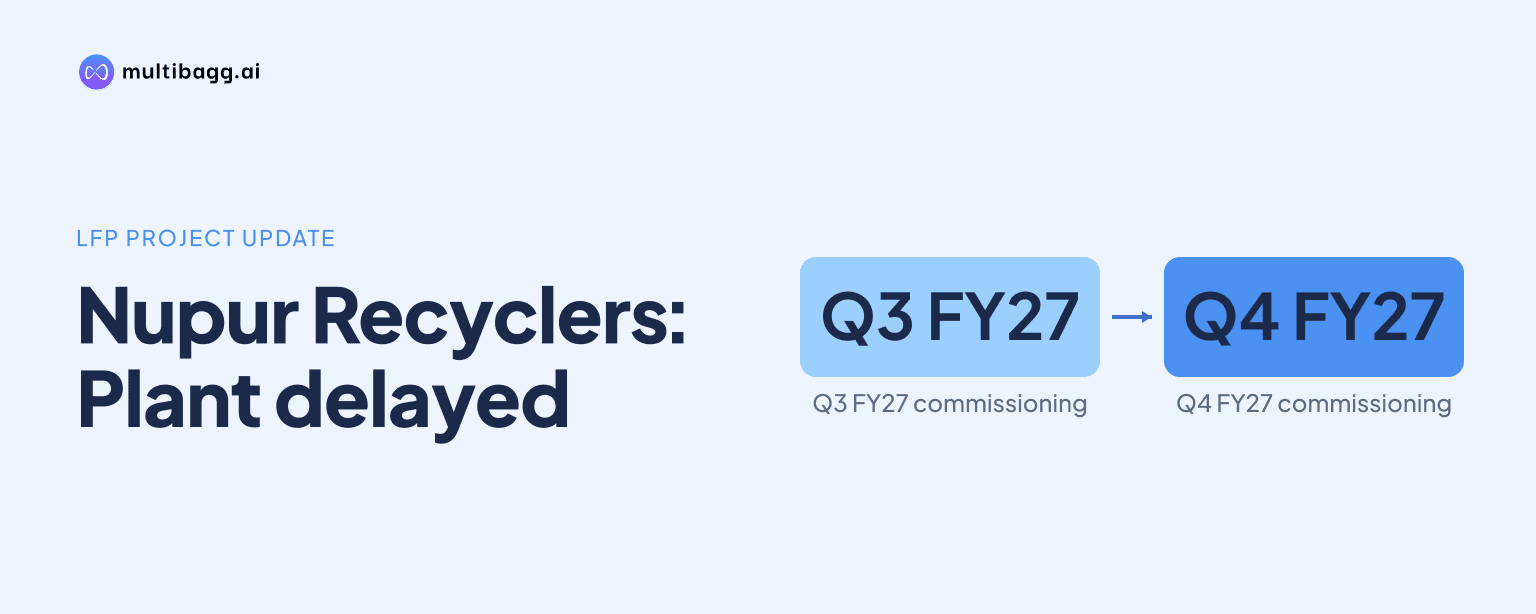
Nupur Recyclers Limited now targets Q4 FY27 commissioning for its 6,000-metric-tonne-a-year lithium iron phosphate battery recycling plant at Sampla, Haryana, instead of the earlier Q3 expectation, as boilers, tanks and other machinery are being installed. Management projects margins of 30% to 40% once the operation begins.
Know Nupur Recyclers inside out
Results, valuation, peers and who's buying, in one view.
Why did Nupur Recyclers move LFP plant commissioning to Q4 FY27?
Nupur Recyclers moved the target to Q4 FY27 because installation work remains for large boilers, tanks and other machinery at the Sampla facility. An analyst on the November 16, 2026 earnings call noted the earlier Q3 FY27 expectation, and Chairman and Managing Director Rajesh Gupta said the company was trying to start the plant in Q4 FY27.
The project is being built on a 5-acre Haryana site with planned covered space of about 1,35,000 square feet. Management said 60,000 square feet of shed construction had been completed by the call date, the remaining shed was under construction, and all machines and tanks had been ordered.
Nupur Recyclers expects battery cutting and opening to start by the end of December, while hydrometallurgy is targeted to begin in Q4 FY27. The two activities have different functions: battery opening separates metals and other materials, while hydrometallurgy is intended to process black mass for recovery of lithium and other outputs.
What will the Sampla LFP battery plant process?
Nupur Recyclers is designing Sampla to process 6,000 metric tonnes a year of lithium iron phosphate, or LFP, batteries used in electric vehicles and energy-storage applications. Management said the facility will recover lithium-bearing material, iron phosphate, graphite, copper, aluminium and sodium sulphate, a by-product named in its opening remarks.
Management described the recycling flow in two stages. The first cuts and opens batteries to separate aluminium, copper, brass and plastic; the second treats black mass to recover lithium, iron phosphate, graphite and other critical materials. In a later call response, management said the plant would use both pyro and hydro processes across these stages.
Black mass from used LFP batteries contains roughly 3.5% to 4% lithium, according to management. It cited lithium carbonate prices of Rs 1,800 to Rs 2,200 per kilogram, but did not provide a projected recovery rate, contracted feedstock volume or price assumptions for the plant's individual recovered products.
What revenue and margin does Nupur Recyclers expect from LFP recycling?
Nupur Recyclers management expects the LFP operation to generate margins of 30% to 40%, compared with its reported consolidated Q2 FY27 earnings before interest, tax, depreciation and amortisation, or EBITDA, margin of 13.54%. This is management's forward-looking expectation rather than reported plant performance, because the hydrometallurgy operation had not begun as of November 16, 2026.
Management provided an indicative example in which a battery valued at Rs 100 and processing costs of Rs 60 could produce recovered material valued at Rs 200 per kilogram. It did not specify the battery weight, define the margin measure, or provide a full cost and recovery model, so the illustration does not establish realised unit economics.
The company estimates that the 6,000-metric-tonne plant could generate up to Rs 200 crore of annual revenue. For FY28, management indicated LFP revenue of Rs 150 crore to Rs 200 crore if the plant stabilises, and said it hoped to reach full utilisation in Q2 FY28 at roughly 12 to 15 tonnes a day.
Got a follow-up? Ask IRIS
How much is Nupur Recyclers spending on the Sampla project?
Nupur Recyclers has budgeted Rs 50 crore to Rs 70 crore for the Sampla project and said it will fund the amount through internal accruals. Management said the listed parent is developing the facility directly, so any revenue and profitability from the operation would be attributed to Nupur Recyclers rather than one of its subsidiaries.
Management allocated about Rs 10 crore to Rs 15 crore to land and Rs 20 crore to Rs 25 crore to building construction. It said the remaining requirement includes machinery and operating expenditure, with about Rs 20 crore to Rs 25 crore intended for battery purchases and other operating needs, indicating that the project budget includes working capital.
The plant requires approvals in addition to consent to establish, or CTE, which management said it already holds. Management expects to apply for hazardous-waste, Ministry of Environment, Forest and Climate Change, or MoEF, and consent-to-operate, or CTO, permissions after machinery installation; it estimated three to six months for the MoEF import licence and expected the other approvals in Q4 FY27.
How does LFP recycling compare with Nupur Recyclers' existing operations?
Nupur Recyclers reported consolidated Q2 FY27 revenue of Rs 116.21 crore, up 124.86% from Rs 51.68 crore in Q2 FY26, while EBITDA rose 148.48% to Rs 15.73 crore from Rs 6.33 crore. The EBITDA margin increased by 129 basis points to 13.54%, which management attributed to higher scrap volumes, a richer product mix, subsidiary contributions and integration.
In H1 FY27, revenue rose 90.27% to Rs 199.24 crore from Rs 104.71 crore, while EBITDA increased 130.34% to Rs 28.59 crore from Rs 12.41 crore. The H1 EBITDA margin was 14.35%, up 250 basis points year on year, providing the financial context for management's plan to use internal accruals for the Rs 50 crore to Rs 70 crore LFP project.
Nupur Recyclers currently imports and sorts zinc, aluminium and stainless-steel scrap, then supplies group operations including Frank Metals Recyclers, Nupur Extrusion and Tycod Autotech. Management said recovered aluminium and copper from the LFP process could be used by group companies, while lithium, iron phosphate, graphite and sodium-based materials would be sold in domestic markets.
Conclusion
Nupur Recyclers has deferred the Sampla LFP plant from its earlier Q3 FY27 expectation to Q4 FY27 while construction, equipment installation and approvals progress. The 6,000-metric-tonne facility is planned as a new recycling stream alongside the existing scrap-processing chain, and management's 30% to 40% margin expectation remains untested until operations begin.
The next disclosed milestones are battery cutting and opening by the end of December, hydrometallurgy commissioning in Q4 FY27, and hazardous-waste, MoEF and CTO approvals. Management expects full utilisation in Q2 FY28 and has indicated that it may consider expanding capacity after the plant has operated for six months to one year.