










Ducol targets Rs 400-500 crore revenue within three years
Key highlights
- Ducol reported H1 FY27 consolidated revenue of Rs 112.26 crore, up 74% from Rs 64.52 crore a year earlier.
- Management targets Rs 400 crore to Rs 500 crore of revenue within about three years, or three times the FY26 base.
- Bitumag and XChem reported H1 FY27 revenue of Rs 32.63 crore and Rs 31.83 crore, respectively.
- Management targets exports of approximately 25% of business within three years, from around 10% currently.
powered by IRIS
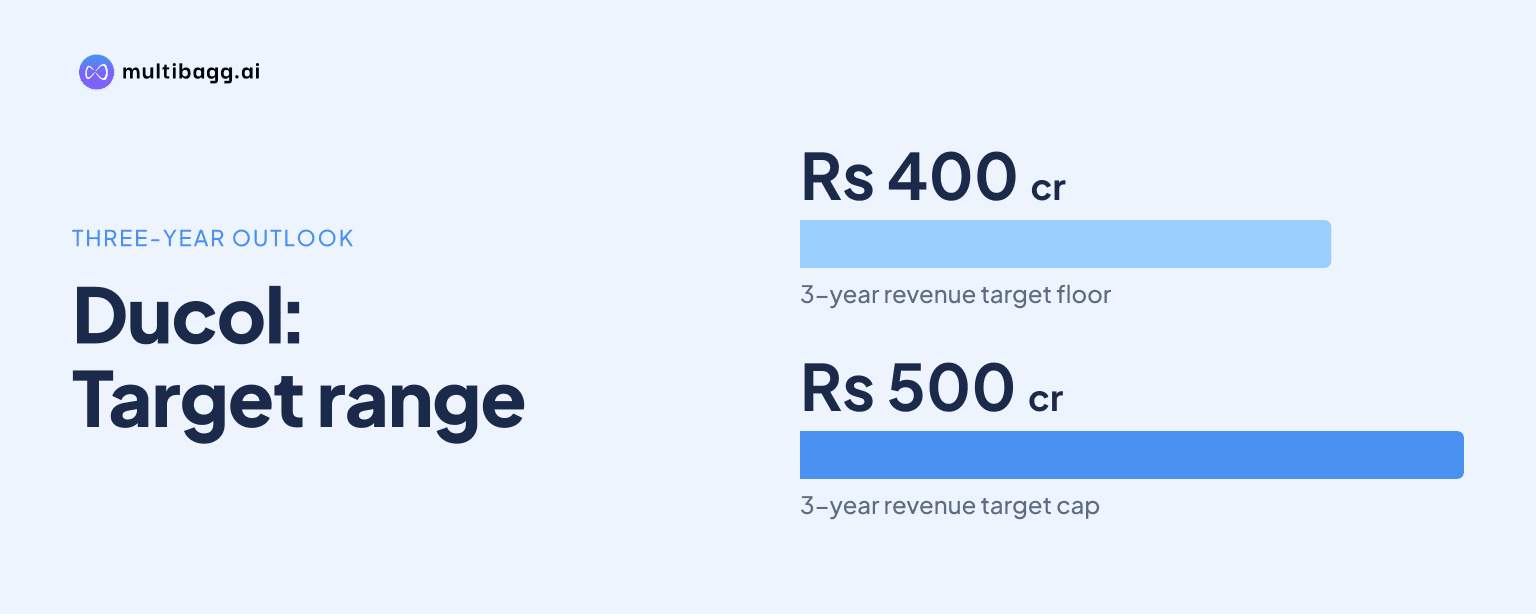
Ducol Organics & Colours Limited is targeting Rs 400 crore to Rs 500 crore of revenue within about three years, or three times its FY26 base, after H1 FY27 consolidated revenue rose 74% year on year to Rs 112.26 crore. Management’s plan depends on acquired businesses, higher plant utilisation, cross-selling and exports.
Know Ducol Organics & Colours inside out
Results, valuation, peers and who's buying, in one view.
What is Ducol’s three-year revenue target?
Ducol is targeting Rs 400 crore to Rs 500 crore of revenue within about three years. On the November 16, 2026 earnings call, Chief Financial Officer Rupesh Nikam said the immediate objective was to triple revenue from the FY26 base through the combined pigment-dispersion, waterproofing and construction-chemicals platform.
The target follows a substantial increase in reported scale in H1 FY27. Consolidated revenue from operations was Rs 112.26 crore, compared with Rs 64.52 crore in the corresponding period of the previous year, producing 74% growth. Earnings before interest, tax, depreciation and amortisation, or EBITDA, were Rs 12.79 crore, while profit after tax was Rs 6.47 crore.
Management linked the three-year ambition to a broader product range rather than the pigment-dispersion business alone. Bitumag adds waterproofing membranes and elastomeric compounds, while XChem adds adhesives, sealants, waterproofing and performance chemicals for construction and industrial applications.
Which businesses are expected to drive Ducol’s growth?
Ducol expects Bitumag and XChem to be important growth drivers, with management saying both could potentially achieve 25% to 30% annual revenue growth from their current base, subject to market conditions and execution. The businesses expand the platform’s exposure to construction chemicals alongside pigment dispersions.
The first-half revenue disclosures show the larger contribution from the acquired businesses. Ducol’s standalone operation reported Rs 48.71 crore in H1 FY27 revenue, while Bitumag reported Rs 32.63 crore and XChem reported Rs 31.83 crore. Bitumag generated Rs 3 crore of EBITDA and XChem generated Rs 3.09 crore.
Bitumag was acquired in full effective April 15, 2025 for approximately Rs 39.7 crore. Ducol completed the 100% acquisition of XChem for approximately Rs 75 crore, comprising Rs 35 crore for the initial 50.67% stake, Rs 7 crore payable within two years and Rs 30 crore settled through a share swap.
Management said more than 70% of the businesses’ historical clientele overlapped. It intends to use those original equipment manufacturer, or OEM, relationships to sell waterproofing, adhesives and construction-chemical products alongside pigment dispersions, while also pursuing new customers and applications.
How much unused capacity does Ducol have?
Ducol has available capacity in its acquired businesses and does not currently see a need for significant capacity expansion over the next two to three years. Management instead indicated refurbishment spending of Rs 5 crore to Rs 7 crore across plants, with the priority being to raise utilisation of existing assets.
Bitumag’s second manufacturing line, commissioned as part of the acquisition arrangement, doubled capacity to about 10 million square metres a year. Utilisation was about 25% to 35%, which management said offered room to increase output without significant near-term plant expansion.
XChem has installed capacity of about 20,000 metric tonnes a year and utilisation of about 30% to 35%. Management targets at least 50% XChem utilisation within three years through cross-selling, additional adhesives sales and the commercialisation of product technologies that had not previously been sold through XChem.
The legacy pigment-dispersion network also has headroom. Wet-dispersion capacity of about 3,000 to 4,500 metric tonnes a year was operating at around 55%, dry-dispersion capacity of about 20,000 metric tonnes at around 70% to 75%, and masterbatch capacity of about 1,800 to 2,500 metric tonnes at around 10% to 15%.
Got a follow-up? Ask IRIS
What EBITDA margin does Ducol expect to achieve?
Ducol is targeting consolidated EBITDA margins of 12% to 15% over the next three years. That compares with a reported consolidated EBITDA margin of 11.39% in H1 FY27, when EBITDA was Rs 12.79 crore on revenue of Rs 112.26 crore.
The acquired businesses were below that three-year target in the first half. Bitumag reported an EBITDA margin of 9.19%, while XChem reported 9.71%; management described their combined margin as around 9.5% and targeted at least 10.5% in FY27.
Ducol’s standalone operation reported a higher H1 FY27 EBITDA margin of 13.76% on Rs 48.71 crore of revenue. Management attributed its expected group margin improvement to higher production volumes, fixed-cost absorption, manufacturing efficiencies and economies of scale as utilisation rises.
How will exports and debt repayment affect Ducol’s plan?
Ducol expects exports to increase to approximately 25% of business within three years from around 10% currently. The plan includes Bitumag’s Southeast Asian relationship with Polybit, for which about 20% of Bitumag capacity has been earmarked, subject to customer qualification and validation.
Management also identified Altek International as a distribution route into the Middle East, Africa and the Indian subcontinent. In addition, Ducol intends to grow pigment-dispersion exports in the Middle East, Africa and South Asia, where management said its current footprint has been limited.
Debt repayment is a stated financial priority alongside expansion. Finance costs related to the two acquisitions were about Rs 1.79 crore in H1 FY27, and acquisition term-loan outstanding was Rs 44 crore at March 2026. Management expects scheduled repayments to reduce this to Rs 41.17 crore by March 2027.
Management said its first priority is paying the Rs 7 crore cash consideration for XChem within two years. It said further term-loan repayment planning would follow improvement in revenue and profitability, making execution against the growth plan relevant to both capacity use and debt reduction.
Conclusion
Ducol’s Rs 400 crore to Rs 500 crore revenue ambition is based on a larger specialty-chemicals platform following the Bitumag and XChem acquisitions. H1 FY27 consolidated revenue of Rs 112.26 crore, up 74% year on year, provides the current scale, while overlapping customers and underused manufacturing capacity are management’s stated mechanisms for expansion.
The next measures to watch are Bitumag’s utilisation from its current 25% to 35% range, XChem’s progress toward at least 50% utilisation within three years and exports moving from around 10% to approximately 25% of business. Management’s planned Rs 7 crore XChem payment and the expected decline in acquisition term loans to Rs 41.17 crore by March 2027 are additional disclosed milestones.