










Duroply Q2 revenue hits ₹122.2 crore, EBITDA margin 7.1%
Key highlights
- Duroply reported record Q2 FY27 revenue of ₹122.2 crore, up 17% year on year and 22.7% from Q1 FY27.
- Q2 FY27 EBITDA increased 33.4% year on year to ₹8.62 crore, lifting EBITDA margin to 7.1% from 6.2%.
- In-house manufactured goods revenue rose 18.5% to ₹62.7 crore, while contract manufacturing revenue increased 15.4% to ₹59.5 crore.
- H1 FY27 cash conversion cycle improved to 101 days, with debtor days declining to 38 from 42 in FY26.
powered by IRIS
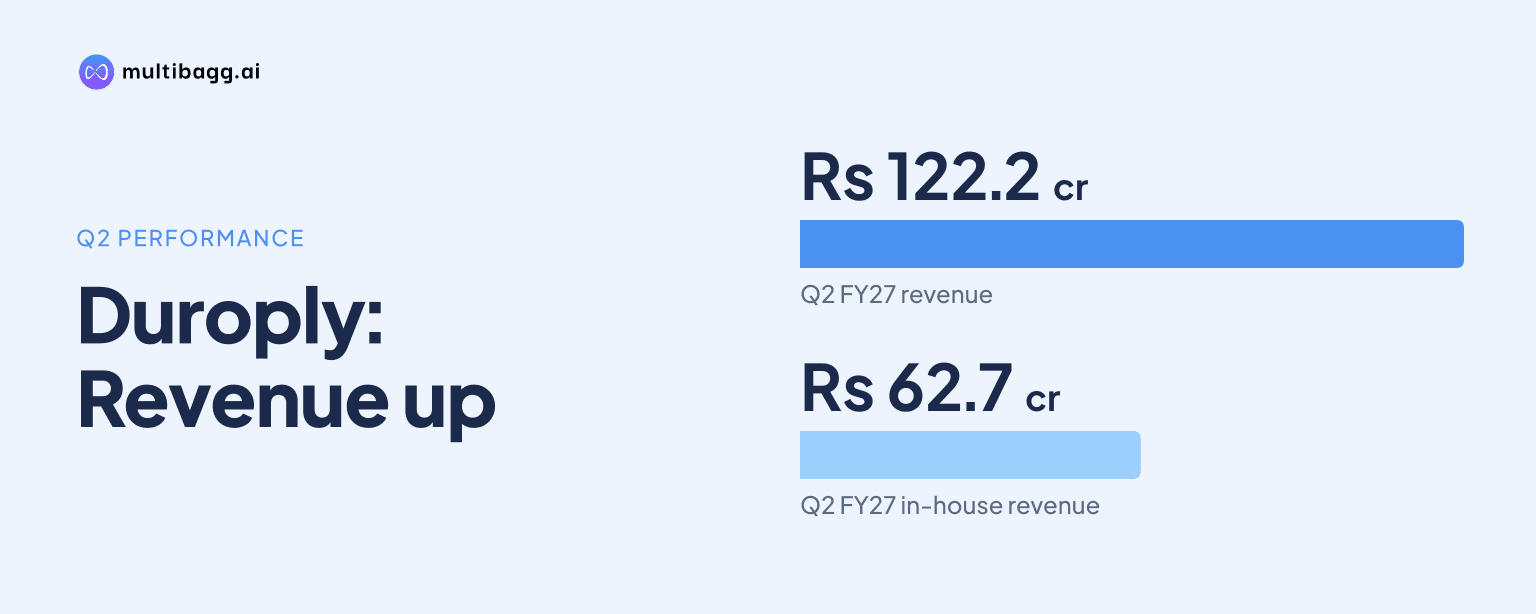
Duroply Industries Limited reported record Q2 FY27 revenue of ₹122.2 crore, up 17% year on year and 22.7% from Q1 FY27, while EBITDA margin rose to 7.1% from 6.2% a year earlier. Management attributed the margin improvement to higher volumes and broadly flat overheads, despite increased raw-material costs.
Know Duroply Industries inside out
Results, valuation, peers and who's buying, in one view.
How did Duroply achieve record Q2 FY27 revenue?
Duroply achieved record Q2 FY27 revenue of ₹122.2 crore, exceeding its prior high of ₹111.6 crore in Q4 FY26. Revenue increased 17% from the corresponding quarter a year earlier and 22.7% from Q1 FY27. Management said Q1 had been affected by challenges in April and May, but growth recovered thereafter.
Both revenue streams recorded double-digit growth in Q2 FY27. In-house manufactured goods revenue rose 18.5% year on year to ₹62.7 crore and increased 22% from Q1 FY27. Contract manufacturing revenue grew 15.4% year on year to ₹59.5 crore and rose 23% sequentially, leaving the two streams close in size.
Duroply’s H1 FY27 revenue was ₹221.9 crore, up 12% from the prior-year half. In-house manufactured goods contributed ₹114 crore and contract manufacturing contributed ₹107.8 crore. The Q2 result therefore accelerated from the first-half growth rate, although management did not provide a full-year revenue target.
Why did Duroply's EBITDA margin increase to 7.1%?
Duroply's EBITDA margin increased to 7.1% because revenue grew 17% while operating expenses rose by 11.3%, according to management. Earnings before interest, tax, depreciation and amortisation, or EBITDA, increased 33.4% year on year to ₹8.62 crore and rose 79% from Q1 FY27 as higher sales were absorbed against relatively flat overheads.
The 7.1% margin was 90 basis points above 6.2% in Q2 FY26 and 230 basis points above 4.8% in Q1 FY27. A basis point equals one-hundredth of a percentage point. Operating expenses declined to 27.5% of revenue from 28.9% a year earlier, while employee cost was about 10.4% of sales, compared with 12.8% in Q1 FY27.
Gross margin moved lower despite the improvement in EBITDA margin. It was 34.6% in Q2 FY27, against about 34.8% a year earlier and 35.5% in Q1 FY27, which management linked to higher raw-material costs. Brand spending was 3.6% of sales, below 3.9% in Q1 FY27 but above the 2.7% recorded for FY26 overall.
Duroply reported Q2 FY27 profit before tax of ₹4.86 crore, up 82% year on year, and profit after tax of ₹4.38 crore. For H1 FY27, EBITDA was ₹13.44 crore, up 13.4%, at a 6.1% margin; profit before tax was ₹5.9 crore, up 29.5%, and profit after tax was ₹4.98 crore, up 25.9%.
Got a follow-up? Ask IRIS
How did Duroply's working capital change in H1 FY27?
Duroply’s cash conversion cycle improved to 101 days in H1 FY27, as debtor days fell to 38 from 42 in FY26 and creditor days increased to 88 from 72. The cash conversion cycle tracks the time between payments to suppliers and cash collection from customers through receivables, inventory and payables.
Inventory days were 151 in H1 FY27, down from 164 in Q1 FY27 but above 145 in FY26. The 13-day sequential reduction in inventory days, together with lower debtor days and longer creditor days, supported the reported 101-day cash conversion cycle. Management did not disclose the comparable cash conversion cycle for FY26.
Duroply’s H1 FY27 gross margin was 35%, compared with 34.5% in the prior-year half. This half-year improvement contrasts with Q2 gross margin of 34.6%, which was below the 35.5% recorded in Q1 FY27 as raw-material costs increased during the quarter.
Can Duroply sustain Q2 FY27 growth and margins?
Duroply management said it expects double-digit growth in FY27 and expects the second half to be better than the first half. Management also said Q2 performance could be repeated over the next six months if conditions remain unchanged, while noting possible construction-related challenges in Delhi and the National Capital Region.
Management identified raw-material inflation as the principal uncertainty for margins. Shipping rates had not fallen and chemical costs were increasing, management said, leaving uncertainty over the extent to which cost increases could be passed on to customers. That risk is visible in the Q2 FY27 gross-margin decline to 34.6% from 35.5% in Q1 FY27.
Duroply has entered the medium-density fibreboard category through Duro HDMMR, a high-density product line. Management said the launch uses an asset-light model with no capital expenditure, relying on another producer’s capacity amid industry overcapacity. It said early response was in line with its expectations and that product extensions would be considered only after the current line is established.
Modernisation at Duroply’s Rajkot plant is continuing, but management did not disclose a completion date, investment amount or capacity addition. The company also said its 3.6% Q2 FY27 brand spend would remain disciplined and subject to returns tracking, without giving a future spending target.
Conclusion
Duroply’s Q2 FY27 combined record revenue of ₹122.2 crore with EBITDA of ₹8.62 crore and a 7.1% margin. Both in-house manufactured goods and contract manufacturing grew by more than 15% year on year, while operating expenses grew more slowly than revenue. The gain in EBITDA margin occurred even as gross margin declined on higher raw-material costs.
The next quarterly earnings call should indicate whether management’s expectation of a stronger second half is being met. Factors disclosed for monitoring include shipping and chemical costs, the ability to pass higher input costs to customers, construction conditions in Delhi and the National Capital Region, Rajkot modernisation progress, and demand for the asset-light Duro HDMMR launch.