










EAAA VAR concentration declines to 33% as seven funds contribute
Key highlights
- EAAA reported Rs 159 crore of net VAR accrued across seven funds at September 30, 2026.
- EAAA's largest fund contributed 33% of period VAR in H1 FY27, down from 100% in FY24.
- EAAA's VAR-earning fund count increased from one in FY24 to seven in H1 FY27.
- EAAA's VAR-contributing strategies increased from one in FY24 to five in H1 FY27.
powered by IRIS
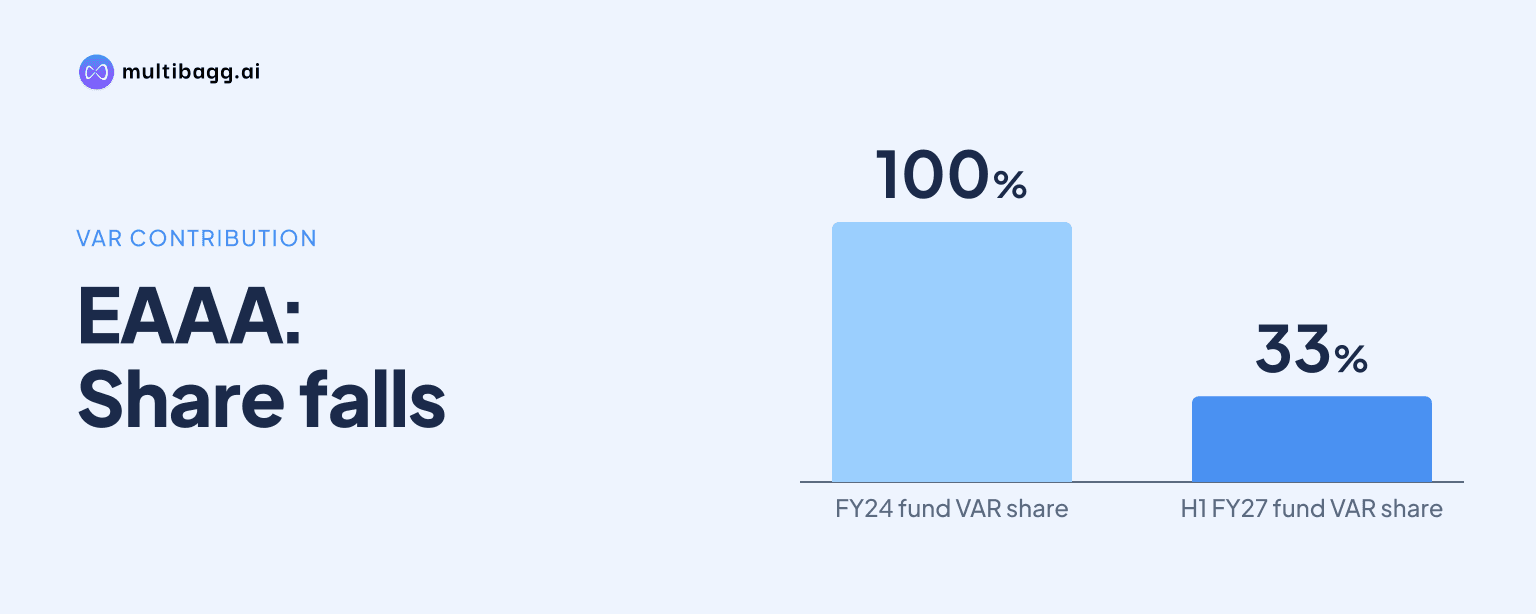
Edelweiss Alternatives (EAAA) reduced its largest fund’s share of variable additional return, or VAR, to 33% in H1 FY27 from 100% in FY24, while net VAR accrued reached Rs 159 crore across seven funds at September 30, 2026. EAAA also reported that VAR-contributing strategies expanded from one to five over the period.
Know EAAA India Alternatives inside out
Results, valuation, peers and who's buying, in one view.
How diversified are EAAA's VAR earnings?
EAAA's VAR earnings were spread across seven funds in H1 FY27, compared with one fund in FY24. Net VAR accrued was Rs 159 crore across those seven funds as of September 30, 2026. EAAA describes VAR as performance-generated income alongside management fees and yield and income flows from general-partner investments in funds.
The number of strategies contributing to VAR rose to five in H1 FY27 from one in FY24. Special Situations was the sole named strategy in FY24; Infrastructure Yield was added in FY25, Performing Credit and Private Equity were added in FY26, and Commercial Real Estate was added in H1 FY27. The disclosure therefore shows diversification by both fund count and strategy count.
EAAA presents the Rs 159 crore figure as net VAR accrued at September 30, 2026, rather than as VAR recognised in FY24, FY25, FY26 or H1 FY27. The presentation does not provide rupee VAR accrual figures for the three earlier periods. It therefore establishes a broader contributor base, but does not permit a calculation of year-on-year growth in accrued VAR.
How has EAAA's VAR concentration changed?
EAAA reduced the largest single fund's share of period VAR by 67 percentage points, from 100% in FY24 to 33% in H1 FY27. The share moved to 80% in FY25 and 66% in FY26 before falling by 33 percentage points in H1 FY27. The latest figure means the largest fund accounted for about one-third, rather than all, of period VAR.
The decline in concentration occurred as the number of VAR-earning funds rose from one in FY24 to two in FY25, six in FY26 and seven in H1 FY27. EAAA added six VAR-earning funds over this period, while the number of contributing strategies rose by four, from one to five. The presentation does not disclose the VAR value generated by each of the seven funds.
EAAA calls VAR diversified and recurring across strategies, based on the expansion from Special Situations alone in FY24 to five strategy contributors in H1 FY27. However, the 33% largest-fund share remains a concentration measure for a single half-year period, not a disclosed forecast for subsequent periods. EAAA does not set a target share for its largest VAR-contributing fund.
Which strategies contribute to EAAA's VAR?
EAAA identified Special Situations, Infrastructure Yield, Performing Credit, Private Equity and Commercial Real Estate as the five strategies contributing to VAR in H1 FY27. The sequence began with Special Situations in FY24, added Infrastructure Yield in FY25, then Performing Credit and Private Equity in FY26, followed by Commercial Real Estate in H1 FY27.
The additions show that EAAA's seven VAR-earning funds in H1 FY27 were drawn from more than one strategy family. Infrastructure Yield and Commercial Real Estate are identified as yield strategies, while Special Situations and Performing Credit sit within the platform's growth-finance offering and Private Equity is included in the growth-equity offering. The presentation does not provide VAR accrued by strategy or identify which strategy contained the 33% largest fund.
EAAA reported total fee-paying assets under management, or FPAUM, of Rs 49,164 crore at September 2026 across its platform. Infrastructure Yield represented 45% of FPAUM, Special Situations 32%, Commercial Real Estate 8% and other strategies 15%. Those FPAUM percentages describe the asset base, rather than the distribution of the Rs 159 crore net VAR accrued.
Got a follow-up? Ask IRIS
How does VAR fit EAAA's earnings model?
EAAA says its revenue has three streams: management fees, yield and income flows on general-partner investments in funds, and performance-based VAR. For yield and income strategies, management estimates revenue yield on FPAUM at about 240 to 260 basis points, pre-tax total cost at about 165 to 175 basis points, and profit after tax, or PAT, yield at about 65 to 70 basis points. One basis point equals one-hundredth of a percentage point.
Management says the majority of VAR generated is shared with the team based on performance and expects VAR to contribute about 25% to 30% of PAT over the long term. This separates the Rs 159 crore net VAR accrued at September 30, 2026 from reported PAT. EAAA does not disclose on these pages how much of the accrued amount was recognised as revenue or PAT, or a timetable for conversion.
Management also describes sustainable PAT growth of about 25% to 30% as part of EAAA's business model, supported by diversified funds and multiple vintages. Its stated long-term parameters include a dividend payout ratio of about 50%, a debt-to-equity ratio of no more than 1 times net worth, and return on equity of about 25% to 30% or more. These are management's stated targets and operating parameters rather than reported H1 FY27 outcomes.
EAAA compares its estimated PAT yield of about 65 to 70 basis points on FPAUM with an average PAT yield of about 25 to 35 basis points for traditional asset managers. That comparison concerns the stated unit economics of the yield and income model. It does not provide a comparable VAR concentration measure for traditional asset managers or alter the disclosed 33% largest-fund share in H1 FY27.
Conclusion
EAAA's disclosures show a less concentrated VAR base between FY24 and H1 FY27: the largest fund's share fell from 100% to 33%, VAR-earning funds increased from one to seven, and contributing strategies rose from one to five. The Rs 159 crore net VAR accrued at September 30, 2026 gives the reported scale of the accrued balance, although earlier rupee accrual balances were not disclosed.
The next disclosures should show whether EAAA can sustain or expand the seven-fund VAR base while maintaining lower dependence on a single contributor. Management's plan calls for PAT growth of about 25% to 30% and a long-term VAR contribution of about 25% to 30% of PAT, making future information on VAR recognition, team sharing and PAT conversion relevant to that framework.