










Edelweiss Alternatives manages 14 solar assets and 26 highways
Key highlights
- Edelweiss Alternatives reports 14 solar assets with 1.73 GWp of capacity and three transmission lines spanning 1,835 circuit kms.
- Edelweiss Alternatives manages 26 highways covering more than 7,700 lane kms across toll, hybrid annuity model and annuity formats.
- Edelweiss Alternatives reports five commercial offices covering 5.7 million sq. ft. in Bengaluru, Gurugram and Pune.
- The office platform lists six stages, including re-leasing, upgrades, lower-cost refinancing and exit readiness.
powered by IRIS
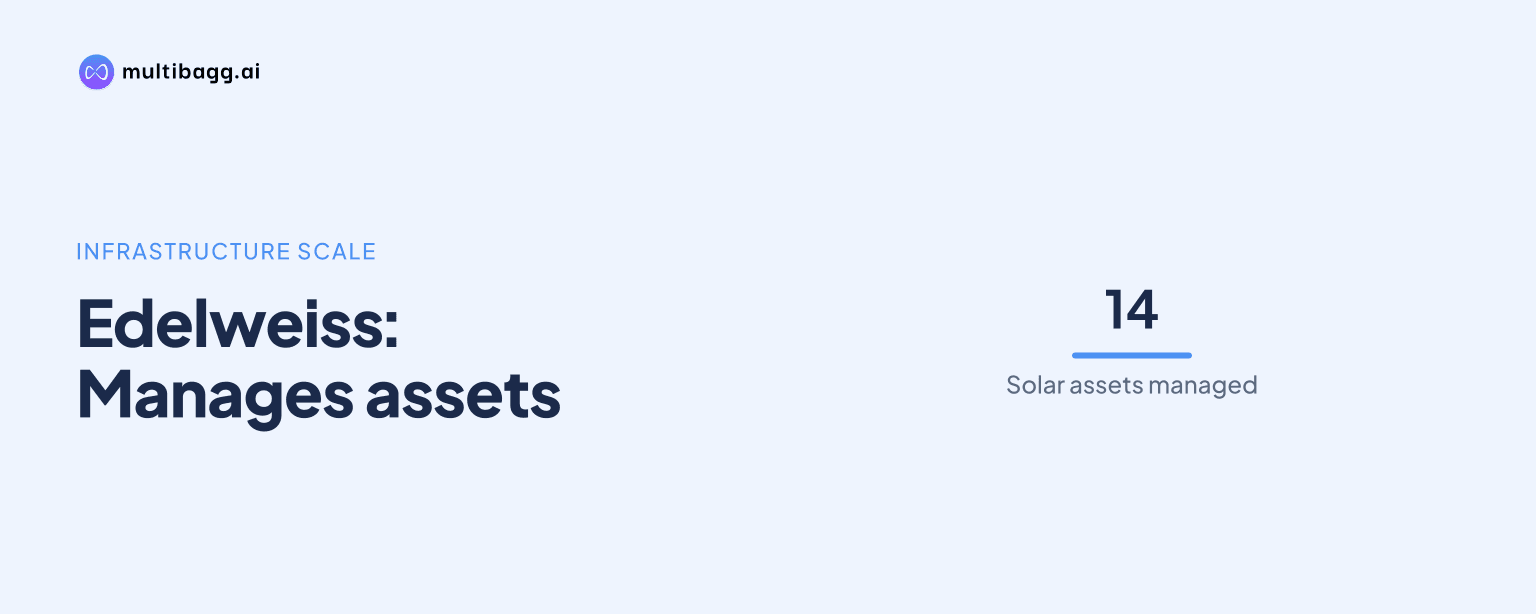
Edelweiss Alternatives manages 14 solar assets with 1.73 GWp of capacity, 26 highways spanning more than 7,700 lane kilometres, and five commercial offices covering 5.7 million sq. ft. Its presentation describes operating interventions including remote solar monitoring, highway analytics, office re-leasing, refinancing and physical upgrades.
Know EAAA India Alternatives inside out
Results, valuation, peers and who's buying, in one view.
How does Edelweiss Alternatives manage energy assets?
Edelweiss Alternatives manages 14 solar assets with 1.73 GWp, or gigawatt-peak, of capacity, as well as three transmission lines totalling 1,835 circuit kms. Its stated process runs from deal origination through active portfolio ownership. Technical and operational diligence includes structural-integrity checks, drone survey videography, soil-health and electrical-property assessments, and energy-yield analysis.
The energy review also includes organisational matters: management of local stakeholders and assessment of key contracts and agreements. This combines physical and electrical work with site-level relationship and contractual review across the 14 solar assets and three transmission lines.
After investment, Edelweiss Alternatives lists revenue enhancement, asset improvement and protection, and operational-efficiency initiatives. Its disclosed tools include drones, remote monitoring, infrared imagery and spectral imagery. The presentation does not give generation, revenue or cost outcomes from those measures, so it identifies them as operating mechanisms rather than reported financial results.
A centralised control room gives what Edelweiss Alternatives calls a bird’s-eye view of the full energy portfolio. Real-time monitoring is therefore presented as a portfolio-wide control for 1.73 GWp of solar capacity, rather than only as an inspection tool for individual sites. The presentation does not state the control room’s launch date, staffing or response-time measures.
What operating tools does Edelweiss Alternatives use on highways?
Edelweiss Alternatives manages 26 highways covering more than 7,700 lane kms across toll, hybrid annuity model, or HAM, and annuity formats. Its stated capabilities cover diligence, business development, technical planning, engineering, pavement-quality assurance, projects and operations, commercial contracts, traffic and revenue, toll systems, safety, health and environment, and client relations.
The transport portfolio differs from the energy portfolio in both its measurement and operating focus. Solar is reported as 1.73 GWp of capacity and 1,835 circuit kms of transmission, while highways are measured in more than 7,700 lane kms. The highway disclosure also names three revenue formats, whereas the energy disclosure focuses on generation assets, transmission lines and remote oversight.
Edelweiss Alternatives identifies glass grid and recycled asphalt pavement as highway innovations, while iHams software is listed for real-time monitoring. It also cites a NABL-accredited laboratory. The presentation does not disclose how many of the 26 highways use these tools or provide pavement-quality, traffic-volume or toll-collection results.
The highway platform is described as covering the full asset life cycle, from diligence and technical planning to project delivery and operations. That scope includes post-investment engineering, commercial contracts and toll-system management. No asset-level comparison is provided for the toll, HAM and annuity groups.
Got a follow-up? Ask IRIS
How does Edelweiss Alternatives seek value in commercial offices?
Edelweiss Alternatives manages five commercial offices covering 5.7 million sq. ft. in Bengaluru, Gurugram and Pune. Its commercial-real-estate framework has six stages: takeover; leasing and branding; sustainability and technology; property management; capital structure; and exit readiness.
At takeover, Edelweiss Alternatives lists technical and tenant audits and operations from day one. Leasing and branding include re-leasing at market rents and the VIRIDIS platform brand. The presentation does not disclose occupancy, tenant retention, achieved rents or the share of the 5.7 million sq. ft. that has been re-leased.
The property-management programme includes efficient upkeep and upgrades to façades, lobbies, lifts and mechanical, electrical and plumbing systems. Before-and-after images identify façade and main-lobby work and a new shuttle lift. Green and environment, health and safety certifications, as well as smart-building technology and data, are listed without energy-saving or certification-count data for the five offices.
The capital-structure stage includes lower-cost refinancing and debt top-ups, while exit readiness covers governance, reporting and preparation. These measures add financing and sale-readiness work to leasing and building operations. Edelweiss Alternatives does not disclose a refinancing amount, interest-rate change, debt balance, valuation or completed exit for offices in the three cities.
How does active ownership fit Edelweiss Alternatives' fund lifecycle?
Edelweiss Alternatives places active asset management through Sekura in the third stage of its five-step alternatives-fund lifecycle: raise capital, invest, build value, distribute yield and realise. The build-value stage sits between deployment across strategies and yield distributions, while realisation can occur through asset sales, refinancing and exits.
The operating actions disclosed for the 14 solar assets, 26 highways and five offices fit this sequence. The office programme, for example, names lower-cost refinancing and exit readiness, and the lifecycle framework identifies refinancing and exits as realisation routes. The presentation does not connect any specific refinancing, distribution or exit to an individual asset.
Edelweiss Alternatives also says each new fund vintage restarts the cycle and adds to future earnings. In a separate illustrative timeline, it says multiple funds and strategies at different stages can produce recurring, overlapping and stacking VAR, or value added revenue, streams as they move from fundraising to investments, yield distributions and exits.
Across the three asset groups, the stated common feature is operating involvement after investment, although the mechanisms differ. Energy uses generation oversight and remote monitoring; transportation uses engineering, pavement, traffic and toll functions; and offices combine tenant work, upgrades, financing and exit preparation. The presentation provides no comparable return, utilisation or operating-cost data across these asset classes.
Conclusion
Edelweiss Alternatives presents an active ownership model across a 1.73 GWp solar portfolio, more than 7,700 lane kms of highways and 5.7 million sq. ft. of commercial offices. The disclosure shows distinct asset-level mechanisms, from remote imagery and a centralised control room to iHams monitoring, re-leasing, lower-cost refinancing and building upgrades, but it does not quantify the resulting financial or operating effects.
The next disclosed lifecycle stages are yield distributions and realisation through asset sales, refinancing and exits. Edelweiss Alternatives says each new fund vintage restarts this cycle, while its illustrative fund timeline indicates that VAR can recur as multiple funds progress through their respective stages.