










Edelweiss Alternatives H1 profit rises 35% to Rs 169 crore
Key highlights
- Edelweiss Alternatives reported H1FY27 PAT of Rs 169 crore, up 35% year on year.
- Fee-paying AUM rose 28% year on year to Rs 49,164 crore as of September 30, 2026.
- H1FY27 total income increased 35% to Rs 616 crore from Rs 457 crore.
- Edelweiss Alternatives declared a second interim dividend of Rs 7 per share for FY2026-27.
powered by IRIS
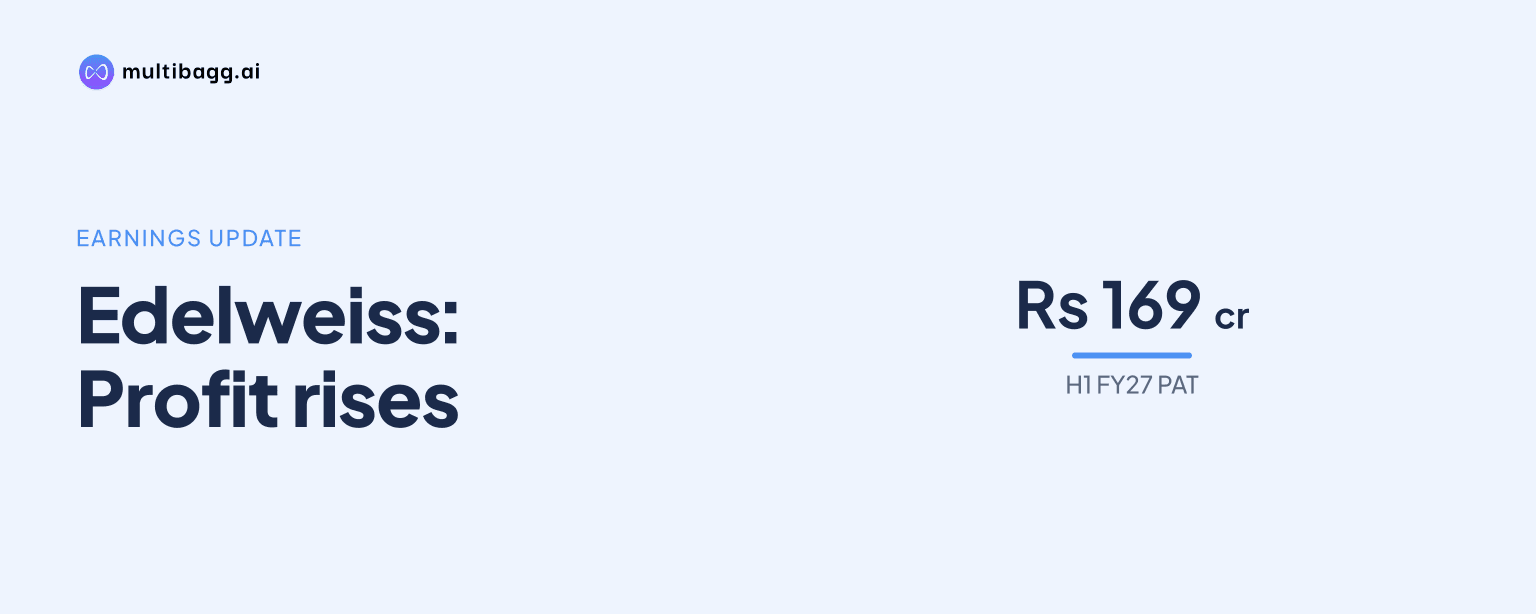
EAAA India Alternatives Limited, known as Edelweiss Alternatives, reported H1FY27 profit after tax of Rs 169 crore, up 35% year on year, while fee-paying assets under management reached Rs 49,164 crore on September 30, 2026, 28% above a year earlier. The unaudited consolidated result was its first since listing on BSE and NSE earlier in November.
Know EAAA India Alternatives inside out
Results, valuation, peers and who's buying, in one view.
How did Edelweiss Alternatives grow H1FY27 profit?
Edelweiss Alternatives increased H1FY27 profit after tax, or PAT, by 35% year on year to Rs 169 crore, alongside a 35% rise in total income to Rs 616 crore from Rs 457 crore in H1FY26. The company linked the increase to sustained expansion in fee-paying assets under management, or FPAUM, and the continued scaling of its alternatives platform.
Management and advisory fees rose 24% year on year to Rs 333 crore in H1FY27. Total income grew 11 percentage points faster than management and advisory fees during the half year ended September 30, 2026, although the release did not provide a separate prior-year PAT figure or a detailed breakdown of expenses.
How much did Edelweiss Alternatives' fee-paying AUM increase?
Edelweiss Alternatives' FPAUM rose 28% year on year to Rs 49,164 crore as of September 30, 2026, from Rs 38,552 crore a year earlier. The Rs 10,612 crore increase was the main asset-scale measure in the announcement, which described FPAUM as an indicator of earnings visibility and revenue-generating assets.
Edelweiss Alternatives also reported a three-year FPAUM compound annual growth rate, or CAGR, of 23%. Management said the expansion reflected its ability to raise, deploy and realise capital across strategies, while increasing the share of assets that contribute recurring management fees. Special Situations, Infrastructure Yield and Commercial Real Estate Yield, its three flagship strategies, represented 85% of FPAUM.
The platform had more than 5,750 client relationships across domestic and global markets. Repeat clients accounted for 77% of assets under management, while institutional and non-institutional investors each represented about 50% of assets, indicating a broadly even split between the two groups.
What did Edelweiss Alternatives report for Q2FY27?
Edelweiss Alternatives reported Q2FY27 PAT of Rs 88 crore, up 27% year on year, while total income increased 14% to Rs 280 crore from Rs 246 crore in Q2FY26. The Rs 88 crore quarterly PAT formed part of the Rs 169 crore reported for H1FY27, which covers two quarters.
Return on equity, or RoE, was 29.4% in Q2FY27, up 275 basis points year on year. A basis point equals one-hundredth of a percentage point. Edelweiss Alternatives linked the improvement to stronger profitability, disciplined capital allocation and greater earnings generation from its expanding asset base, but did not disclose the Q2FY26 RoE percentage.
Got a follow-up? Ask IRIS
Which investment strategies supported Edelweiss Alternatives' platform?
Edelweiss Alternatives reported deployment and portfolio activity in infrastructure, commercial real estate, credit and private equity for the period ended September 30, 2026. Its Infrastructure Yield strategy acquired two operational toll-road assets in Tamil Nadu through the National Highways Authority of India, or NHAI, Toll-Operate-Transfer Bundle 19, while Commercial Real Estate acquired a Grade A office asset with approximately 95% occupancy.
In Special Situations and Performing Credit, Edelweiss Alternatives invested in Cyient Semiconductors, which focuses on custom chip design and power semiconductor solutions. Its Private Equity strategy achieved a public-market listing for portfolio company Rentomojo. The announcement did not disclose investment amounts, valuations or expected returns for these transactions.
Edelweiss Alternatives said it owns and operates 5.7 million square feet of commercial real estate, more than 7,700 lane kilometres of roads, 1,835 circuit kilometres of transmission lines and 1.73 gigawatt-peak of solar assets. Growth Finance, comprising Special Situations and Performing Credit, had deployed more than Rs 42,979 crore and realised Rs 46,471 crore to date.
What did Edelweiss Alternatives disclose about its listing and dividend?
Edelweiss Alternatives declared a second interim dividend of Rs 7 per equity share for FY2026-27, equal to 140% of the Rs 5 face value. The board approved the unaudited standalone and consolidated results on November 11, 2026, and stated that there had been no new issuance of non-convertible securities during the quarter ended September 30, 2026.
The initial public offering was an offer for sale of Rs 1,200 crore and was subscribed 4.17 times, according to Edelweiss Alternatives. The qualified institutional buyer, or QIB, book was subscribed 13.79 times and contributed about 72% of total demand. Edelweiss Alternatives said the issue was oversubscribed across every investor category and identified participation by the top five mutual fund companies, Norges Bank, Hornbill Capital and Schroders.
Conclusion
Edelweiss Alternatives combined 35% growth in H1FY27 PAT to Rs 169 crore with a 35% rise in total income to Rs 616 crore and a 28% increase in FPAUM to Rs 49,164 crore. Management and advisory fees grew 24% to Rs 333 crore, while Q2FY27 RoE increased by 275 basis points year on year to 29.4%.
The next results will show whether FPAUM continues to grow from the September 30, 2026 level and whether management and advisory fees maintain their pace. Management said its focus remains on sustained FPAUM growth, fund performance and long-term value creation through raising, deploying and realising capital across its strategies.