










Edelweiss Alternatives sees ₹25.1 lakh crore market by CY30F
Key highlights
- Edelweiss Alternatives forecasts Indian alternatives AUM of ₹25.1 lakh crore in CY30F, compared with ₹14.3 lakh crore in CY25.
- Yield and income strategies are projected to reach ₹10.6 lakh crore, or 42% of Indian alternatives AUM, by CY30F.
- Edelweiss Alternatives forecasts 16% to 18% CAGR for yield and income strategies from CY25 to CY30F.
- The presentation identifies an indicative ₹2.53 lakh crore domestic institutional capital pool for alternatives investments.
powered by IRIS
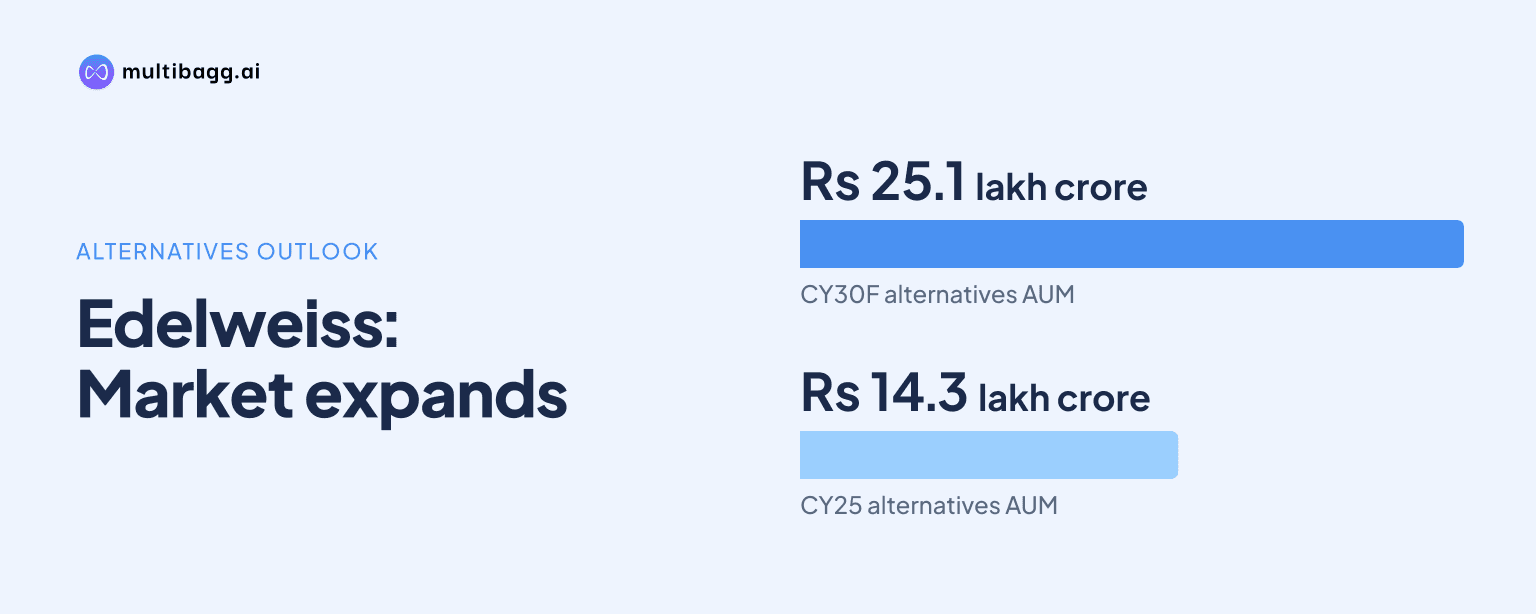
Edelweiss Alternatives forecasts Indian alternatives assets under management, or AUM, will reach ₹25.1 lakh crore in CY30F, with yield and income strategies accounting for 42%, or ₹10.6 lakh crore. The forecast compares with ₹14.3 lakh crore in CY25 and assumes 16% to 18% compound annual growth for the yield segment.
Know EAAA India Alternatives inside out
Results, valuation, peers and who's buying, in one view.
What is Edelweiss Alternatives forecasting for Indian alternatives?
Edelweiss Alternatives forecasts that Indian alternatives AUM will rise to ₹25.1 lakh crore in CY30F from ₹14.3 lakh crore in CY25, representing an approximately 1.8-times expansion. This is an industry forecast rather than a projection of AUM managed by Edelweiss Alternatives. The presentation identifies alternatives as an underpenetrated segment of Indian asset management.
India’s alternatives AUM equalled 3.9% of CY2025 gross domestic product, according to the presentation. That compared with 9.8% in Asia, 17.4% in Europe and 30.7% in North America. Edelweiss Alternatives uses the gap between India and these regions to support its view that the domestic market has scope to expand.
The historical series shows total Indian alternatives AUM rising from ₹5.7 lakh crore in CY15 to ₹12.1 lakh crore in CY21 and ₹14.3 lakh crore in CY25. The ₹2.2 lakh crore increase between CY21 and CY25 was smaller than the ₹10.8 lakh crore increase implied by the CY25-to-CY30F forecast. The comparison illustrates the scale of the projected next phase rather than a reported growth rate.
Why does Edelweiss Alternatives expect yield and income to lead?
Edelweiss Alternatives expects yield and income strategies to reach ₹10.6 lakh crore by CY30F, equal to 42% of the projected ₹25.1 lakh crore alternatives market. The segment had ₹4.8 lakh crore of AUM in CY25. Management forecasts a 16% to 18% compound annual growth rate, or CAGR, for yield and income strategies from CY25 to CY30F.
The CY30F forecast implies a ₹5.8 lakh crore increase in yield and income AUM over five calendar years. Edelweiss Alternatives says this part of the market is poised to outpace the wider alternatives industry, driven by growing domestic wealth and higher allocations by institutions. The presentation does not provide a separate CY30F AUM estimate for growth strategies.
Edelweiss Alternatives classifies infrastructure, commercial office assets and credit strategies as yield and income strategies. It separates these from growth strategies, including private equity and venture capital. Its stated demand mechanism is investor interest in regular-yielding avenues that are not correlated with equities, rather than an expected investment return from any individual asset class.
Got a follow-up? Ask IRIS
How could wealth and institutions expand alternatives demand?
Edelweiss Alternatives identifies approximately ₹222 lakh crore of total wealth to be added in India by 2030. It links this prospective wealth creation to initial public offerings, stake sales and dividends, as well as greater wealth-manager penetration. The presentation says investors with increasing wealth are looking for products offering stable yields, capital preservation and lower equity correlation.
The presentation identifies institutions, large family offices, ultra-high-net-worth individuals and high-net-worth individuals as potential users of diversification and yield solutions. Edelweiss Alternatives also cites an approximately 54% allocation to alternatives by US family offices as a directional comparison. It does not forecast that Indian family offices will reach that allocation or quantify how much of the ₹222 lakh crore wealth addition may enter alternatives.
Edelweiss Alternatives identifies an indicative ₹2.53 lakh crore pool of domestic institutional capital available for alternatives investments. It compares this opportunity with global alternatives exposure of about 20% to 45% for pension institutions and 5% to 7% for insurance institutions. Those ranges are comparative benchmarks, not disclosed current allocation levels for Indian pension or insurance institutions.
A further industry development cited by Edelweiss Alternatives is the 2026 launch of the National Pension System Bharat Fund of Funds Platform. The presentation says the platform is intended to channel long-term domestic pension capital into alternatives. It does not disclose the platform’s corpus, investment timetable or the amount that could be directed to yield and income strategies.
How does Edelweiss Alternatives link its model to the market outlook?
Edelweiss Alternatives says it manages patient capital in closed-ended alternative investment fund structures with terms of six to eight years. Its stated focus is yield and income through non-equity-correlated strategies including infrastructure, commercial real estate and special situations. The company says it has more than 17 years of operating history and raises capital across strategy vintages every two to three years.
The company reported more than 5,750 clients, with 77% of AUM from repeat clients, and said three flagship strategies were raising their second, third and fourth vintages. For H1 FY27, Edelweiss Alternatives reported fee-paying AUM of ₹49,164 crore, up 28% year on year, total income of ₹616 crore and profit after tax of ₹169 crore, with income and profit each up 35%. Management’s long-term target is fee-paying AUM growth of about 20% to 30% CAGR.
Conclusion
Edelweiss Alternatives’ market case combines a low 3.9% alternatives-AUM-to-GDP ratio in India with projected wealth creation and institutional demand. Its central forecast is that the market reaches ₹25.1 lakh crore in CY30F, while yield and income strategies become the largest identified component at ₹10.6 lakh crore and 42% of the total.
What to watch next is whether the 2026 National Pension System Bharat Fund of Funds Platform translates into allocations, alongside fundraising progress in Edelweiss Alternatives’ three flagship strategy vintages. Management’s disclosed plan calls for long-term fee-paying AUM growth of approximately 20% to 30% CAGR, while its industry forecast runs through CY30F.