










Eicher Motors Q2 profit rises 15% to Rs 1,573 crore as revenue grows
Key highlights
- Eicher Motors’ consolidated Q2 profit rose 15% year on year to Rs 1,573.37 crore.
- Revenue from operations increased 20% to Rs 7,421.72 crore in the quarter ended September 30, 2026.
- Eicher Motors’ share of VECV profit rose to Rs 186.07 crore from Rs 134.91 crore a year earlier.
- Half-year net cash from operating activities rose to Rs 3,671.56 crore from Rs 2,657.88 crore.
powered by IRIS
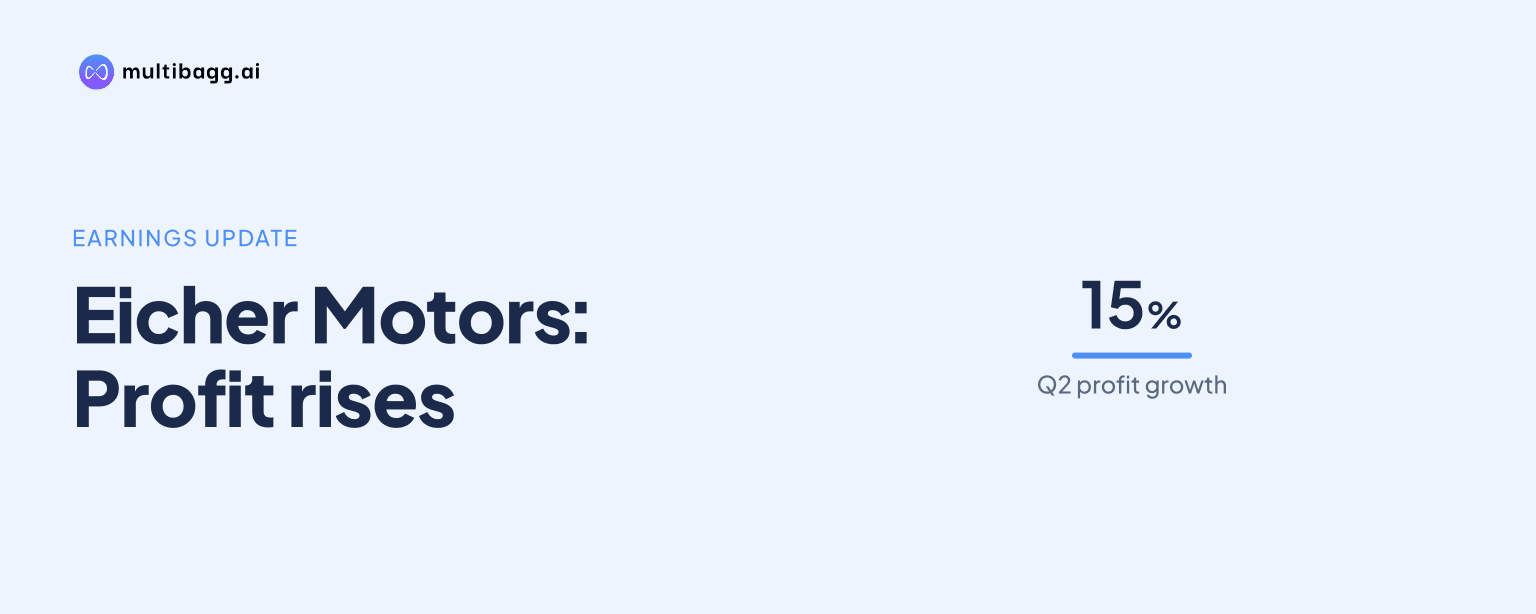
Eicher Motors Limited reported consolidated profit of Rs 1,573.37 crore for the quarter ended September 30, 2026, 15% above Rs 1,369.45 crore a year earlier, as revenue from operations grew 20% to Rs 7,421.72 crore and its VECV share of profit reached Rs 186.07 crore.
Know Eicher Motors inside out
Results, valuation, peers and who's buying, in one view.
Why did Eicher Motors’ Q2 profit increase?
Eicher Motors’ Q2 profit increased because higher operating revenue and a larger share of profit from VE Commercial Vehicles Limited (VECV) more than offset higher expenses. Profit before the VECV share, exceptional items and tax rose to Rs 1,806.31 crore from Rs 1,644.10 crore in the quarter ended September 30, 2025, while the VECV contribution rose by Rs 51.16 crore.
Total income increased to Rs 7,753.60 crore from Rs 6,522.51 crore, led by revenue from operations of Rs 7,421.72 crore. Other income declined to Rs 331.88 crore from Rs 350.92 crore, meaning the year-on-year income increase came from operating revenue rather than other income.
Eicher Motors also reported a sequential increase from the quarter ended June 30, 2026, when revenue from operations was Rs 6,632.42 crore and profit was Rs 1,462.51 crore. Although other income fell from Rs 466.31 crore in the June quarter to Rs 331.88 crore in the September quarter, operating revenue increased by Rs 789.30 crore.
How much did VECV add to Eicher Motors’ earnings?
VECV added Rs 186.07 crore through Eicher Motors’ share of joint-venture profit in the September 2026 quarter, compared with Rs 134.91 crore in the September 2025 quarter. The contribution also exceeded the Rs 167.50 crore recorded in the quarter ended June 30, 2026.
The VECV share took profit before exceptional items and tax to Rs 1,992.38 crore in the latest quarter from Rs 1,779.01 crore a year earlier. Before the joint-venture contribution, Eicher Motors recorded Rs 1,806.31 crore of profit before the VECV share, exceptional items and tax.
For the half year ended September 30, 2026, Eicher Motors’ share of VECV profit rose to Rs 353.57 crore from Rs 292.02 crore in the corresponding prior-year period. Consolidated profit for the six months increased to Rs 3,035.88 crore from Rs 2,574.67 crore, while revenue from operations rose to Rs 14,054.14 crore from Rs 11,213.43 crore.
Got a follow-up? Ask IRIS
What changed in Eicher Motors’ revenue and costs?
Revenue from contracts with customers increased to Rs 7,262.13 crore in the September 2026 quarter from Rs 6,071.19 crore a year earlier, while other operating income rose to Rs 159.59 crore from Rs 100.40 crore. Eicher Motors reports one primary business segment, automobile products and related components, and therefore did not provide a product-line or geographic revenue split.
Total expenses rose to Rs 5,947.29 crore from Rs 4,878.41 crore. Raw materials and components consumed increased to Rs 4,210.65 crore from Rs 3,376.71 crore, employee benefits expense rose to Rs 506.64 crore from Rs 417.92 crore, and other expenses increased to Rs 849.86 crore from Rs 767.02 crore.
Depreciation and amortisation expense rose to Rs 262.80 crore from Rs 199.56 crore, while finance costs increased to Rs 22.28 crore from Rs 19.16 crore. Changes in inventories resulted in a credit of Rs 147.12 crore in the latest quarter, compared with a Rs 50.62 crore credit a year earlier, while purchases of traded goods rose to Rs 242.18 crore from Rs 148.66 crore.
Tax expense was Rs 419.01 crore, compared with Rs 409.56 crore in the September 2025 quarter. The latest tax charge comprised current tax of Rs 496.62 crore and a deferred-tax credit of Rs 77.61 crore; basic earnings per share, not annualised, rose to Rs 57.31 from Rs 49.93.
What do Eicher Motors’ balance sheet and cash flows show?
Eicher Motors had total assets of Rs 34,410.45 crore at September 30, 2026, compared with Rs 32,163.56 crore at March 31, 2026. Current assets increased to Rs 13,306.05 crore from Rs 9,554.25 crore, including other financial assets of Rs 5,946.26 crore compared with Rs 3,025.96 crore.
Total equity rose to Rs 25,941.15 crore at September 30 from Rs 25,100.15 crore at March 31. Current borrowings were Rs 140.77 crore, compared with Rs 117.38 crore six months earlier, while non-current borrowings were Rs 209.35 crore versus Rs 201.63 crore.
Net cash from operating activities for the half year ended September 30, 2026 was Rs 3,671.56 crore, up from Rs 2,657.88 crore in the prior-year half. Eicher Motors spent Rs 860.29 crore on purchases or acquisitions of property, plant, equipment and intangible assets, including work in progress and assets under development, versus Rs 616.98 crore a year earlier.
Financing activities used Rs 2,291.70 crore in the six-month period, including Rs 2,251.08 crore of dividends paid. Cash and cash equivalents at the end of the period, less bank overdrafts, were Rs 221.23 crore, compared with Rs 238.55 crore at the end of the prior-year half.
Conclusion
Eicher Motors’ September-quarter result combined a Rs 1,250.13 crore year-on-year rise in revenue from operations with a Rs 51.16 crore increase in the VECV profit share. These gains accompanied a Rs 1,068.88 crore increase in total expenses and resulted in profit before tax of Rs 1,992.38 crore and profit for the period of Rs 1,573.37 crore.
The disclosed unresolved matter is Eicher Motors’ obligation under the Environment Protection (End-of-Life Vehicles) Rules, 2025, which took effect on April 1, 2025. The group said the central portal is partially operational and the pricing mechanism for Extended Producer Responsibility certificates has not been notified, so it cannot reliably estimate the obligation until a measurement framework is established.