










Royal Enfield FY26 international revenue rises to Rs 3,288 crore
Key highlights
- Royal Enfield reported Rs 3,288 crore of international motorcycle revenue in FY26, up Rs 742 crore from FY25.
- Royal Enfield’s international volumes reached 120,634 units in FY26, up 20,498 units from FY25.
- Royal Enfield reported FY26 middleweight-market shares of 9.7% in APAC, 7.6% in EMEA and 6.6% in the Americas.
- Royal Enfield reported five subsidiaries, seven CKD operations, two technology centres and four manufacturing locations.
powered by IRIS
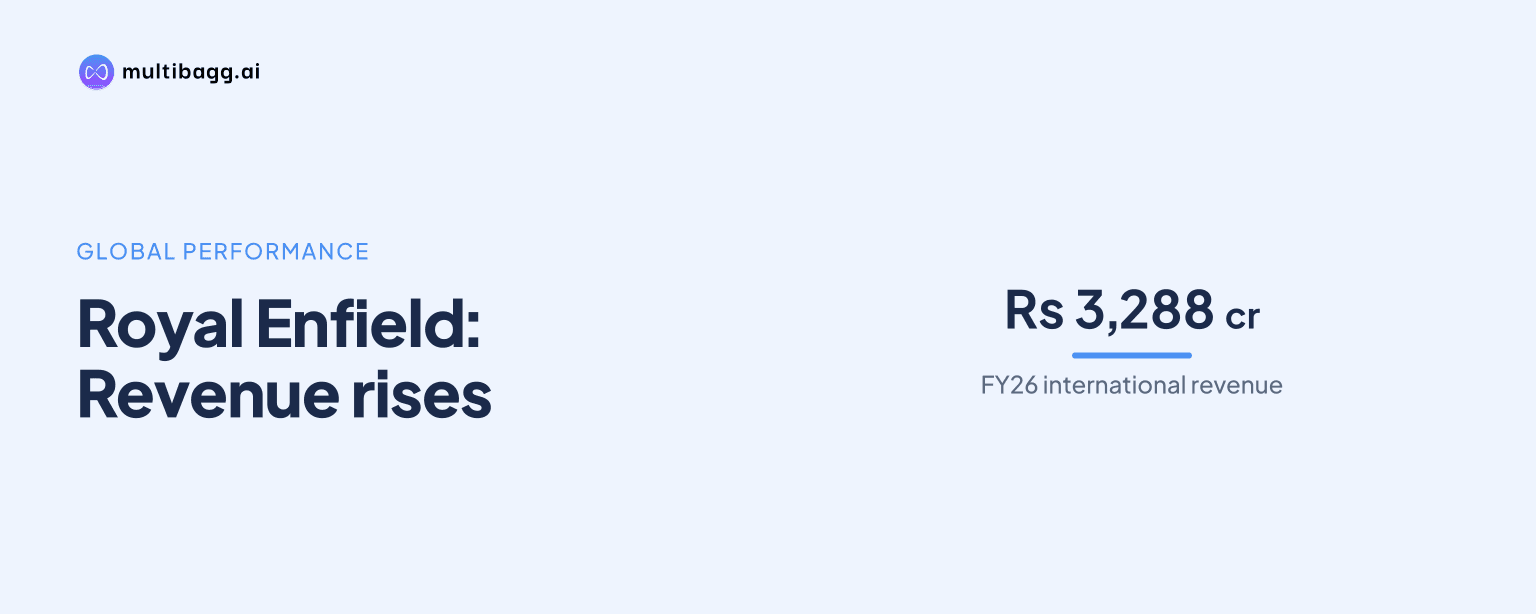
Royal Enfield reported Rs 3,288 crore of international motorcycle revenue in FY26, while overseas volumes reached 120,634 units, up from Rs 2,546 crore and 100,136 units in FY25. Both figures were the highest in the revenue and volume series disclosed in the November 2026 investor presentation.
Know Eicher Motors inside out
Results, valuation, peers and who's buying, in one view.
How much international revenue did Royal Enfield report in FY26?
Royal Enfield reported Rs 3,288 crore of revenue from its international motorcycle business in FY26, an increase of Rs 742 crore from Rs 2,546 crore in FY25. FY26 also exceeded the previous high of Rs 2,085 crore reported in FY23.
International motorcycle revenue fell to Rs 1,861 crore in FY24 from Rs 2,085 crore in FY23, before increasing by Rs 685 crore in FY25 and Rs 742 crore in FY26. The absolute increase in FY26 was therefore Rs 57 crore larger than the increase recorded in FY25.
Royal Enfield labels the measure as revenue from international business and identifies it as international revenue from the motorcycle business. It is distinct from allied-business revenue, which includes spare parts, service, accessories and apparel and was Rs 3,351 crore in FY26; the presentation gives no country-level split of the Rs 3,288 crore motorcycle figure.
How did Royal Enfield’s overseas volumes change in FY26?
Royal Enfield’s international volumes rose to 120,634 units in FY26 from 100,136 units in FY25, an increase of 20,498 units. The FY26 total surpassed the previous peak of 100,136 units in FY25.
Volumes rose from 19,721 units in FY19 to 38,622 in FY20, then declined to 35,675 in FY21. They increased to 74,238 units in FY22 and 89,226 in FY23 before falling to 77,209 in FY24, meaning the FY25 and FY26 gains reversed the FY24 decline.
Revenue and volume both increased in FY26, with revenue rising by Rs 742 crore as volume increased by 20,498 units. Royal Enfield does not disclose average selling prices, currency effects, product-level shipment data or country contributions, so the presentation does not identify the drivers of revenue growth beyond higher total international volumes.
Got a follow-up? Ask IRIS
What market share does Royal Enfield have in global mid-size motorcycles?
Royal Enfield reported its highest disclosed regional middleweight-market share in Asia-Pacific, or APAC, at 9.7% in FY26. The reported share was 7.6% in Europe, the Middle East and Africa, or EMEA, and 6.6% in the Americas.
These percentages cover the middleweight segment in countries where Royal Enfield was present as of FY26, rather than all motorcycles across each geography. The presentation does not disclose the market sizes, country-level shares or unit volumes that underpin the 9.7%, 7.6% and 6.6% regional figures.
APAC’s 9.7% share was 3.1 percentage points above the Americas’ 6.6%, while EMEA’s 7.6% was 1.0 percentage point above the Americas. Royal Enfield also highlighted the Classic 650 125th Edition at Brasília Capital Moto Week 2026, the FT450 flat-tracker at Slide School Cup 2026 in Thailand, and custom builds at Art of Speed 2026 in Malaysia, without reporting sales from those activities.
Where does Royal Enfield operate internationally?
Royal Enfield reported five subsidiaries, seven completely knocked down, or CKD, operations, two technology centres and four manufacturing locations. CKD refers to motorcycle kits supplied for assembly, while the presentation uses “Dis” for distributor markets.
The map identifies subsidiaries in Canada, the United Kingdom, Thailand, Brazil and North America. It identifies technology centres in India and the United Kingdom, while the aggregate disclosure of four manufacturing locations does not give plant-level capacity, output or the location of every manufacturing site.
Royal Enfield identifies CKD operations in Bangladesh and Thailand and distributor-linked CKD entries in Nepal, Brazil, Colombia and Argentina. Its map also lists market presence in Vietnam, Cambodia, Japan, South Korea, Taiwan, Hong Kong, Malaysia, Singapore, Indonesia and New Zealand, as well as distributor coverage in Australia, Europe and EMEA, and Mexico; it does not disclose revenue or assembly volumes by market.
Conclusion
Royal Enfield’s FY26 international data show simultaneous expansion in revenue and volume after the FY24 declines in both measures. APAC had the largest disclosed middleweight share at 9.7%, ahead of EMEA at 7.6% and the Americas at 6.6%, while the operating model combined five subsidiaries, seven CKD operations, two technology centres and four manufacturing locations.
The November 2026 presentation discloses no international expansion target, market-level revenue breakdown or assembly-capacity plan. The next useful disclosure would be whether Royal Enfield quantifies the contribution of its seven CKD operations, five subsidiaries and 2026 product activities to international revenue and volume growth.