










Royal Enfield’s R&D network has 1,170-plus staff in FY26
Key highlights
- Royal Enfield has more than 1,170 product-development employees across Chennai and Bruntingthorpe as of FY 2026.
- Eicher Motors Limited reports approximately Rs 2,350 crore of cumulative R&D spending over the last five years.
- Royal Enfield lists annual motorcycle capacity of approximately 9 lakh units at Vallam and 6 lakh units at Oragadam.
- Royal Enfield’s allied-business revenue rose by Rs 601 crore to Rs 3,351 crore in FY26 from Rs 2,750 crore in FY25.
powered by IRIS
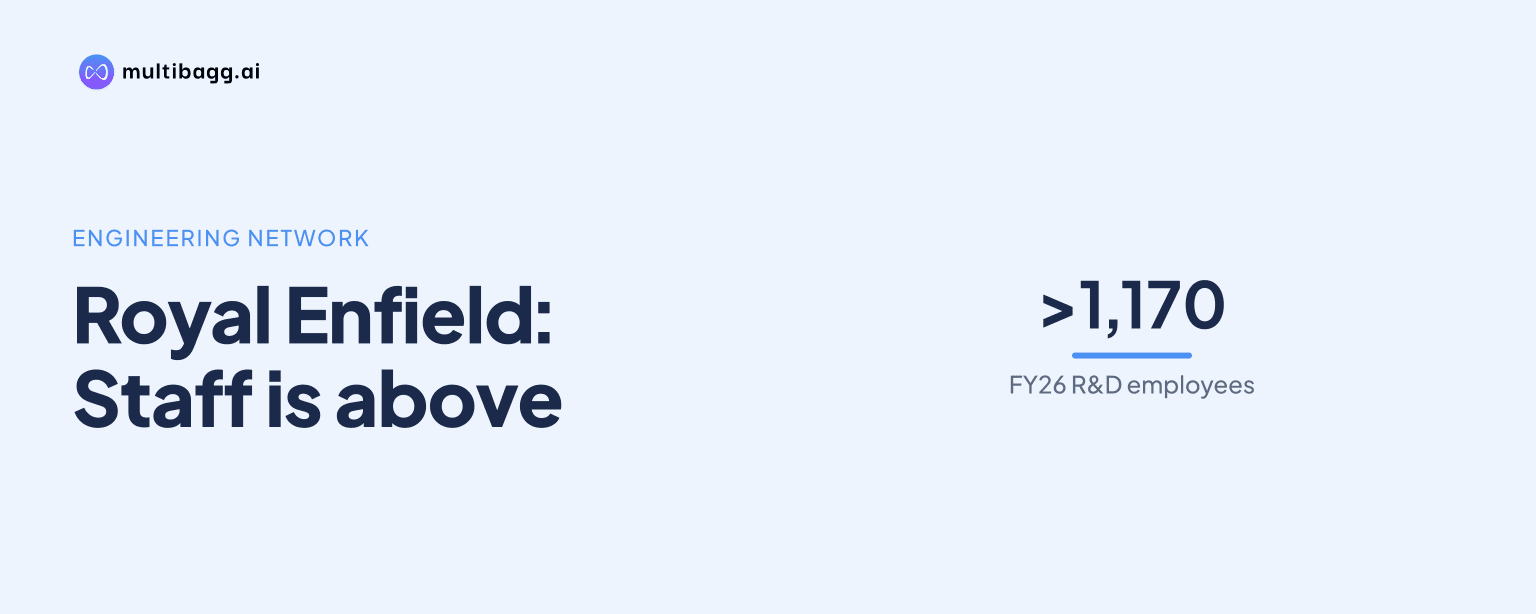
Royal Enfield has more than 1,170 product-development employees across its Chennai and Bruntingthorpe technology centres as of FY 2026, supported by approximately Rs 2,350 crore of cumulative research and development spending over five years by Eicher Motors Limited. Chennai accounts for 1,000-plus members, while the UK centre has more than 170 employees.
Know Eicher Motors inside out
Results, valuation, peers and who's buying, in one view.
How large is Royal Enfield’s product-development workforce?
Royal Enfield’s disclosed product-development workforce exceeds 1,170 people as of FY 2026, combining 1,000-plus members at Chennai with more than 170 employees at Bruntingthorpe in the UK. The figures cover engineers, designers and other employees involved in motorcycle design and development.
Chennai is the larger disclosed centre by headcount, with at least 1,000 members compared with more than 170 at Bruntingthorpe. Royal Enfield says the Chennai centre brings engineering and design teams together under one roof, while the UK team has international experience spanning motorcycle development from concept to pre-production.
The two centres are operationally linked rather than described as independent development sites. Royal Enfield says Chennai is fully integrated with the UK Technology Centre, while the India facility uses a New Product Introduction, or NPI, framework intended to develop products in an optimal timeframe.
The disclosed space and workforce figures show Chennai as the larger site on both measures. Bruntingthorpe nevertheless has a defined product-development role for midsize motorcycles, including work from concept through pre-production.
What equipment supports Royal Enfield’s development work?
Royal Enfield’s Chennai technology centre houses engine, chassis and component test equipment within its 1,97,072 sq. ft. facility. The site combines these testing resources with engineering and design teams, and operates under the NPI framework disclosed in the FY 2026 presentation.
Royal Enfield’s Bruntingthorpe centre occupies approximately 36,000 sq. ft. and is a hub for research and product development for midsize motorcycles. Its listed resources include an industrial design studio, testing and validation equipment, and workshop facilities.
The facilities have different stated technical emphases. Chennai specifically lists engine, chassis and component testing, whereas Bruntingthorpe lists design, validation and workshop capability for midsize motorcycle development from concept through pre-production.
The source does not disclose the number of development programmes, models or prototypes being handled at either centre. It also does not assign separate budgets, utilisation levels or annual output targets to Chennai’s 1,000-plus-person team or Bruntingthorpe’s 170-plus-person team.
How much has Eicher Motors Limited spent on R&D?
Eicher Motors Limited has spent approximately Rs 2,350 crore cumulatively on research and development during the last five years, according to the FY 2026 presentation. The disclosure appears alongside Royal Enfield’s two technology centres, but it is attributed to Eicher Motors Limited.
The presentation does not provide annual R&D expenditure for any of the five years. It also does not split the approximately Rs 2,350 crore between Chennai and Bruntingthorpe, or distinguish expenditure on engineering, testing, design studios, workshops or validation equipment.
This means the five-year figure establishes the cumulative scale of reported R&D spending but cannot be used to calculate a reported yearly run rate. The source also gives no future R&D spending target, planned increase or stated allocation for the NPI framework.
The reported R&D disclosure sits alongside Royal Enfield’s product-development infrastructure rather than a specific model launch. For example, the presentation identifies the UK centre’s midsize-motorcycle remit and Chennai’s engine, chassis and component testing, but does not connect the Rs 2,350 crore figure to a named motorcycle programme.
Got a follow-up? Ask IRIS
What motorcycle production capacity does Royal Enfield disclose?
Royal Enfield discloses annual capacity of approximately 9 lakh motorcycles at Vallam and 6 lakh motorcycles at Oragadam. Vallam therefore has approximately 3 lakh more motorcycles of annual capacity than Oragadam based on the capacities in the November 2026 presentation.
Cheyyar began chrome plating and adjunct operations in July 2026, and a brownfield expansion is underway. Royal Enfield does not disclose the expansion’s investment value, completion date, incremental capacity or output target.
The production disclosures distinguish motorcycle assembly capacity at Vallam and Oragadam from support activities at other sites. Thiruvottiyur is identified for custom operations, while Cheyyar’s stated July 2026 development concerns chrome plating and adjunct operations rather than a disclosed motorcycle-capacity figure.
Royal Enfield also reported allied-business revenue of Rs 3,351 crore in FY26, compared with Rs 2,750 crore in FY25, an increase of Rs 601 crore. Allied business includes spare parts, service, accessories and apparel, and is separate from the production capacities reported for Vallam and Oragadam.
Where does Royal Enfield have CKD assembly plants?
Royal Enfield lists completely knocked down, or CKD, assembly plants in six countries: Thailand, Brazil, Bangladesh, Nepal, Argentina and Colombia. The presentation names the six locations but provides no production capacity, investment or sales figures for individual CKD plants.
The CKD network is separate from the four India locations identified in the operations overview: Thiruvottiyur, Vallam, Oragadam and Cheyyar. The source does not specify which motorcycles are assembled in Thailand, Brazil, Bangladesh, Nepal, Argentina or Colombia.
Royal Enfield separately says it launched the Flying Flea C6 in five cities across Europe in 2026. The motorcycle is available in Flea Green, Storm Black and Parachute White, but the presentation does not state where it is manufactured or whether any of the six CKD sites assembles it.
The presentation therefore establishes a six-country CKD footprint but not its operating scale. It does not disclose volumes, capacity utilisation, export flows, local sourcing, model allocation or the relationship between CKD operations and the Flying Flea C6 launch.
Conclusion
Royal Enfield’s disclosed development structure combines more than 1,170 staff across Chennai and Bruntingthorpe, with facilities of 1,97,072 sq. ft. and approximately 36,000 sq. ft., respectively. Eicher Motors Limited’s approximately Rs 2,350 crore cumulative five-year R&D expenditure provides the reported financial context for engineering, design, testing, validation and pre-production activity across those sites.
The next disclosed operational development to watch is Cheyyar’s brownfield expansion after chrome plating and adjunct operations began in July 2026. Royal Enfield has not provided a completion date, investment amount or capacity addition, while the NPI framework remains its stated mechanism for progressing product development.