










Royal Enfield reaches about 84% India mid-size share in H1FY27
Key highlights
- Royal Enfield reported about 84% share of India’s mid-size motorcycle segment in H1FY27.
- Royal Enfield motorcycle volume rose to 1,107,000 units in FY26 from 903,000 in FY25.
- Royal Enfield’s share of motorcycles above 125 cubic centimetres rose from 15.5% in FY15 to 31.3% in H1FY27.
- Royal Enfield had 1,176 large-size stores and 937 studio stores in FY26.
powered by IRIS
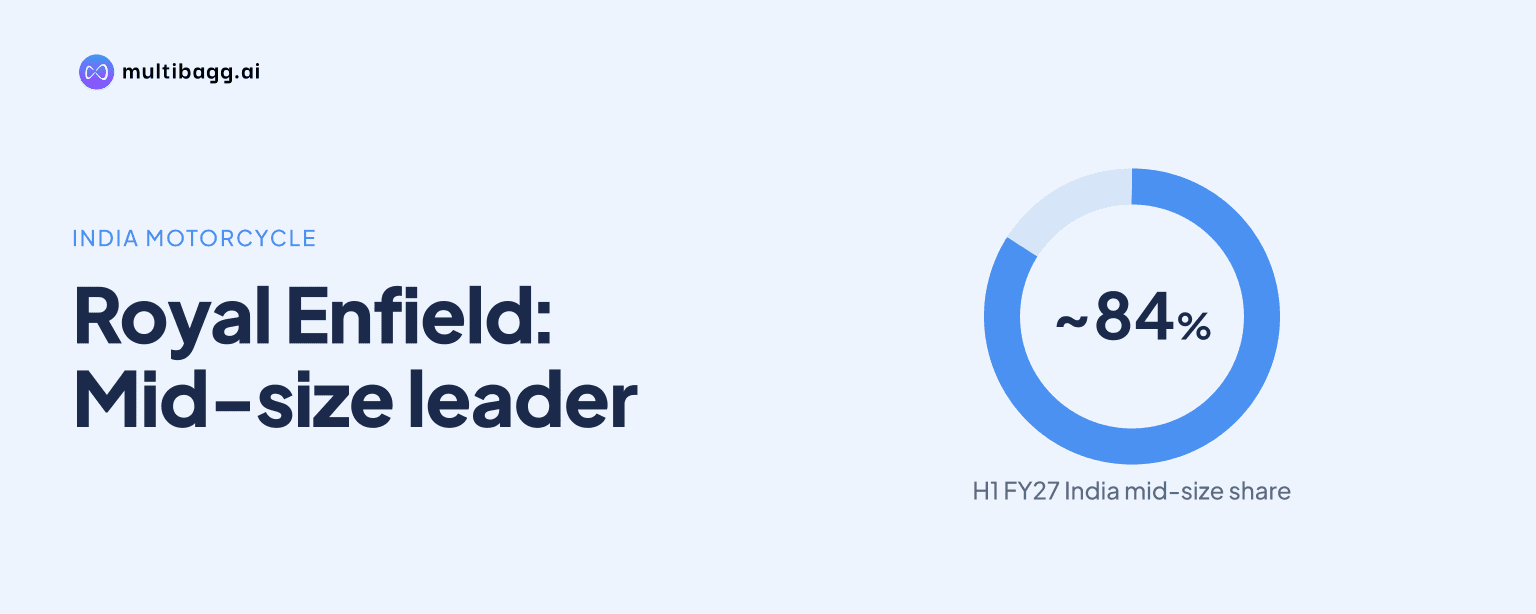
Royal Enfield held about 84% of India’s mid-size motorcycle segment in the first half of FY27 (H1FY27), following FY26 motorcycle volume of 1,107,000 units. That FY26 total was 204,000 units above FY25 volume of 903,000, while Royal Enfield reported 642,000 units in H1FY27.
Know Eicher Motors inside out
Results, valuation, peers and who's buying, in one view.
What is Royal Enfield's India mid-size share?
Royal Enfield’s India mid-size motorcycle share was about 84% in H1FY27, based on industry data cited in its November 2026 investor presentation. The presentation identifies the figure specifically as Royal Enfield’s share in the Indian mid-size segment, rather than its share of all motorcycles or of motorcycles above 125 cubic centimetres.
The H1FY27 share measure follows a rise in reported motorcycle volume to 1,107,000 units in FY26 from 903,000 in FY25 and 835,000 in FY24. The FY26 increase of 204,000 units was greater than the FY25 increase of 68,000 units over FY24, while H1FY27 volume of 642,000 units exceeded half of the preceding full-year total.
Royal Enfield does not disclose an FY27 full-year volume target or a full-year mid-size share target in the presentation. The about-84% reading is therefore a first-half market-share datapoint, and it should be viewed separately from the company’s reported FY26 annual volume.
How has Royal Enfield's motorcycle volume changed?
Royal Enfield’s motorcycle volume rose from 521,000 units in FY22 to 1,107,000 units in FY26, an increase of 586,000 units over four fiscal years. Before that recovery, volume had fallen from 802,000 units in FY19 to 574,000 in FY21 and 521,000 in FY22; Royal Enfield attributes the FY20, FY21 and FY22 results to the COVID-19 pandemic and supply-chain constraints.
The recovery was sequential from FY22 onward: volume increased by 214,000 units in FY23, 100,000 in FY24, 68,000 in FY25 and 204,000 in FY26. Royal Enfield’s product timeline records the Hunter 350 and Super Meteor 650 in FY23, followed by the Himalayan 450, Shotgun 650 and new Bullet 350 in FY24.
Royal Enfield listed the Guerrilla 450, Bear 650, Classic 650 and Goan Classic 350 among FY25 launches, then the Bullet Battalion Black, Bullet 650 and Scram 440 in FY26. H1FY27 included the Himalayan 440, while the current range shown in the presentation spans 350, 440, 450 and 650 cubic centimetre engine platforms and an electric L Platform rated at 3.91 kilowatt-hours, 15.5 kilowatts and 60 newton-metres.
Got a follow-up? Ask IRIS
How has Royal Enfield's wider India motorcycle share changed?
Royal Enfield’s displayed share of motorcycles above 125 cubic centimetres increased to 31.3% in H1FY27 from 15.5% in FY15. Its displayed share of all motorcycles increased to 9.2% from 3.0% over the same FY15-to-H1FY27 comparison, showing that the presentation tracks gains under two wider market definitions.
The 31.3% measure concerns motorcycles above 125 cubic centimetres, whereas the 9.2% measure concerns all motorcycles and the about-84% measure concerns the mid-size segment. These definitions are not interchangeable: the presentation separately labels each one, without providing the underlying market volumes for the three segment definitions.
The rise in the above-125-cubic-centimetre share was 15.8 percentage points between FY15 and H1FY27, compared with a 6.2-percentage-point rise in the all-motorcycle share. Across the company’s reported volume history, Royal Enfield increased from 589,000 units in FY16 to 1,107,000 units in FY26, with the 650 cubic centimetre Twins introduced in FY19 after the 411 Himalayan OG in FY17.
How has Royal Enfield expanded its dealership network?
Royal Enfield had 1,176 large-size stores in FY26, up from 1,132 in FY25 and 825 in FY18. The FY26 count was 351 stores above FY18, and the year-on-year increase was 44 stores from FY25.
Royal Enfield operated 937 studio stores in FY26, 36 more than the 901 reported in FY25. The studio format had previously reached 1,031 stores in FY21 and 1,055 in FY22, then declined to 969 in FY23 and 901 in FY24 before the FY26 increase.
Royal Enfield also states that it ranked first in the 2026 dealer satisfaction survey cited in the presentation for the second year in a row. The presentation places the FY26 network of 1,176 large-size stores and 937 studio stores before the H1FY27 mid-size share reading, but it does not quantify sales by store format or attribute the share result to a specific network action.
Conclusion
Royal Enfield’s reported domestic position combines about 84% share in India’s mid-size motorcycle segment in H1FY27 with FY26 volume of 1,107,000 units, up 204,000 from FY25. Its wider displayed market shares also increased from FY15 to H1FY27, reaching 31.3% for motorcycles above 125 cubic centimetres and 9.2% for all motorcycles, while the large-size store network reached 1,176 locations in FY26.
The next disclosed result to watch is FY27 completion, because the presentation gives H1FY27 volume of 642,000 units but no annual volume or market-share target. Investors can also monitor whether the Himalayan 440, added in H1FY27, and the FY26 Bullet 650 and Scram 440 coincide with further changes in volumes, segment share and the 937-store studio network.