










EID Parry targets FY28 consumer break-even after bulk exit
Key highlights
- EID Parry targets FY28 break-even for its consumer-products business.
- Consumer-products turnover fell to Rs 120 crore in Q2 FY27 from Rs 165 crore a year earlier.
- Value-added-product saliency increased to 28% in Q2 FY27 from 16%.
- EID Parry plans jaggery launches towards the end of Q3 and wider general-trade distribution.
powered by IRIS
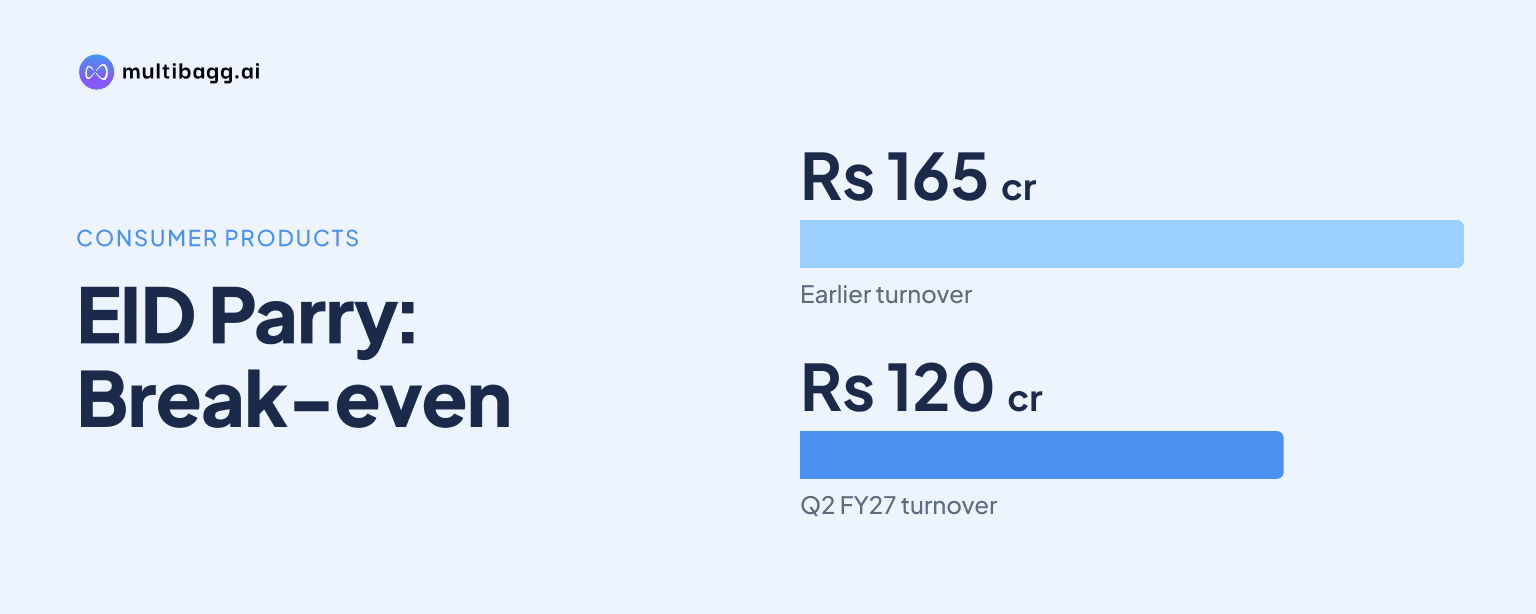
E.I.D.- Parry (India) Limited is targeting FY28 break-even in consumer products after Q2 FY27 turnover fell to Rs 120 crore from Rs 165 crore, while value-added-product saliency rose to 28% from 16%. Management said the reset removes low-margin bulk categories and redirects spending towards distribution, brands and product development.
Know EID Parry (India) inside out
Results, valuation, peers and who's buying, in one view.
Why is EID Parry targeting FY28 consumer break-even?
EID Parry is targeting FY28 break-even because it is reshaping the consumer-products portfolio around products and channels with higher contribution margins. Management said the business was two quarters into this recalibration in Q2 FY27 and that Contribution Margin 1, or CM1, had increased significantly, although it did not disclose the margin percentage or the segment loss.
The plan requires operating expenditure before the stated FY28 target. Management said the business does not require capital expenditure, but needs spending on advertising and sales promotion, brand building, employee capabilities and new-product development. It also said proceeds from asset monetisation are likely to support the consumer-products group’s fast-moving consumer goods, or FMCG, operations.
FY28 is management’s target, not a reported profitability outcome. Management repeated the timeframe when asked later in the Q2 FY27 call, but did not disclose a quarterly profit and loss figure, cash burn, marketing budget or revenue threshold for break-even. The available evidence therefore shows the direction of the turnaround, rather than measured progress towards profitability.
Why did EID Parry consumer turnover fall in Q2 FY27?
EID Parry’s consumer-products turnover fell because it reduced sales of bulk dal and white sugar, categories management described as low margin. Turnover was Rs 120 crore in Q2 FY27, compared with Rs 165 crore in the corresponding prior-year quarter, as the company also removed parts of its earlier pulses and rice portfolio.
The Rs 45 crore decline was linked to deliberate portfolio pruning, rather than a quantified statement on consumer demand. Management said consumer margins were stronger quarter on quarter because of higher realisations and a focus on high-margin products. It did not provide comparable gross-margin or CM1 figures, so the amount of margin improvement cannot be calculated from the call.
EID Parry continues to sell white sugar, but said it has selected channels and pack sizes that provide a base level of margin. Management described this as different from selling bulk white sugar through channels and pack formats that did not provide sufficient margins. The same approach applies to retained pulses products after the withdrawal from bulk categories.
How is EID Parry building a higher-value product mix?
EID Parry lifted value-added-product saliency by 12 percentage points to 28% in Q2 FY27 by reducing bulk sales and prioritising brown sugar, jaggery and newer launches. Management said these value-added products carry significantly higher gross margins, while the exited bulk pulses and bulk white-sugar lines did not fit the intended long-term model.
The mix change came with a clear trade-off in Q2 FY27: turnover decreased to Rs 120 crore, while the share of value-added products increased from 16% to 28%. This comparison indicates that management accepted lower reported sales in the quarter in pursuit of a larger higher-value component. The transcript does not establish whether the 28% share can be maintained as distribution expands.
Jaggery is part of the next product plan. Management said it was preparing a few launches towards the end of Q3, particularly in jaggery, and expected them to add scale. It did not disclose product names, stock-keeping units, prices, launch locations or expected sales, so their financial contribution remains unspecified.
Got a follow-up? Ask IRIS
What will drive EID Parry’s consumer-products growth?
EID Parry said expansion in distribution, jaggery launches and a broader product line are expected to drive consumer-products growth. General-trade distribution is increasing, management said, while organised-trade coverage is already established in southern India. The company is considering how to take distribution and its portfolio into additional segments.
Management identified distribution expansion as a key driver even in the current year, alongside the proposed end-of-Q3 jaggery launches. For the following year, it said a wider product line would be needed. The call did not disclose the number of outlets, distributors, cities or states served, nor did it quantify the consumer business’s organised-trade revenue.
EID Parry’s nutraceuticals operations are reported separately from consumer products. In Q2 FY27, nutraceutical turnover from Indian operations was Rs 10.26 crore, against Rs 7.60 crore a year earlier, while consolidated turnover was Rs 70 crore versus Rs 61 crore. Management cited growth in pet joint health and derm products, but said there were no capital-allocation plans for nutraceuticals.
What could affect EID Parry’s FY28 break-even plan?
EID Parry’s FY28 outcome will depend on whether higher-margin sales can replace the turnover removed from bulk categories while covering higher operating expenditure. Management said the consumer business needs investment in advertising and sales promotion, personnel and product development, making both the gross-margin mix and the level of spending relevant to the target.
White sugar remains relevant because it is still part of the packaged consumer portfolio. In the separate sugar segment, EID Parry’s Q2 FY27 realisation was Rs 45.11 per kg, up from Rs 40.67 per kg a year earlier, and sugar revenue rose to Rs 486 crore from Rs 368 crore. These figures do not measure consumer-product profitability, but show the company retains exposure to the underlying sugar category.
Management has not set quarterly break-even milestones or disclosed consumer EBITDA, or earnings before interest, tax, depreciation and amortisation. Its stated route is instead operational: maintain higher-value products, improve distribution, launch jaggery products and spend on brand and product development. The FY28 timeline should therefore be assessed against disclosures on mix, sales growth and operating expenditure.
Conclusion
EID Parry has accepted lower consumer-products turnover to alter the economics of the business. The Q2 FY27 comparison of Rs 120 crore turnover against Rs 165 crore a year earlier, alongside a rise in value-added-product saliency to 28% from 16%, captures management’s shift away from bulk pulses and white sugar towards packaged, higher-margin lines.
The next disclosed milestones are jaggery launches towards the end of Q3, continuing general-trade distribution expansion and a broader product range in the following year. Progress towards management’s FY28 break-even target will depend on whether these steps sustain the 28% value-added mix and generate sufficient contribution to absorb brand-building and product-development spending.