










EID Parry Expects India Sugar Imports in SY27 After Weak Monsoon
Key highlights
- EID Parry said India may need sugar imports in SY27 as management estimates a crop about 10% lower next year.
- Karnataka’s crushing season may be 10-15 days shorter after an 8-10 day late start, according to EID Parry.
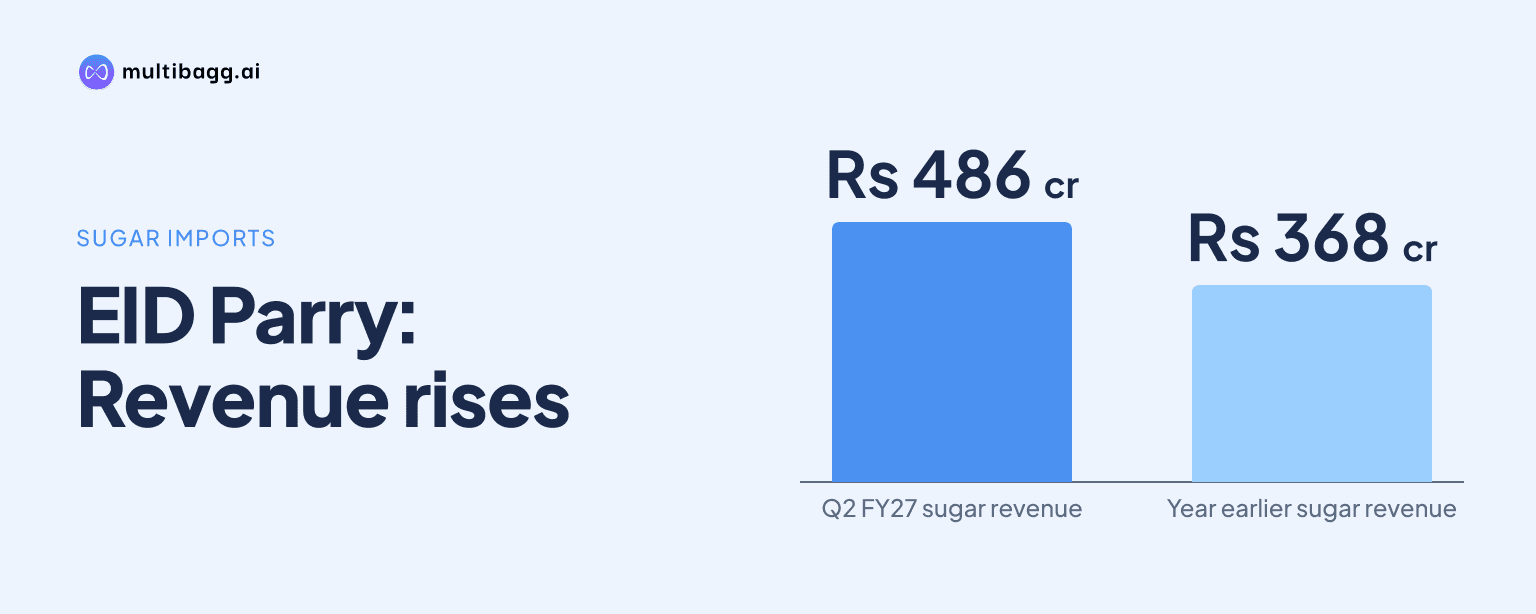
- EID Parry’s Q2 FY27 sugar revenue rose to Rs 486 crore from Rs 368 crore a year earlier.
- EID Parry sold 84,000 metric tonnes of sugar in Q2 FY27 at an average realization of Rs 45.11 per kg.
powered by IRIS
E.I.D.- Parry (India) Limited said on November 16, 2026, that India will quite likely need sugar imports in SY27 to bridge a supply gap, as it estimates a crop about 10% lower next year and expects Karnataka’s crushing season to be 10-15 days shorter after a subpar southwest monsoon.
Know EID Parry (India) inside out
Results, valuation, peers and who's buying, in one view.
Why does EID Parry expect India to import sugar in SY27?
EID Parry expects sugar imports could be needed in sugar year (SY) 2026-27 because lower cane yields, shorter crushing seasons and water availability could reduce domestic supply. Management identified Karnataka and Maharashtra as the principal areas affected by the subpar southwest monsoon and said lower dam water levels could also influence fresh cane planting for the following crop.
The company did not provide an expected import quantity or a nationwide SY27 production forecast. Its view marks a change from the SY25-26 balance presented on the November 16 call, when gross sugar production was 31 million metric tonnes (MMT), ethanol diversion was 3.1 MMT, domestic consumption was 28.5 MMT and exports were 0.8 MMT, leaving closing stock of 3.7 MMT.
Management said the prospective need for imports reflects the outlook for the SY27 crop, rather than a revision to the reported SY25-26 position. It also said global sugar supply was expected to move from a surplus of about 1.1 MMT in 2025-26 to a deficit of about 0.2 MMT in 2026-27, with production of about 180 MMT against consumption of about 180.4 MMT.
How much could Karnataka’s sugar season shrink?
EID Parry said Karnataka had started its season about 8-10 days late and could have a crushing season 10-15 days shorter. Ashiq J. A. H., chief operating officer for sugar and biofuel, attributed the expected reduction in industry crushing volumes to weather, water availability and cane yield, rather than to current-season sowing.
Fresh planting could still affect the subsequent crop. Management estimated an 8%-10% possible downside in sowing, depending on water levels in dams, and said its current estimate was for a crop about 10% lower next year. It cautioned that it was too early to comment on the countrywide crop because industry data were still arriving and industry bodies had yet to publish their estimates.
Tamil Nadu has so far moved differently from Karnataka and Maharashtra. Management said Tamil Nadu cane volumes had trended 8%-10% higher this year, but added that higher sugar prices may support both regions while Tamil Nadu’s higher production cost could limit its contribution to EID Parry’s overall margin profile.
What changed in EID Parry’s sugar operations in Q2 FY27?
EID Parry’s sugar revenue rose to Rs 486 crore in Q2 FY27 from Rs 368 crore in the corresponding quarter a year earlier, driven by higher sales volume and realization. Sugar sales increased to 84,000 metric tonnes from 73,000 metric tonnes, while average realization increased to Rs 45.11 per kg from Rs 40.67 per kg.
Crushing rose to 4.03 lakh metric tonnes in 66 days from 3.66 lakh metric tonnes in 48 days in the prior-year quarter. Sugar production consequently increased to 32,000 metric tonnes from 27,000 metric tonnes, although recovery declined to 7.86% from 7.97% and cane landed cost increased to Rs 3,798 per metric tonne from Rs 3,620 per metric tonne.
EID Parry held 56,000 metric tonnes of closing sugar stock at a valuation of Rs 42.5 per kg at the end of Q2 FY27. Management said all fair and remunerative price (FRP) payments to cane farmers were made within the prescribed timeline, despite the quarter’s cane landed cost being Rs 178 per metric tonne higher year on year.
Got a follow-up? Ask IRIS
How are cane prices and government measures affecting the outlook?
EID Parry said the cane-price framework in Karnataka remains unresolved after farmer agitations in Karnataka and Maharashtra. Management said companies in parts of northern Karnataka appeared to be committing around Rs 3,800 per metric tonne for cane, compared with an average FRP range of Rs 3,300-Rs 3,400 per metric tonne in north Karnataka.
Management said a committee of experts had been formed to examine farmer demands. It said it hoped the process would result in a fair, formula-based and uniformly applicable framework binding on all stakeholders, but did not state when the committee would conclude or specify the final cane price EID Parry will pay.
In the wider domestic market, management said a subpar monsoon, lower inventories and seasonal sugar-price increases affected Q2 FY27. It said government interventions, including duty-free sugar imports, tighter dealer stock limits and more frequent quota allocations, improved availability and moderated ex-mill sugar prices by the end of the quarter; the call did not disclose the volume of imports or the revised national inventory level.
What could alter EID Parry’s sugar and ethanol mix?
EID Parry said ethanol production for the current year could be in the range of 14 crore litres to 15 crore litres. Management said some output could shift towards extra neutral alcohol (ENA), and it expects the government’s allocation approach and the position of grain-based ethanol to evolve over the next couple of quarters.
Distillery production fell to 307 lakh litres in Q2 FY27 from 392 lakh litres a year earlier, but alcohol sales increased to 440 lakh litres from 409 lakh litres. Of Q2 FY27 alcohol sales, ENA accounted for 212 lakh litres and ethanol for 234 lakh litres, while average realization declined to Rs 63.99 per litre from Rs 67.55 per litre.
Despite the lower realization, distillery revenue increased to Rs 305 crore from Rs 291 crore in the corresponding prior-year quarter. EID Parry’s co-generation business also generated 385 lakh units of power in Q2 FY27, up from 307 lakh units, while exports increased to 175 lakh units from 128 lakh units and revenue rose to Rs 17.67 crore from Rs 11.94 crore.
Conclusion
EID Parry’s November 16 assessment indicates that India’s sugar balance could shift from SY25-26 closing stock of 3.7 MMT to an import requirement in SY27 if lower yields and a shorter season reduce cane availability. For EID Parry, Q2 FY27 sugar revenue rose by Rs 118 crore year on year as higher sales and realizations offset a 0.11 percentage-point decline in sugar recovery and higher cane cost.
The next items to watch are Karnataka and Maharashtra water availability, fresh planting and industry crop estimates, which management said were still developing in November 2026. EID Parry also plans to provide a further outlook in Q3, while the expert committee’s cane-price discussions and the company’s 14 crore-litre to 15 crore-litre ethanol-production expectation remain relevant to the integrated sugar and biofuel business.