










EID Parry shifts sugar sales to 15–24-day contracts amid volatility
Key highlights
- EID Parry said nearly 96–97% of its long-term sugar contracts have been completed.
- EID Parry expects most future sugar contracts to run for 15 to 24 days.
- EID Parry said it will largely mirror spot sugar prices for now.
- EID Parry said it has no capex or inorganic plans in sugar and biofuel.
powered by IRIS
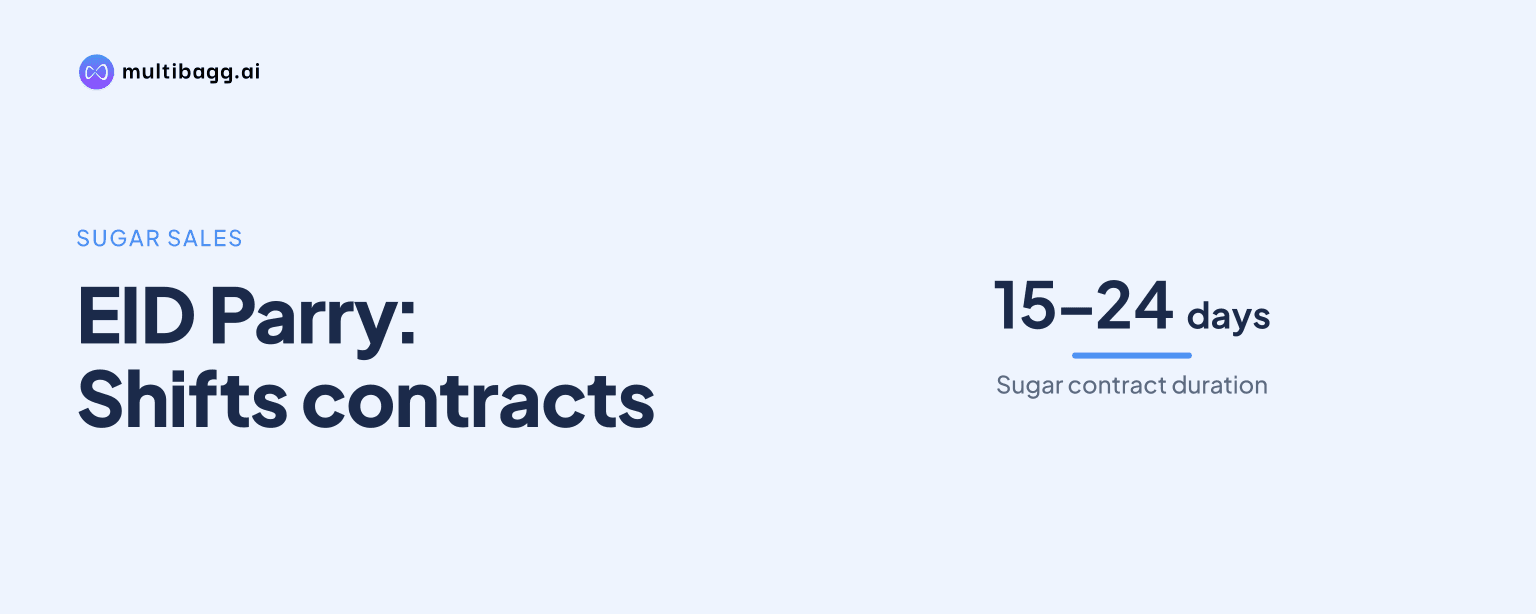
EID Parry said in its Q2 FY27 earnings call that most future sugar contracts may run for only 15 to 24 days as it largely mirrors spot prices, after completing nearly 96–97% of its long-term contracts amid continuing price volatility.
Know EID Parry (India) inside out
Results, valuation, peers and who's buying, in one view.
Why is EID Parry shortening its sugar contracts?
EID Parry is shortening contract durations because management said price volatility has led it to avoid longer-term sugar commitments over the last six months. Ashiq J. A. H. said the company expects volatility to continue in the sugar segment, so it will remain cautious about long-term contracts rather than make extended pricing commitments.
The 15-to-24-day range is management’s stated upper limit for most contracts going forward, including contracts with prime customers. This means EID Parry intends to reassess customer pricing at intervals measured in weeks rather than rely on the longer-term arrangements it said are almost fully completed.
Management tied the change to the pricing environment, rather than to a disclosed shift in customer mix, sales volume or sugar production. The call did not provide historic contract lengths, a split between institutional and other customers, or the proportion of sugar sales that will be covered by each contract type.
How much of EID Parry’s long-term sugar book is complete?
EID Parry said it had completed almost 96–97% of all its long-term sugar contracts during the preceding six months. Only a small residual portion of that contract book therefore remained, while the company’s stated forward approach is to favour shorter agreements.
The comparison is between a substantially completed long-term contract position and prospective contracts lasting 15 to 24 days. EID Parry did not disclose whether the completed contracts had fixed prices, price-adjustment clauses or particular durations, and it did not quantify their revenue, tonnage or profit contribution.
An analyst asked how EID Parry’s institutional contracts are structured by timeframe and how often changes in underlying sugar spot prices are passed on. Management responded by describing shorter new or continuing commitments and its intention to largely mirror spot prices, rather than setting out a pass-through formula for existing contracts.
Will EID Parry link sugar sales to spot prices?
EID Parry said it will largely tend to mirror spot prices for now. This is management’s clearest indication that sugar sales pricing will be more closely aligned with prevailing market prices as contracts are renewed or entered into under the 15-to-24-day framework.
Mirroring spot prices does not mean EID Parry disclosed a daily repricing mechanism, a named market index or a guaranteed spread over spot sugar prices. Management used the qualifier “largely” and described the approach as current, supporting a spot-price-linked direction rather than a detailed permanent pricing policy.
The shorter duration gives EID Parry more frequent opportunities to reconsider prices than a longer-term commitment would. However, the Q2 FY27 call did not quantify any effect on sugar revenue, margin, working capital, customer retention or earnings sensitivity from the revised contract approach.
Got a follow-up? Ask IRIS
What does the new contract approach mean for EID Parry’s customer sales?
EID Parry said even prime customers may receive contracts lasting no more than 15 to 24 days, subject to management’s expectation that sugar prices will remain volatile. The company did not say it would stop serving institutional customers, but described a shorter contracting window for most agreements.
The transcript places the contract policy alongside a consumer-products portfolio strategy. Management said EID Parry still sells white sugar but has selected channels and pack sizes intended to provide a base level of margin, rather than sell bulk sugar through channels and pack sizes that did not provide that margin in the past.
Management also said brown sugar, jaggery and newer launches are significantly higher-gross-margin products, while it has removed much of its earlier pulses and rice portfolio. These consumer-product comments are separate from institutional contracting, but show that EID Parry is differentiating between bulk categories and value-added products in its sugar-related sales mix.
What has EID Parry said about its wider sugar strategy?
EID Parry said it has no capital-expenditure or inorganic plans in sugar and biofuel, with management focused instead on operating its existing large span of facilities effectively. That position was stated in response to a question about acquisitions after planned asset divestments.
Management said it continues to evaluate options that could buffer the cyclicality of the sugar business, but described potential outcomes as too early to discuss. It also said it is not immediately pursuing the option raised by an analyst and is not exploring anything in biochemicals.
One disclosed initiative is commercialising green grow media and improving the monetisation of bagasse. Management said work is continuing on that substrate opportunity and expects it to lead to stronger businesses over time, although it is separate from the 15-to-24-day sugar contract policy.
Conclusion
EID Parry is responding to sugar-price volatility by moving away from extended commitments after completing nearly 96–97% of its long-term contracts. Management’s plan is for most future contracts, including those with prime customers, to last only 15 to 24 days and to largely mirror spot prices. The operational shift is clear, but the call did not quantify its effect on sales, margins or customer volumes.
The next point to watch is whether management retains the 15-to-24-day limit if volatility persists, as it expects, or discloses a different pricing structure at the next quarterly interaction. EID Parry concluded its Q2 FY27 call by saying it looked forward to interacting again in the next quarter, while leaving unresolved the detailed spot-price pass-through mechanism and the financial impact of the revised contracts.