










Ellenbarrie’s margin fell to 36% despite gases margin gain
Key highlights
- Ellenbarrie’s consolidated EBITDA margin declined to about 36% in Q2 FY27 from about 39% in Q1 FY27.
- Ellenbarrie’s gases segment margin increased to about 39% in Q2 FY27 from about 38% in Q1 FY27.
- Ellenbarrie reported Rs 114.3 crore of Q2 FY27 revenue, up 28% year on year, and Rs 40.7 crore of EBITDA.
- Ellenbarrie said freight-cost pass-through to customers typically has a two-to-three-month lag.
powered by IRIS
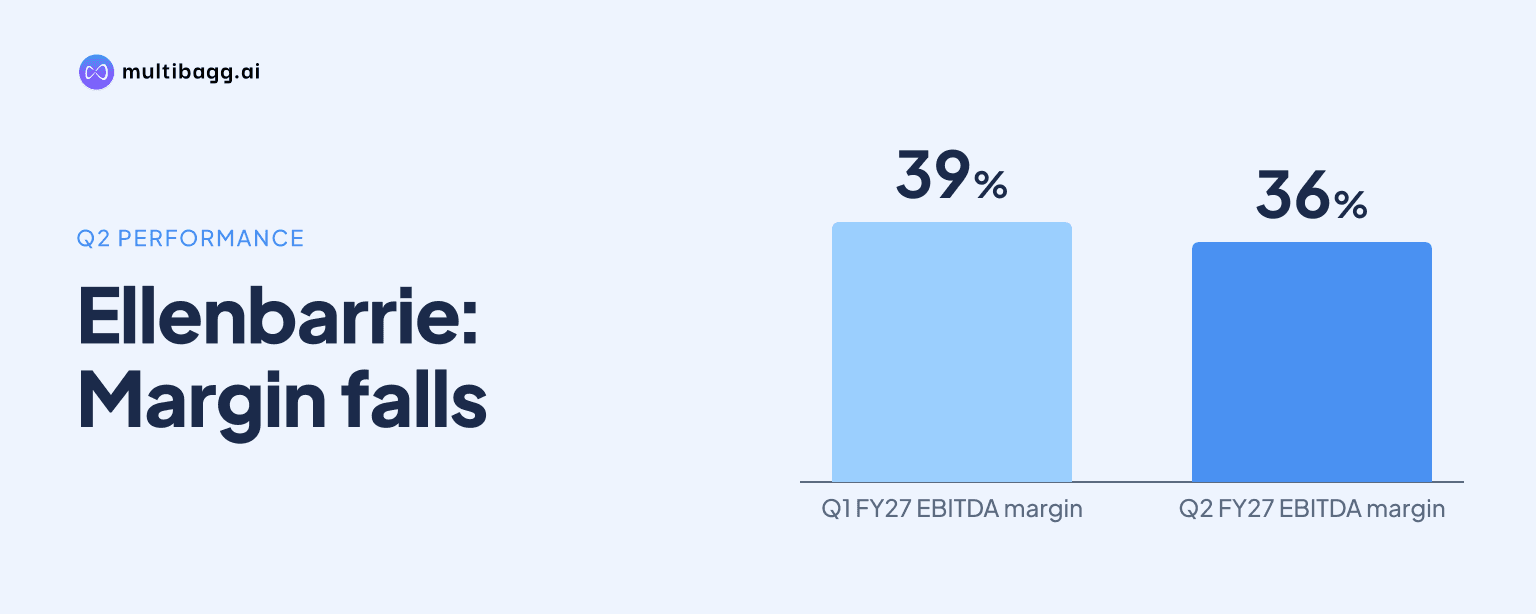
Ellenbarrie’s consolidated EBITDA, or earnings before interest, tax, depreciation and amortisation, margin declined to about 36% in Q2 FY27 from about 39% in Q1 FY27, as higher transportation costs and engineering-team expenses outweighed an increase in its gases segment margin to about 39%.
Know Ellenbarrie Industrial Gases inside out
Results, valuation, peers and who's buying, in one view.
What caused Ellenbarrie’s Q2 FY27 margin decline?
Ellenbarrie said higher transportation costs and employee expenses caused the consolidated margin decline in Q2 FY27. Revenue from operations rose to Rs 114.3 crore from Rs 98.7 crore in Q1 FY27 and Rs 89.2 crore in Q2 FY26, representing 16% sequential growth and 28% year-on-year growth, but the company-wide EBITDA margin nevertheless moved down by about 3 percentage points sequentially.
Transportation costs increased as a share of revenue because diesel prices rose and some deliveries covered longer distances, management said. These costs sit within other expenses, and their increase affected the consolidated margin even as total EBITDA increased to Rs 40.7 crore in Q2 from Rs 38.7 crore in Q1. Higher absolute EBITDA alongside a lower margin indicates that expenses increased faster than revenue during the quarter.
Power remained about 22% of revenue from sales of gases in both Q1 and Q2, according to management. That comparison indicates the disclosed quarterly movement was not attributed to a change in power’s share of gases revenue; management instead identified transportation and employee costs as the two main drivers of the consolidated margin movement.
Did Ellenbarrie’s gases business become more profitable?
Yes, Ellenbarrie’s gases segment margin rose to about 39% in Q2 FY27 from about 38% in Q1 FY27. Revenue from gases-related products and services grew about 27% year on year during the quarter, meaning the core business delivered higher sales and a modest sequential segment-margin improvement despite the softer consolidated result.
Management asked investors to distinguish the gases segment from the group margin because the business lines have different commercial models. The core gases operation includes recurring supply arrangements, while project engineering includes engineering and execution work. The Q2 comparison therefore shows that the reported 36% consolidated margin did not represent a deterioration in the disclosed gases segment margin.
The September 2026 commissioning of a 325-tonnes-per-day on-site plant in Durgapur, West Bengal, added a further source of gases revenue. The plant operates under a 15-year take-or-pay gas-supply agreement, began commercial operations in September, and lifted Ellenbarrie’s total on-site installed capacity above 1,000 tonnes per day. Management expects the benefit of a full operating quarter to begin in Q3 FY27.
When should freight-cost pass-through affect margins?
Ellenbarrie said it can pass higher transportation costs to most customers under long-term contracts, but the process has a two-to-three-month lag. Management expects the transportation-cost effect to normalise over the coming quarters, rather than immediately in the same period in which diesel-linked freight costs rise.
The lag matters because increased diesel prices first raise freight expense before contractual price adjustments reach customers. Management did not quantify the transportation-cost increase in rupees or provide a specific quarter for full recovery. Its stated expectation is instead based on long-term customer contracts and the normal timing of pass-throughs.
The commercial structure differs from the Durgapur on-site agreement, which is designed around a 15-year take-or-pay supply contract. For deliveries requiring longer-distance transport, Ellenbarrie’s Q2 outcome illustrates that a contractual pass-through mechanism may not prevent a temporary quarterly margin effect if cost inflation arrives before revised billing takes effect.
Got a follow-up? Ask IRIS
How did engineering-team hiring affect Q2 costs?
Ellenbarrie said employee expenses rose because it paid annual increment arrears relating to earlier quarters and expanded its project engineering team. The company quantified the project engineering division’s employee-expense effect at about Rs 1.1 crore in Q2 FY27, describing the team buildout as an investment in future execution capability.
The hiring follows a Rs 480 crore engineering, procurement and construction, or EPC, contract awarded by Bharat Heavy Electricals Limited near the end of September for a 1,200-tonnes-per-day cryogenic air separation unit in Odisha. The contract covers design, engineering, supply, erection, commissioning and handover, will be executed over eight quarters, and is expected to be commissioned in FY29. Revenue will be recognised according to actual project progress and applicable accounting requirements.
Management said project engineering contracts generally carry lower margins than the core gases business, estimating a high-single-digit to low-double-digit margin range for this type of work. It attributed that profile to the absence of long-term capital deployment, with working capital rather than long-term asset investment required. Ellenbarrie said it already reports gases and project engineering as separate segments.
What does argon indicate about Ellenbarrie’s product mix?
Management said argon is a high-margin product for Ellenbarrie and that its long-term demand trend remains intact because demand is increasing faster than supply. It declined to disclose quarterly realised argon prices, but said prices had remained healthy and around average realisations in the recent past.
Ellenbarrie also produces ultra-high-purity oxygen and argon, which management described as distinct from commercial oxygen or commercial argon. These products require additional quality analysis and certification, and management said those additional requirements support much higher prices. The company makes ultra-high-purity oxygen using a hydrogen electrolyser at its earlier Uluberia plant near Kolkata, while ultra-high-purity argon is made at most of its plants.
The electrolyser represents a very small part of total turnover, total cost and total revenue, according to management. The disclosure supports a distinction between higher-realisation specialist gases and Ellenbarrie’s broader commercial gas portfolio, but the company did not provide sales, margin or volume contribution for ultra-high-purity gases or argon in Q2 FY27.
Conclusion
Ellenbarrie’s Q2 FY27 margin change was principally a consolidated-cost issue rather than a disclosed weakening in the gases operation. Revenue rose to Rs 114.3 crore and EBITDA rose to Rs 40.7 crore sequentially, while the gases segment margin increased to about 39%; however, diesel-linked transport expense, longer-haul deliveries, arrears and engineering-team expansion reduced the company-wide margin to about 36%.
The next indicators are whether the two-to-three-month freight pass-through cycle reduces the transport-cost effect and whether the Durgapur plant contributes a full quarter of revenue in Q3 FY27. Management also plans to advance initial engineering for the BHEL project, while the planned north and central India merchant plants are expected to begin contributing revenue in the second half of the next financial year after a typical six-to-eight-quarter ramp-up period.