










Ellenbarrie shifts merchant plant revenue to H2 FY28
Key highlights
- Ellenbarrie expects both delayed merchant plants to contribute revenue in H2 FY28 instead of the earlier H2 FY27 reference.
- Management said land allotment and statutory approvals caused the delay in the two merchant projects.
- Ellenbarrie assumes a merchant plant requires 6 to 8 quarters to ramp up after it comes live.
- Uluberia 2 spare capacity and a new on-site plant are expected to support approximately 20% annualised revenue growth before H2 FY28.
powered by IRIS
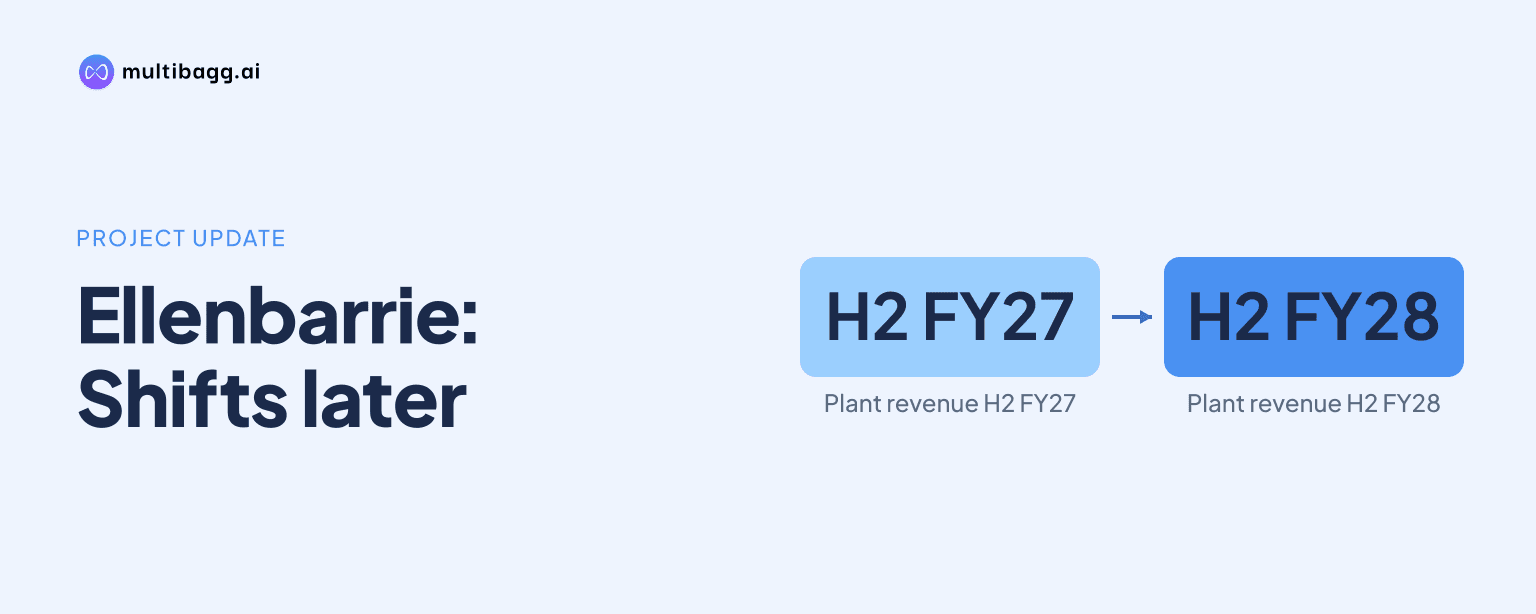
Ellenbarrie Industrial Gases Limited expects its north and central India merchant plants to contribute revenue in H2 FY28, after a prior H2 FY27 expectation was delayed by land allotment and statutory approvals. Ellenbarrie said both plants should come live around the middle of FY28, but merchant plants generally require six to eight quarters to ramp up.
Know Ellenbarrie Industrial Gases inside out
Results, valuation, peers and who's buying, in one view.
Why did Ellenbarrie delay its two merchant plants?
Ellenbarrie said land allotment by the respective state governments and statutory approvals were the main reasons its two merchant plants moved out of the earlier H2 FY27 timetable. Management told investors that both facilities are now expected to begin contributing revenue in H2 FY28, representing a roughly one-year shift in the anticipated revenue start.
Management said a delay of one or two quarters can be normal for a project of this size, while noting that government processes do not necessarily progress at the speed of industrial planning. The explanation concerned external land and approval processes, rather than equipment problems, a change in the plants' intended capacity or a disclosed reduction in expected demand.
Ellenbarrie did not disclose project-specific construction progress, the status of individual land allotments, or the remaining approval steps for either location. It also did not provide separate commissioning dates within FY28, meaning the disclosed timetable is for both plants to come live around the middle of FY28 and for revenue to begin in H2 FY28.
When will Ellenbarrie’s delayed plants earn revenue?
Ellenbarrie expects both merchant plants to come live around the middle of FY28 and to start contributing revenue in H2 FY28. Management made the distinction after an analyst referred to a previous H1 FY28 operating expectation: the facilities may start around mid-year, but revenue contribution is expected in the financial year's second half.
Ellenbarrie said it typically assumes six to eight quarters for a merchant plant to ramp up. Therefore, the H2 FY28 revenue contribution indicates the start of commercial activity, not full utilisation of the new assets. The company did not provide a revenue estimate for either plant's first half-year of operation.
Management also declined to identify whether peak utilisation would be reached in FY30 or later. It said the pace will depend on market conditions and on the timing of new industries announced in the relevant regions, because customers' own projects may be completed on time or delayed.
The two facilities are associated with the Rs 450 crore capex programme discussed for the next two merchant plants. Ellenbarrie confirmed that the capex reference related to the planned plants, but did not disclose how the Rs 450 crore is divided between the north and central India locations or how much had been spent at the time of the call.
What supports Ellenbarrie’s growth before H2 FY28?
Ellenbarrie expects spare capacity at Uluberia 2 and incremental revenue from a new on-site plant to support growth until the delayed merchant plants begin contributing in H2 FY28. Management said these two units should drive approximately 20% annualised revenue growth during the intervening period.
Uluberia 2 was commissioned in Q4 of the preceding financial year and still has spare capacity available, according to management. That available capacity is important because it gives Ellenbarrie a source of additional merchant sales without waiting for the north and central India projects to be commissioned.
The new on-site plant has a different revenue model from a merchant facility. Management said it would generate a fixed amount each month and would not require a ramp-up for its core contracted supply, which is under a long-term take-or-pay arrangement. Some smaller quantity may be available for external sale as the customer increases production.
Ellenbarrie expects the on-site plant to add revenue in H2 FY27. Management said on-site revenue generally has a higher margin profile than bulk revenue, so the plant's contribution could affect the revenue mix before the two merchant plants begin their own six-to-eight-quarter ramp-up period.
Got a follow-up? Ask IRIS
How does the delay affect Ellenbarrie’s longer-term capacity plan?
Ellenbarrie said its current revenue run rate is about Rs 400 crore, while incremental revenue and the full-year utilisation effect from new plants could add about Rs 300 crore. Management referred to a potential movement from roughly Rs 450 crore to Rs 500 crore towards Rs 800 crore as the assets are utilised, but did not assign a financial year to the Rs 800 crore reference.
The H2 FY28 delay means part of the capacity addition within that longer-term revenue framework will arrive later than previously expected. However, management did not revise the Rs 800 crore reference during the call, nor did it state that the delayed projects' ultimate capacity or investment rationale had changed.
Management said it made the investment decision based on industries announced in the regions around the planned facilities. Those industries remain a demand consideration, but their implementation timing is uncertain, which means physical commissioning around mid-FY28 would not by itself establish how quickly the plants reach their intended utilisation.
The interim earnings mix will also include project engineering revenue, which management said carries lower margins than the core gases business because it mainly requires working capital rather than long-term capital. Ellenbarrie said the gases segment was near its long-term indicated margin of about 40%, at 39%, while argon's contribution had risen to around 14% to 16%.
What are the main execution issues for Ellenbarrie?
Ellenbarrie’s first execution issue is whether the outstanding land and statutory processes allow both facilities to come live around the middle of FY28. The second is commercial ramp-up, because management’s six-to-eight-quarter assumption means the facilities will require time after commissioning to build merchant volumes.
A further consideration is local customer development. Management said that new industries had announced plans in the areas served by the proposed plants, but also said it could not predict their loading pace because those customers might defer their own capital expenditure. This uncertainty was the reason management did not specify whether peak utilisation could be reached in FY30.
For the nearer term, Ellenbarrie’s stated plan relies on Uluberia 2 spare capacity and the new on-site plant to support approximately 20% annualised revenue growth. That differs from the delayed merchant-plant model: the on-site plant has take-or-pay contracted revenue, while merchant volumes depend on capacity utilisation and demand from a broader local industrial base.
Conclusion
Ellenbarrie has shifted expected revenue from its two north and central India merchant plants to H2 FY28 because land allotment and statutory approvals delayed the projects. The plants are expected to come live around the middle of FY28, but their contribution will build over a typical six-to-eight-quarter merchant-plant ramp-up rather than arrive at mature utilisation immediately.
The next milestones are the plants' mid-FY28 commissioning and the start of H2 FY28 revenue contribution. Management has not disclosed the remaining approval timetable, a plant-wise capex split within the Rs 450 crore programme, or the year of peak utilisation, leaving local industrial project timing and the pace of merchant-volume loading as the main matters to watch.