










EMERALD’s FY26 fixed assets more than doubled as debt rose
Key highlights
- EMERALD’s FY26 fixed assets rose to Rs 130.1601 crore from Rs 55.7285 crore in FY25.
- EMERALD’s long-term borrowings increased to Rs 57.6561 crore in FY26 from Rs 16.4043 crore in FY25.
- EMERALD’s reported debt-to-equity ratio rose to 1.18 times in FY26, while its current ratio improved to 1.38 times.
- EMERALD reported FY26 revenue from operations of Rs 218.1596 crore and profit after tax of Rs 10.3250 crore.
powered by IRIS
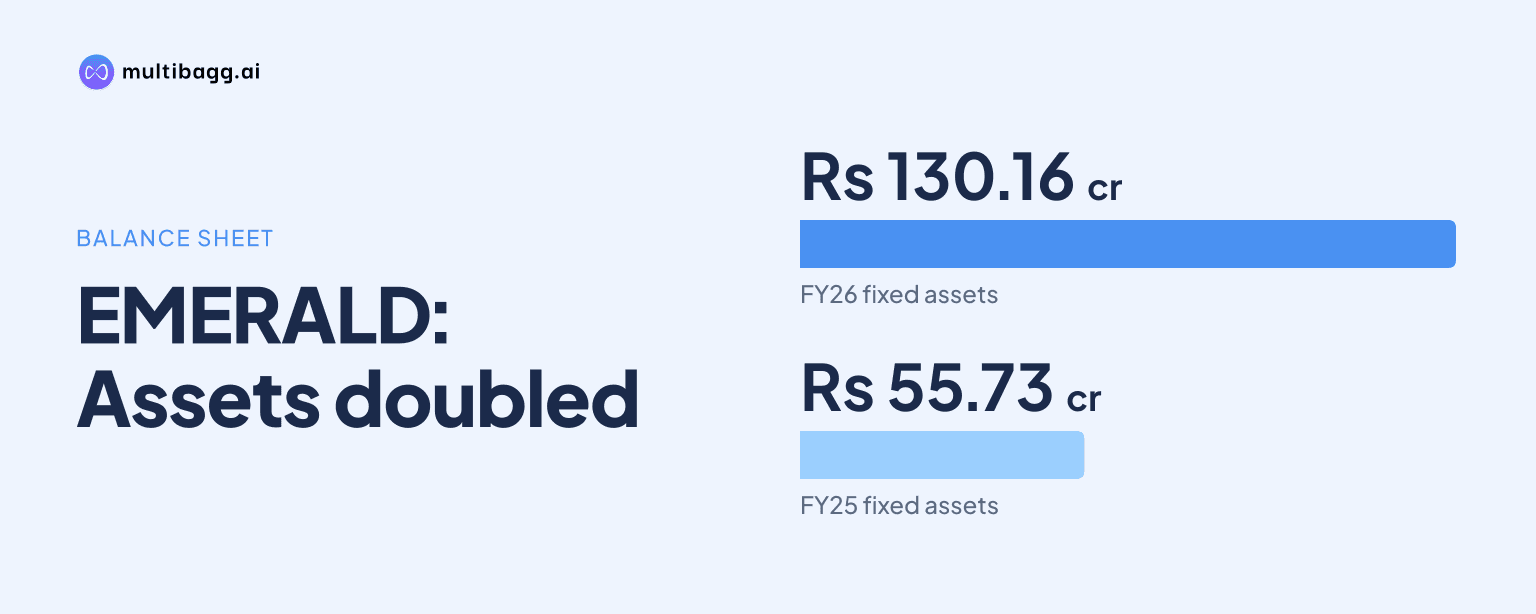
EMERALD’s fixed assets rose to Rs 130.1601 crore in FY26 from Rs 55.7285 crore in FY25, while long-term borrowings increased to Rs 57.6561 crore from Rs 16.4043 crore. The balance-sheet shift coincided with capital work in progress falling from Rs 30.4094 crore to a dash and the reported debt-to-equity ratio rising to 1.18 times.
Know Emerald Tyre Manufacturers inside out
Results, valuation, peers and who's buying, in one view.
How much did EMERALD’s fixed-asset base increase in FY26?
EMERALD’s fixed assets increased by Rs 74.4316 crore in FY26 to Rs 130.1601 crore, compared with Rs 55.7285 crore in FY25. The FY26 balance was also above the Rs 54.4116 crore reported in FY24, showing that the major increase occurred in the latest financial year.
Capital work in progress, or CWIP, was shown as a dash in FY26 after standing at Rs 30.4094 crore in FY25 and Rs 6.4206 crore in FY24. The simultaneous increase in fixed assets and removal of CWIP is consistent with assets moving from work in progress into fixed assets, but the presentation does not provide a project-level reconciliation or identify individual commissioned assets.
Total non-current assets rose by Rs 37.9513 crore to Rs 138.5859 crore in FY26 from Rs 100.6346 crore in FY25. As the increase in fixed assets exceeded that total movement, other non-current asset balances declined, led by long-term loans and advances, which fell to Rs 2.5489 crore from Rs 13.2467 crore.
Why did EMERALD’s long-term borrowings rise in FY26?
EMERALD’s long-term borrowings increased by Rs 41.2518 crore to Rs 57.6561 crore in FY26 from Rs 16.4043 crore in FY25. Total non-current liabilities increased to Rs 63.6510 crore from Rs 20.7905 crore over the same period.
The FY26 increase in fixed assets of Rs 74.4316 crore occurred alongside the rise in long-term borrowings, but the presentation does not state that a specific borrowing funded a specific asset or project. It does disclose a growth roadmap that includes a commissioned automated rubber mixing plant, expanded solid-tyre manufacturing capacity and new tyre-building machines.
Long-term provisions increased to Rs 35.29 lakh in FY26 from Rs 20.60 lakh in FY25, while deferred tax liabilities rose to Rs 4.3841 crore from Rs 2.9098 crore. Other financial liabilities were nearly unchanged at Rs 1.2580 crore, compared with Rs 1.2704 crore, leaving the borrowing increase as the largest movement among non-current liabilities.
How did EMERALD’s overall debt and capital structure change?
EMERALD’s reported debt-to-equity ratio increased to 1.18 times in FY26 from 0.81 times in FY25, while net worth rose to Rs 115.3736 crore from Rs 109.3149 crore. The FY26 ratio remained below the FY24 level of 1.61 times, when net worth was Rs 54.1496 crore.
Short-term borrowings also rose, reaching Rs 78.0348 crore in FY26 from Rs 71.8172 crore in FY25. Combining the reported long-term and short-term borrowing balances gives total borrowings of Rs 135.6909 crore in FY26, compared with Rs 88.2215 crore a year earlier; this calculation excludes other financial liabilities reported separately by EMERALD.
Share capital was unchanged at Rs 19.4765 crore in FY25 and FY26, while reserves and surplus rose to Rs 95.8971 crore from Rs 89.8384 crore. The Rs 6.0587 crore increase in net worth was smaller than the Rs 47.4694 crore year-on-year increase in combined reported long-term and short-term borrowings.
Got a follow-up? Ask IRIS
Did EMERALD’s liquidity improve despite higher borrowings?
EMERALD’s reported current ratio improved to 1.38 times in FY26 from 1.28 times in FY25, as current assets rose to Rs 147.4834 crore while current liabilities were nearly unchanged at Rs 107.0447 crore. The FY26 ratio was also above the FY24 level of 1.18 times.
Inventories increased to Rs 73.6372 crore in FY26 from Rs 66.7366 crore, while trade receivables rose to Rs 53.6946 crore from Rs 45.0915 crore. These two operating asset categories increased by a combined Rs 15.5037 crore, whereas cash and bank balances declined to Rs 10.5456 crore from Rs 15.5970 crore.
Current liabilities increased by Rs 4.18 lakh between FY25 and FY26. Trade payables declined to Rs 20.3105 crore from Rs 26.7880 crore, partly offsetting higher short-term borrowings and other current liabilities, which increased to Rs 4.0752 crore from Rs 3.4229 crore.
What were the earnings effects of EMERALD’s larger asset and debt base?
EMERALD reported FY26 revenue from operations of Rs 218.1596 crore, up from Rs 199.4680 crore in FY25, while EBITDA, or earnings before interest, tax, depreciation and amortisation, increased to Rs 34.4736 crore from Rs 30.2066 crore. Management says the capacity enhancement is expected to support revenue potential of about Rs 350 crore at full utilisation by FY28.
Below EBITDA, finance costs increased to Rs 13.7075 crore in FY26 from Rs 9.9969 crore in FY25, and depreciation and amortisation expense rose to Rs 6.9723 crore from Rs 5.8864 crore. Profit before tax declined to Rs 13.7938 crore from Rs 14.3233 crore, while profit after tax fell to Rs 10.3250 crore from Rs 10.4334 crore.
Return on equity declined to 8.95% in FY26 from 9.54% in FY25, and return on capital employed declined to 10.95% from 12.31%. Earnings per share fell to Rs 5.30 from Rs 6.52, indicating that higher operating earnings were accompanied by higher finance and depreciation charges in FY26.
Conclusion
EMERALD’s FY26 accounts show a material move toward a larger fixed-asset base and higher borrowing. Fixed assets reached Rs 130.1601 crore as CWIP moved from Rs 30.4094 crore to a dash, while long-term borrowings reached Rs 57.6561 crore and short-term borrowings rose to Rs 78.0348 crore. At the same time, the current ratio improved to 1.38 times, revenue increased to Rs 218.1596 crore and profit after tax was Rs 10.3250 crore.
The next disclosed milestone is management’s expectation that capacity enhancements can support revenue potential of about Rs 350 crore at full utilisation by FY28. Investors can watch whether the commissioned mixing plant, expanded solid-tyre capacity and tyre-building machines translate into that utilisation, and whether finance costs, depreciation, receivables and inventory move in line with the larger operating base.