










Emerald targets ₹350 crore revenue potential by FY28 capacity plan
Key highlights
- Emerald states revenue potential of about ₹350 crore at full utilisation by FY28.
- Emerald reported FY26 revenue from operations of ₹218.16 crore, versus ₹199.47 crore in FY25.
- Emerald’s FY26 fixed assets were ₹130.16 crore, compared with ₹55.73 crore in FY25.
- Emerald reported FY26 EBITDA of ₹34.47 crore and profit after tax of ₹10.33 crore.
powered by IRIS
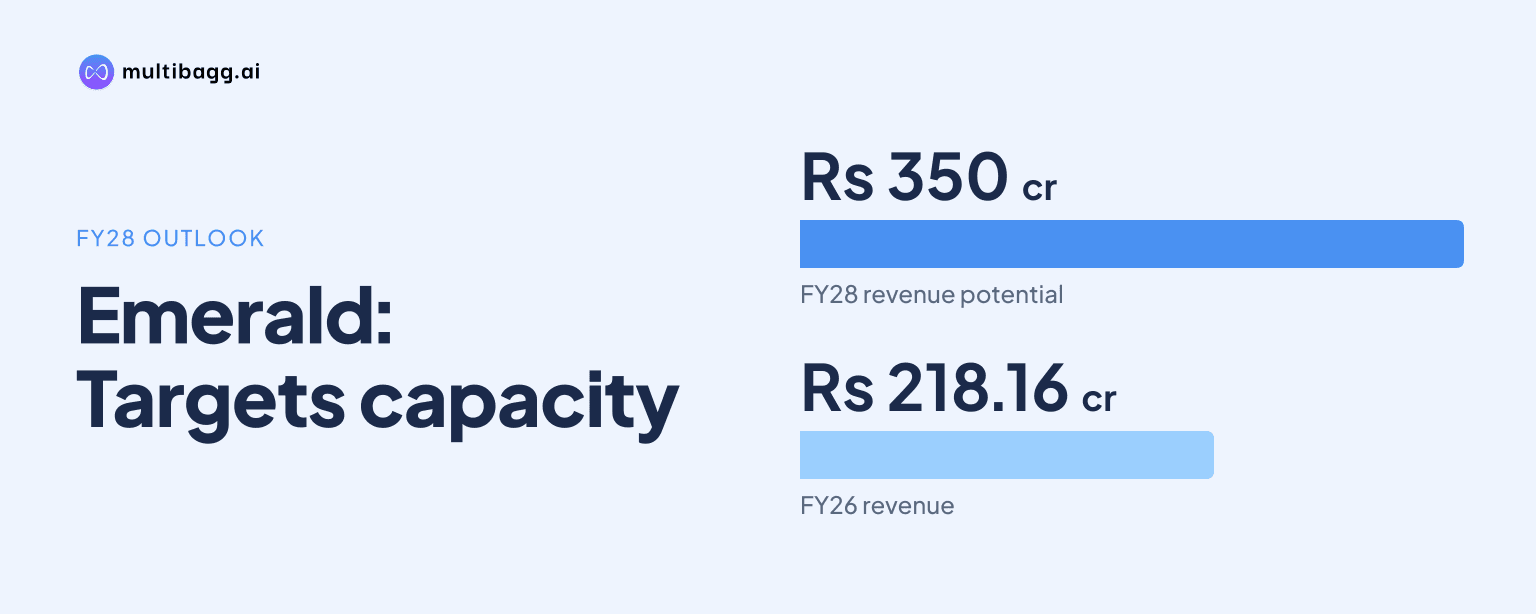
Emerald Tyre Manufacturers Limited says its commissioned automated rubber mixing plant, expanded solid tyre capacity and new tyre building machines can support revenue potential of about ₹350 crore at full utilisation by FY28. The roadmap also relies on AXIMO premium tyres, overseas market expansion and original equipment manufacturer programmes.
Know Emerald Tyre Manufacturers inside out
Results, valuation, peers and who's buying, in one view.
What is Emerald's FY28 revenue potential?
Emerald’s stated revenue potential is about ₹350 crore at full utilisation by FY28. The company presents this as capacity-linked potential, rather than reported revenue or a confirmed sales forecast, and does not disclose an annual revenue run-rate, order book or utilisation level for the intervening periods.
The stated potential exceeds Emerald’s FY26 revenue from operations of ₹218.16 crore. Revenue from operations was ₹199.47 crore in FY25 and ₹170.99 crore in FY24, so the FY28 capacity potential is above the latest reported annual revenue level.
FY26 revenue rose from FY25 and FY24, while EBITDA increased from ₹30.21 crore in FY25 to ₹34.47 crore in FY26. Profit after tax, however, declined from ₹10.43 crore in FY25 to ₹10.33 crore in FY26, according to Emerald’s profit and loss statement.
What operational additions support Emerald's FY28 plan?
Emerald identifies a commissioned automated rubber mixing plant, expanded solid tyre manufacturing capacity and new tyre building machines as the operational additions supporting its FY28 plan. The company says the new machines improve productivity and quality, while the combined capacity enhancement underpins the about ₹350 crore revenue potential at full utilisation.
The presentation does not disclose the rubber mixing plant’s volume, the number of tyre building machines, incremental tyre capacity or capital expenditure for the projects. Emerald’s FY26 balance sheet reported fixed assets of ₹130.16 crore, compared with ₹55.73 crore in FY25, while capital work in progress of ₹30.41 crore in FY25 was not reported as a balance-sheet line in FY26.
Emerald describes its production model as an integrated manufacturing facility with end-to-end production under one roof. The company says this structure supports quality control, flexibility, cost efficiency and response to market demand, but does not quantify savings or margin effects from the rubber mixing plant.
How does AXIMO fit Emerald's revenue roadmap?
AXIMO is Emerald’s premium solid tyre range, which management says is expected to support better realisations and profitability. The product strategy focuses on high-performance, application-engineered tyres, making product mix and customer adoption relevant to the FY28 revenue potential as well as manufacturing capacity.
Emerald reports strong customer acceptance for AXIMO in Europe and the Middle East. The presentation does not disclose AXIMO sales volume, pricing or revenue share, so it does not quantify how much of the about ₹350 crore potential could come from the premium range versus the broader solid tyre portfolio.
The AXIMO programme sits alongside Emerald’s stated ability to supply tyres in multiple sizes and applications, including customised products for original equipment manufacturers, or OEMs, and aftermarket customers. Emerald also cites ISO 9001:2015 and ISO 14001:2015 certifications, adherence to European Union REACH standards and in-house research and development, without providing a further product-launch timetable.
Got a follow-up? Ask IRIS
Which overseas markets is Emerald targeting?
Emerald is targeting expansion in Europe, Australia, Latin America, Saudi Arabia and Southern Africa to reduce dependence on a single geography. These markets add to its existing export presence in the United States, United Arab Emirates, Europe, United Kingdom and other markets.
Emerald says it has subsidiaries in Belgium and Dubai as part of its international footprint. The presentation does not provide country-level revenue, export revenue, market share or targets for the five expansion geographies, leaving their individual contribution to FY28 revenue unspecified.
Geographic diversification is presented as a mechanism to broaden the customer base rather than a quantified financial commitment. In FY26, Emerald reported other income of ₹6.99 crore, compared with ₹3.15 crore in FY25, but the document does not connect that increase to a named overseas market or export activity.
What is Emerald doing to win more OEM business?
Emerald says new OEM development programmes are under way and product approvals have been completed with multiple global customers. The company is engaging OEMs in India, Brazil, Italy and other international markets, while regional stocking initiatives remain under evaluation to support OEM growth.
The presentation does not identify the approved customers, products, expected volumes or contract values. Regional stocking is described as under evaluation rather than as a commissioned facility or announced investment, so its possible effect on FY28 capacity utilisation is not quantified.
The OEM programme complements Emerald’s customisation capability and expanded manufacturing base. At FY26, trade receivables were ₹53.69 crore versus ₹45.09 crore in FY25, while inventories rose to ₹73.64 crore from ₹66.74 crore; Emerald does not attribute either balance-sheet movement to OEM activity or the capacity expansion.
Conclusion
Emerald’s roadmap combines about ₹350 crore of capacity-based revenue potential by FY28 with premium products, wider geographic coverage and OEM development. The comparison with FY26 revenue from operations of ₹218.16 crore shows the scale of the stated capacity ambition, while the rubber mixing plant, expanded solid tyre capacity and tyre building machines are the disclosed operating mechanisms behind it.
The next matters to watch are full utilisation of the expanded facilities by FY28, commercial progress for AXIMO in Europe and the Middle East, and conversion of OEM approvals into disclosed orders or sales. Management has also said regional stocking initiatives are under evaluation, leaving their timing, cost and contribution unresolved in the presentation.