










Emerald Tyre Manufacturers Limited H1 EBITDA margin falls to 13.18%
Key highlights
- Emerald Tyres reported H1 FY27 total income of Rs 117.43 crore and an EBITDA margin of 13.18%.
- Management said input costs rose about 40% to 42%, while Emerald Tyres implemented an approximately 13% price increase.
- A Dubai shipment took nearly 50 days versus a normal 10 to 20 days, according to management.
- Management is trying to raise EBITDA margin to 15% and estimates FY27 revenue of about Rs 265 crore.
powered by IRIS
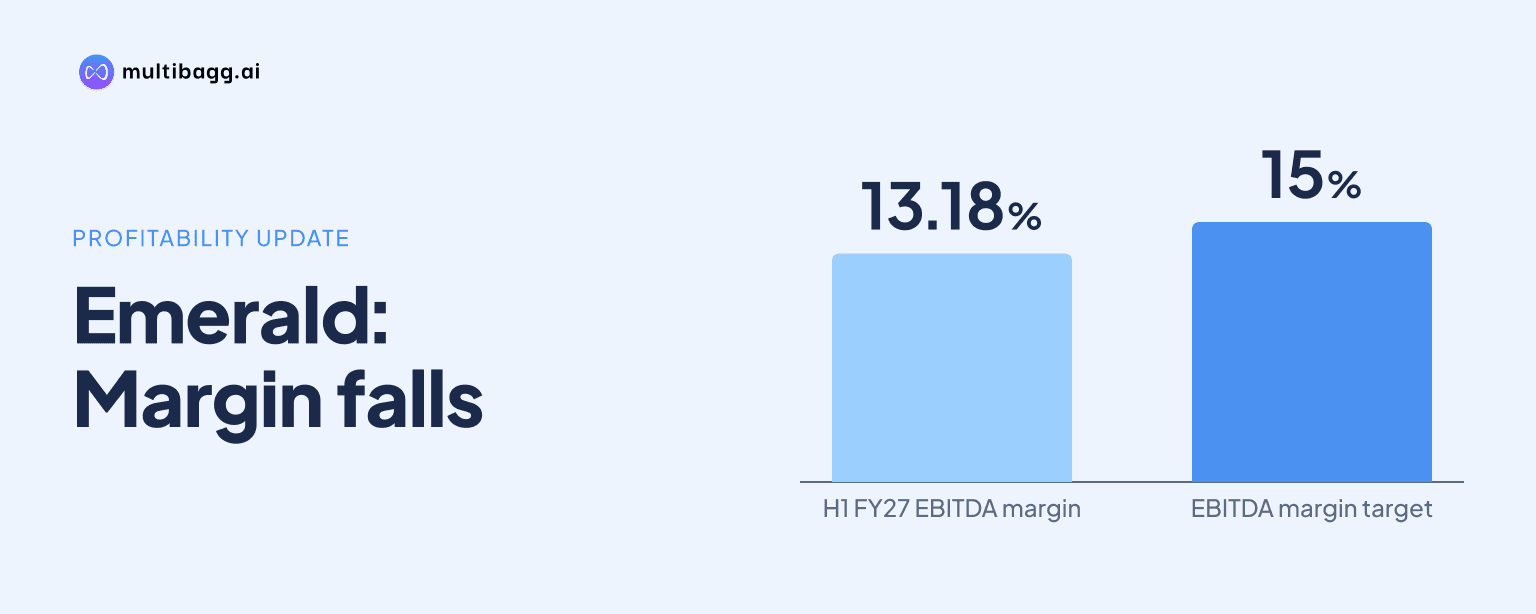
Emerald Tyres reported a 13.18% earnings before interest, tax, depreciation and amortisation (EBITDA) margin for H1 FY27, as input costs rose about 40% to 42% and shipping delays deferred customer deliveries, management said on November 17, 2026. The half year ended September 30, 2026, produced total income of Rs 117.43 crore and profit after tax of Rs 1.96 crore.
Know Emerald Tyre Manufacturers inside out
Results, valuation, peers and who's buying, in one view.
What caused Emerald Tyres’ H1 FY27 margin pressure?
Raw-material inflation and shipping disruption caused Emerald Tyres’ H1 FY27 margin pressure, with EBITDA declining by about 3% to 3.3%, according to management. It said crude oil had risen by almost 60% at its high point, while natural-rubber prices had increased by about 25% to 30%. Tyre inputs including carbon black, synthetic rubber and nylon fabric are linked to oil derivatives.
Shipping delays added to the cost and sales pressure because customers faced higher freight bills while waiting longer for stock. Management said a Dubai shipment that would normally take about 10 to 20 days had taken nearly 50 days and had not arrived. A shipment to Saudi Arabia had taken about 70 days and was also yet to arrive, while European transit times rose from 35 days to 60 days.
The pressure differed by tyre category. Management said nylon fabric, an input used in pneumatic tyres, had risen by almost 45%. It said pneumatic-tyre gross margin fell to about 10% to 11% from roughly 25%, whereas solid-tyre gross margin declined to 25% from 35% to 38%.
How much of the cost increase did Emerald Tyres recover through prices?
Emerald Tyres said it implemented an approximately 13% price increase against a 40% to 45% increase in raw-material costs. Management separately cited a weighted price index increase of around 30% to 32%, after making multiple smaller revisions while input prices continued to move during negotiations with customers.
The company said its sales mix constrained the speed of recovery because 80% of its global-market business is in replacement sales, where customers can resist repeated price changes. Exports accounted for 75% of H1 FY27 revenue, and customers were also managing freight costs and delayed inventory. Management said buyers deferred additional shipments when earlier consignments had not arrived.
Emerald Tyres said it used cost optimisation, operational efficiency and product re-engineering to offset part of the gap between costs and prices. It also prioritised higher-margin products, including AXIMO tyres, rather than using all available capacity for standard products. However, management said some premium-product orders were held back by customers amid the disruption.
Got a follow-up? Ask IRIS
Why did Emerald Tyres miss its first-half revenue plan despite orders?
Customer delivery deferrals, rather than a lack of orders, kept Emerald Tyres’ H1 FY27 total income at Rs 117.43 crore against a planned Rs 135 crore to Rs 136 crore, management said. It estimated that Rs 18 crore to Rs 19 crore of planned revenue was lost through postponed orders, delayed price increases and customers’ own market constraints.
Production volume rose only 5% to 6%, according to management, because customers asked the company to pause later deliveries until prior consignments reached them. Solid-tyre capacity utilisation was about 55% to 58%, compared with 70% to 75% for pneumatic tyres. This left capacity available despite management describing the order book as healthy.
Product mix also shifted during the period. Management said premium AXIMO expansion orders were deferred, while the domestic market was relatively more receptive. Domestic revenue represented 25% of H1 FY27 sales and exports 75%; domestic sales were about 95% solid tyres and 5% pneumatic tyres, while exports were split about equally between the two tyre types.
What does Emerald Tyres expect for the second half of FY27?
Emerald Tyres management expects easing input costs, resumed premium-product orders and higher capacity use to support H2 FY27, but it did not commit to a specific annual revenue outcome. Management said the first half had already reduced the period available to compensate for deferred shipments and lost revenue.
Management said it had made two price revisions in the second half and did not foresee price reductions. Its stated aim is to raise EBITDA margin to 15% from 13.18% in H1 FY27. That expectation depends on raw-material costs easing and customers accepting deliveries of premium products that were delayed during the first half.
For FY27 revenue, management described about Rs 265 crore as a reasonable estimate and said sales could move towards Rs 280 crore to Rs 285 crore if conditions remain supportive. It also said it was seeking 25% to 30% top-line growth. These are management expectations rather than formal guidance.
A proposed larger-tyre programme with a major original equipment manufacturer, or OEM, is part of the capacity plan. Management said the project had been held up by US tariff uncertainty, but could lift solid-tyre utilisation to about 80% to 82% in H2 FY27 if it proceeds. The company is also concentrating on higher-end products such as telehandler, scissor-lift and airport ground-support-equipment tyres.
Conclusion
Emerald Tyres’ H1 FY27 performance shows the combined effect of input-cost inflation, incomplete price recovery and delayed exports. Total income of Rs 117.43 crore was below management’s Rs 135 crore to Rs 136 crore first-half plan, while the 13.18% EBITDA margin reflected a reported 3% to 3.3% decline in EBITDA amid pressure on both pneumatic and solid-tyre margins.
The next measures to watch are management’s attempt to reach a 15% EBITDA margin, its Rs 265 crore FY27 revenue estimate and the possible rise in solid-tyre utilisation to 80% to 82% through the OEM programme. Execution of deferred premium orders and the pace of input-cost easing will determine whether Emerald Tyres can move towards its stated Rs 280 crore to Rs 285 crore revenue potential.