










Emmforce builds agri platform with Rs 125 crore capacity
Key highlights
- Emmforce says TAFE rotavator parts have been in full-scale production since July 2025.
- Emmforce has disclosed Rs 125 crore of near-term capacity for its agri division.
- Emmfarm rotavators have launched in Maharashtra, while distribution is live in Maharashtra, Karnataka and Madhya Pradesh.
- A separate US export order is expected to generate about Rs 60 crore of annual revenue in FY27.
powered by IRIS
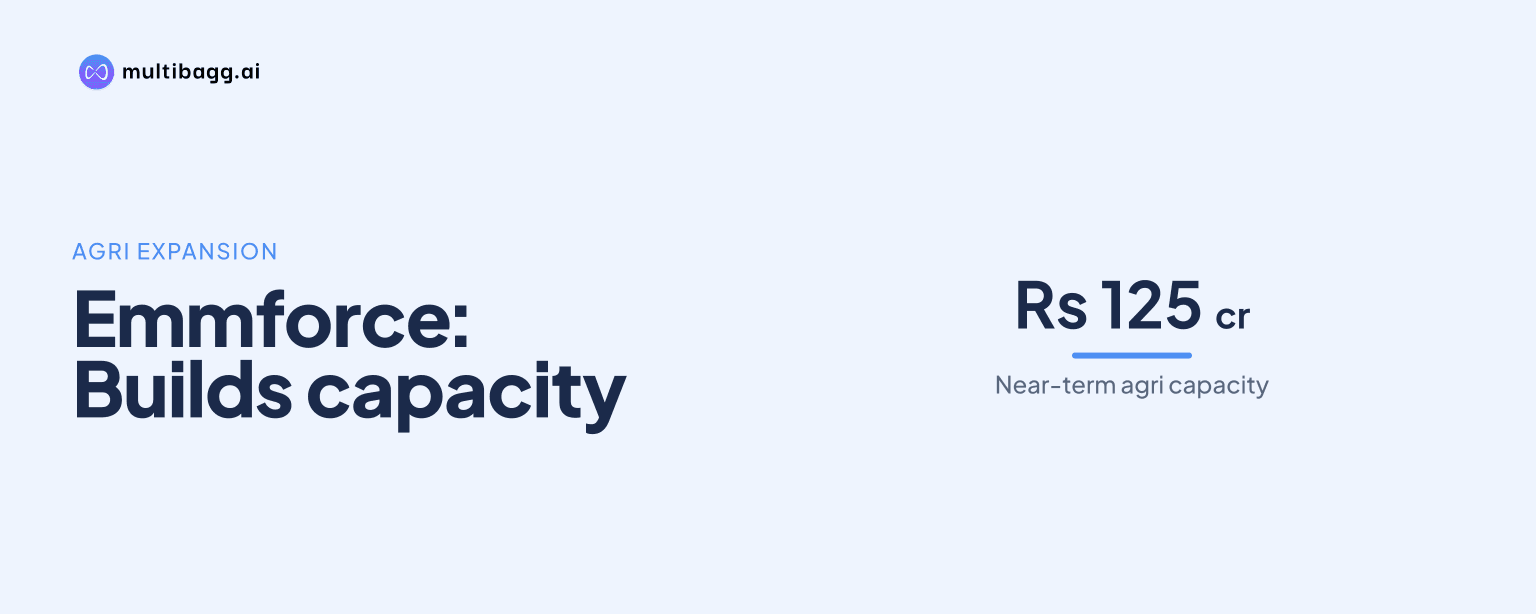
Emmforce is building a domestic agri-equipment platform around TAFE-approved rotavator products, Emmfarm sales and Rs 125 crore of near-term capacity, with TAFE rotavator parts in full-scale production since July 2025. The initiative is intended to diversify Emmforce beyond its export-heavy drivetrain business through subsidiary manufacturing and distributor-led sales.
Know Emmforce Autotech inside out
Results, valuation, peers and who's buying, in one view.
How is Emmforce building its agri-equipment business?
Emmforce is building the agri business through production at a subsidiary, TAFE approvals, the Emmfarm rotavator brand and a distributor-led domestic sales model. The company identifies scaling its agri division as its first strategic priority and lists rotavators, rotavator parts and rotavator blades as the relevant product categories. Agri production has already commenced through a subsidiary, according to the presentation.
The agri strategy sits alongside Emmforce's export-led drivetrain operations rather than replacing them. A recently secured US export order worth Rs 470 crore is already in commercial production at full run-rate and is expected to generate about Rs 60 crore of annual revenue in FY27. Separately, Emmforce received a long-term US drivetrain order expected to provide Rs 10.50 crore of annual revenue in October 2025, showing that the agri platform is being developed while drivetrain programmes continue to expand.
Management says the agri move is intended to diversify revenue beyond the export-heavy drivetrain business and create higher-margin potential through next-generation agri implements. It also cites policy support and farm mechanisation as reasons for demand visibility. These are management's stated strategic rationales, not reported financial outcomes, because the presentation does not disclose agri revenue, profitability, order value or unit sales.
What does the TAFE relationship mean for Emmforce?
The TAFE relationship gives Emmforce approvals to manufacture rotavators, rotavator parts and rotavator blades, while TAFE rotavator parts have been in full-scale production since July 2025. This disclosed approval scope covers both finished implements and components used in rotavator applications. Emmforce says business volumes with TAFE continue to scale, but it does not quantify production volumes, revenue or contract tenure.
The July 2025 production milestone distinguishes the TAFE activity from a separate US drivetrain programme that remained in an earlier stage in October 2025. For that US order, Emmforce said its Production Part Approval Process, or PPAP, batch had been sent to the customer and commercial production was expected in Q3 FY27. TAFE rotavator parts were therefore already in full-scale output, while the US programme was awaiting approval and launch.
TAFE is included in Emmforce's list of industry companies alongside names such as Swaraj, CNH, Sonalika International, Indo Farm and Captain Tractors. However, the presentation specifically identifies manufacturing approvals and full-scale production only for TAFE rotavator parts. It does not state that every company named in that list is an agri customer or disclose pricing, minimum-volume commitments or the duration of the TAFE arrangement.
Got a follow-up? Ask IRIS
Where is Emmforce selling Emmfarm rotavators and blades?
Emmforce has launched Emmfarm rotavators in Maharashtra, while its distributor-led go-to-market strategy is currently live in Maharashtra, Karnataka and Madhya Pradesh. The Emmfarm launch is the brand-facing part of the domestic plan, distinct from the subsidiary's TAFE-approved manufacturing activity. Emmforce reports encouraging market traction in Maharashtra but provides no dealer count, rotavator unit-sales figure or branded-product revenue.
Blade distribution has a wider stated reach than the Emmfarm launch. Emmforce says its blades have commenced sales through a growing distributor network across India, while it identifies Maharashtra, Karnataka and Madhya Pradesh as the states where the distributor-led strategy is currently live. The presentation therefore describes a Maharashtra-specific rotavator brand launch, three active distribution states and blade sales through a broader India-wide network.
Emmforce plans to take Emmfarm into Southern India in the coming months, targeting markets with a focus on product quality. This is a disclosed expansion plan rather than a completed rollout, and the presentation does not name the states, distributors or launch date. The company also does not provide a sales target for the Southern India expansion or a timetable for adding distributors beyond the existing three-state strategy.
What scale and market backdrop does Emmforce disclose?
Emmforce discloses Rs 125 crore of near-term capacity for the agri business, the main company-specific monetary measure of the planned scale. The presentation describes the portfolio as margin accretive and linked to domestic brand-building, but does not provide a target margin, capacity-utilisation level or date for reaching the stated capacity. It also does not specify the production units represented by the Rs 125 crore capacity figure.
The presentation frames the agri opportunity around the global farm-equipment market and the rotavator-blades market. It cites a 12.1% compound annual growth rate, or CAGR, for the farm-equipment market between 2024 and 2030, and a 9.1% CAGR for the rotavator-blades market between 2024 and 2033. These market figures are context for the strategy, not forecasts of Emmforce's sales or profit.
The agri platform uses a different route to market from the drivetrain business. The drivetrain strategy focuses on Tier-1 original equipment manufacturers in the US, Europe and Asia, whereas the agri plan combines TAFE production, an Emmfarm domestic brand and distributors. Emmforce has provided annual revenue expectations of Rs 60 crore, Rs 10.50 crore and Rs 10 crore for separate US drivetrain orders, but gives no comparable annual revenue estimate for TAFE parts, Emmfarm or blades.
Conclusion
Emmforce has put the operational elements of its agri diversification in place: subsidiary production, TAFE approvals, full-scale TAFE rotavator-parts production from July 2025, an Emmfarm launch in Maharashtra and distributor activity in Maharashtra, Karnataka and Madhya Pradesh. The Rs 125 crore near-term capacity is the principal disclosed indicator of intended scale, while the existing drivetrain business retains expected FY27 annual revenue of about Rs 60 crore from one US export order.
The next disclosed development to watch is Emmforce's planned expansion of Emmfarm into Southern India in the coming months. Investors will also need future company disclosures to assess how TAFE volumes, India-wide blade distribution and the Rs 125 crore capacity translate into agri revenue, margins and utilisation, as the presentation leaves those measures unresolved.