










Emmforce cuts FY27 Mobility target as Mahindra model is uneconomic
Key highlights
- Emmforce cut FY27 Mobility revenue guidance by Rs 10 crore to Rs 20 crore.
- Mobility recorded a Rs 2.8 crore loss on Rs 14.5 crore of H1 FY27 revenue.
- Emmforce targets about Rs 40 crore of Mobility revenue in FY28, including Rs 25 crore of market sales.
- TAFE’s two months of labour unrest delayed Mobility blade supplies during the peak season.
powered by IRIS
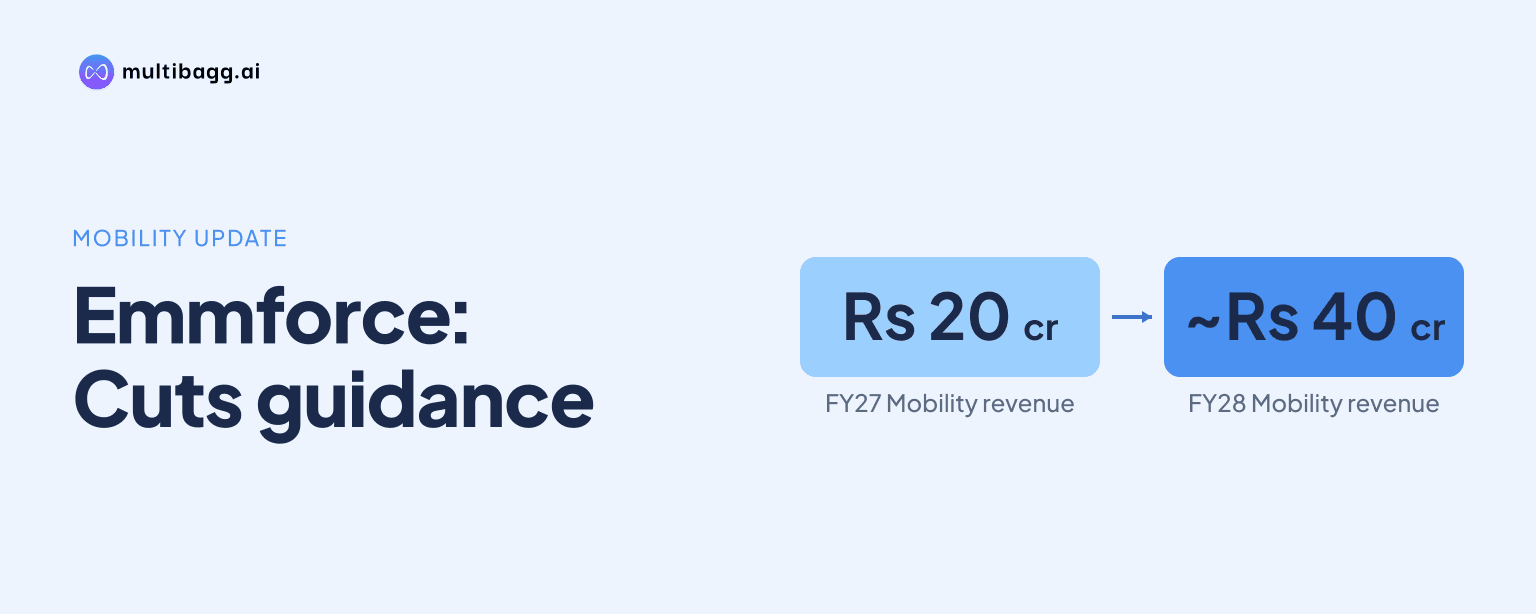
Emmforce Autotech Limited cut Emmforce Mobility’s FY27 revenue target to Rs 20 crore from Rs 30 crore after management found the proposed Mahindra contract-manufacturing model would generate no profit; the subsidiary reported a Rs 2.8 crore loss on Rs 14.5 crore of H1 FY27 revenue.
Know Emmforce Autotech inside out
Results, valuation, peers and who's buying, in one view.
Why did Emmforce cut Mobility’s FY27 revenue target?
Emmforce reduced Mobility’s FY27 target by Rs 10 crore because delayed TAFE supplies and an expected agri-market slowdown reduced the sales outlook. TAFE, described by management as Mobility’s main agri customer, had labour unrest for two months during the season and first used blade inventory sourced from previous suppliers before starting purchases from Emmforce.
The revised consolidated FY27 revenue guidance is Rs 185 crore, down from Rs 195 crore. Management retained its Rs 165 crore target for the standalone business but lowered Mobility’s projection to Rs 20 crore from Rs 30 crore; it said it would try to offset the shortfall through the main business, though Rs 185 crore remains the stated consolidated guidance.
Mobility generated Rs 14.5 crore of H1 FY27 revenue, including Rs 8.6 crore of external sales, and made a Rs 2.8 crore loss. This contrasted with consolidated H1 FY27 revenue of Rs 92.5 crore and profit after tax of about Rs 6 crore, versus standalone profit after tax of about Rs 9 crore, which management said reflected the subsidiary’s impact.
Why did Emmforce abandon large-player contract manufacturing?
Emmforce rejected complete-equipment contract manufacturing for Mahindra because management concluded the arrangement would not provide a profit. Managing Director Ashok Mehta said the company initially pursued the opportunity to save the time and management bandwidth required to establish its own brand, but later found it was effectively serving the customer without adequate returns.
The decision does not end Mobility’s work with established agri-equipment companies. Management distinguished TAFE because Mobility supplies fabricated, machined and heat-treated parts, powder coating and approved blades, while TAFE performs final assembly at its own plant. That component-supply arrangement remains part of Mobility’s plan, unlike the complete-rotavator model rejected for Mahindra.
Emmforce now plans a mix of EMMFarm-branded products, selected private-label supply and component sales. Management said it may undertake private-label work for smaller companies, while avoiding large customers whose scale and purchasing terms could limit supplier earnings; it said a South Indian private-label customer had repeated orders during the season.
How is Emmforce building the EMMFarm brand?
Emmforce has launched EMMFarm rotavators in Maharashtra and identified South India and Madhya Pradesh as the next markets. Management called the initial Maharashtra response very good but did not quantify dealer additions, orders or revenue, and said the focus had shifted from development to building volumes, dealers and brand awareness.
Mobility is also selling rotavator blades through a growing distributor network across India. Management said customers had started buying the blades and expected repeat orders as the product gained acceptance, creating an aftermarket route alongside EMMFarm rotavators and TAFE component supplies.
Management expects Mobility to have no cash loss in H2 FY27, although it said the subsidiary would still reduce consolidated margins for the full year because of the H1 loss. It gave no quantified H2 revenue or profit target, so the stated no-cash-loss objective is not equivalent to a forecast of full-year profitability.
Got a follow-up? Ask IRIS
What does Emmforce expect from Mobility in FY28?
Emmforce targets about Rs 40 crore of Mobility revenue in FY28, comprising roughly Rs 25 crore of market sales and Rs 15 crore of internal sales. That target is twice the revised Rs 20 crore FY27 target, with management citing business awarded to another associate company that will use Mobility’s forging and heat-treatment facility.
Management did not provide FY28 consolidated profit guidance, but said Mobility could be break-even or better at Rs 40 crore of revenue. Mehta later said he did not expect the subsidiary to remain loss-making at that sales level, while cautioning that profit after tax might still be limited; these are management expectations rather than reported results.
The FY28 plan also includes alternative use of Mobility equipment. Management expects the 1,600-ton forging press to have no spare capacity because of associate-company work, and said the blade line could be used for automotive parts in the following year if agri-product volumes take longer to scale.
What financial pressures accompany Emmforce’s pivot?
Emmforce’s near-term task is to contain Mobility’s losses while managing a longer cash cycle in its US business. Consolidated operating cash flow was negative Rs 5.9 crore in H1 FY27 as receivables rose to Rs 63 crore in September from Rs 34 crore in March, with about Rs 40 crore related to one US customer.
That US programme requires six to eight weeks of inventory in a US warehouse, about two months of goods in transit and a two-month payment cycle, producing a roughly six-month cycle. Management expects receivables of about Rs 50 crore by FY27-end, while H1 capital expenditure fell to Rs 3 crore from Rs 18 crore a year earlier and installed capacity stood at about Rs 350 crore.
At the group level, management forecasts FY27 standalone profit after tax of about Rs 18 crore and consolidated profit after tax of about Rs 14 crore. It also aims to restore standalone earnings before interest, tax, depreciation and amortisation margin to 20% to 22% from about 19.5% in H1 FY27 through price revisions and lower freight costs, with some customer increases expected from December 1.
Conclusion
Emmforce has chosen to build Mobility around EMMFarm rotavators, distributor-led blade sales, selected private-label work and component supply rather than pursue unprofitable large-player complete-equipment contracts. The reduced FY27 target reflects both the TAFE disruption and the economics management identified in the Mahindra model, while the Rs 40 crore FY28 target depends on a broader mix of external and internal demand.
The next disclosures to watch are whether Mobility meets management’s H2 FY27 no-cash-loss objective, whether TAFE blade supplies rise after the two-month disruption, and whether receivables decline towards the stated Rs 50 crore FY27-end expectation. Management also identified revenue against Rs 185 crore guidance, standalone margin recovery to 20% to 22%, operating cash flow and Mobility capacity utilisation as its next operating benchmarks.