










Encompass plans two premium brands after three additions
Key highlights
- Encompass plans another premium food brand in the near term and a premium WBC brand in the medium term.
- Encompass added three labels: QUIRKLOOM and Blisshome were launched, while bummer was acquired.
- stōa paris reported Rs 14.6 crore of H1 FY27 revenue, compared with Rs 6.1 crore for small batch™.
- small batch™ reported 199% H1 FY27 year-on-year revenue growth and a 74.6% gross margin.
powered by IRIS
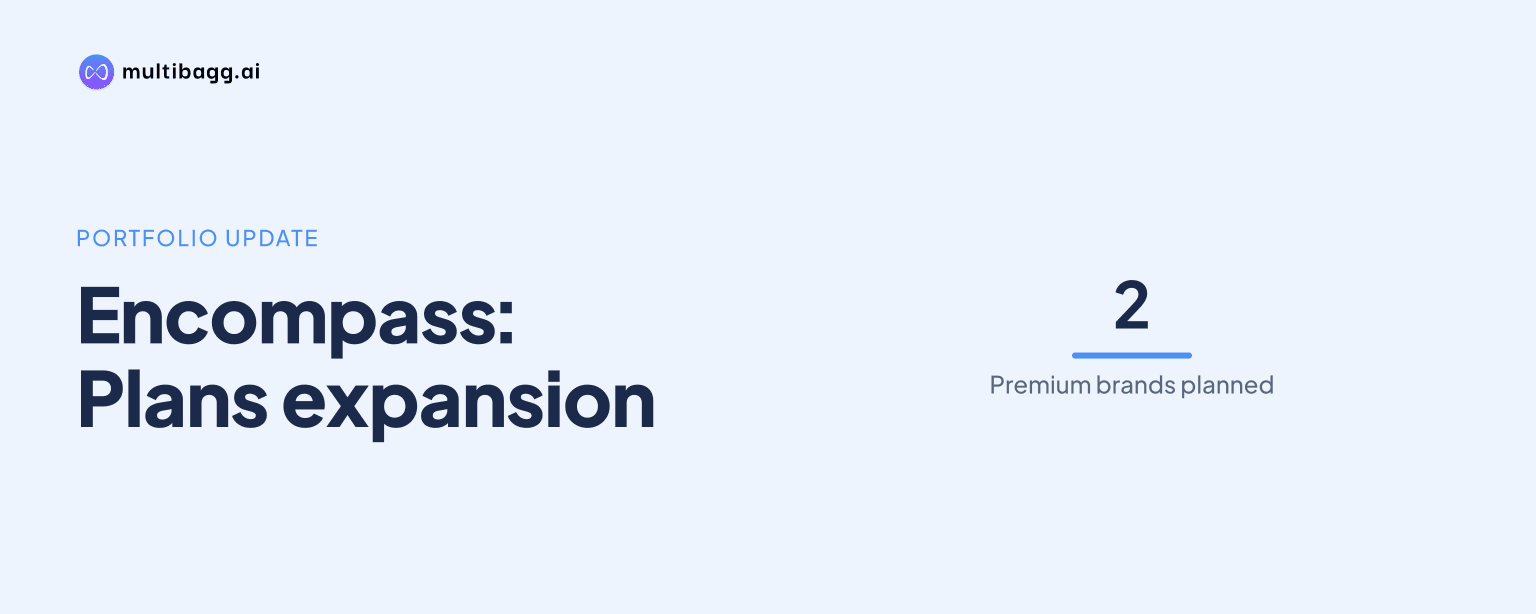
Encompass plans another premium food brand in the near term and a premium WBC brand in the medium term after adding three labels, comprising two launches and one acquisition. The presentation identifies QUIRKLOOM and Blisshome as launched brands and bummer as an acquired brand, while stōa paris generated Rs 14.6 crore of H1 FY27 revenue.
Know Encompass Design India inside out
Results, valuation, peers and who's buying, in one view.
What brands has Encompass added to its portfolio?
Encompass has added three brands: QUIRKLOOM and Blisshome were launched, while bummer was acquired. QUIRKLOOM is positioned as a Gen-Z-inspired bedsheet brand with bold prints, Blisshome sells curated home essentials, and bummer offers innerwear and loungewear. The presentation does not disclose the acquisition price for bummer or launch dates for the two new labels.
The additions expand Encompass primarily in home-related categories while also adding an innerwear and loungewear proposition. QUIRKLOOM and Blisshome join stōa paris in home furnishing, whereas bummer sits outside that segment. The group also operates small batch™ in consumer food, giving it four listed consumer-brand areas: food, home textiles, home essentials and apparel-related products.
Encompass describes its model as identifying high-intent opportunities, building differentiated brands and scaling them through shared infrastructure. It says the platform can recycle capital to create value, but gives no separate revenue, margin or active stock-keeping unit, or SKU, data for QUIRKLOOM, Blisshome or bummer in H1 FY27.
What does Encompass plan to launch next?
Encompass plans another premium food brand in the near term, expanding into an adjacent premium food category with what management describes as a distinctive and differentiated proposition. The presentation does not identify the new brand, specify its product category or give a launch date, investment budget or sales target.
Encompass also identifies a medium-term opportunity to launch a premium WBC brand in health and wellness focused on modern consumer needs. The presentation does not define WBC, name the intended brand, or set out the precise health-and-wellness category. The stated sequence is clear, with food labelled near term and WBC labelled medium term, but neither label is tied to a calendar date.
The food initiative would be adjacent to small batch™, Encompass’s chef-led gourmet food brand. small batch™ sells Asian sauces, chilli oils, premium ketchups, crisps, cocktail mixers, chocolate and other condiments. The proposed WBC entry, by contrast, would take the portfolio into a health-and-wellness segment not listed among the group’s current consumer brands.
How does Encompass support new brand creation?
Encompass says trading, e-commerce enablement and access to select gated markets provide a cash-flow layer to support consumer-brand creation. Trading distributes branded and non-branded fast-moving consumer goods, or FMCG, and lifestyle products across domestic and international markets. The presentation supplies no revenue or cash-flow amount for either the trading or e-commerce activity.
The shared-platform approach is intended to address costs that Encompass says are difficult for standalone brands to bear. These include funding customer acquisition and brand building, supporting specialist teams, driving repeat purchase and profitable growth, and absorbing fixed costs at an early stage. Each of these mechanisms relates to operating a consumer brand rather than to a disclosed financial forecast.
In Encompass’s qualitative portfolio chart, consumer brands occupy the high-growth area, while trading and e-commerce occupy the high-cash-flow area. The chart says consumer brands can build meaningful cash flows as they scale and gain wider reach, while established non-brand businesses provide steady growth. It does not set a cash-flow target, payback period or funding allocation for the planned food or WBC launches.
Got a follow-up? Ask IRIS
How are Encompass’s disclosed brands performing?
Encompass’s H1 FY27 disclosures show that stōa paris produced more revenue than small batch™, while small batch™ grew faster year on year. stōa paris recorded Rs 14.6 crore of H1 FY27 revenue, compared with Rs 6.1 crore for small batch™, a difference of Rs 8.5 crore. H1 FY27 is the period label used in the presentation.
small batch™ reported 199% year-on-year revenue growth in H1 FY27, compared with 62.1% for stōa paris. The food brand also reported a 74.6% gross margin and 54.8% contribution margin, while the home-textile brand reported 68.3% and 41.3%, respectively. Encompass does not provide equivalent performance measures for its three recently added labels.
Repeat revenue was 29% at small batch™ and 22% at stōa paris, a difference of 7 percentage points. small batch™ had 40 active SKUs, compared with 928 at stōa paris. The higher SKU count at stōa paris corresponds with a wider listed home range that includes bed sheets, pillow covers, comforters, curtains, table linen and crockery.
How do Encompass’s main brands reach customers?
Encompass’s two disclosed brands both relied mainly on online channels in H1 FY27, with small batch™ more concentrated in direct-to-consumer, or D2C, sales. D2C revenue represented 71.5% of small batch™ revenue and 62.6% of stōa paris revenue, a gap of 8.9 percentage points.
Other online revenue represented 23.2% at small batch™ and 34.3% at stōa paris, while offline revenue accounted for 5.3% and 3.2%, respectively. Online channels therefore represented 94.7% of small batch™ revenue and 96.9% of stōa paris revenue. The presentation does not disclose channel mixes for QUIRKLOOM, Blisshome or bummer.
The two brands also reported different order values and online ratings in H1 FY27. small batch™ had an average order value of Rs 1,544 and an average online rating of 4.9 out of 5.0, while stōa paris reported Rs 2,700 and 4.5 out of 5.0. Both brands reported 2x return on advertising spend, or ROAS, in the period.
Conclusion
Encompass is broadening its consumer-brand platform through two launches, one acquisition and a disclosed pipeline of another premium food brand followed by a premium WBC brand. The operating data show distinct existing positions: small batch™ reported Rs 6.1 crore of H1 FY27 revenue and 199% growth, while stōa paris reported Rs 14.6 crore, 928 active SKUs and a larger average order value of Rs 2,700.
What to watch next is whether Encompass identifies the new food and WBC brands, clarifies their category scope and gives timing or investment details. The presentation provides only near-term and medium-term labels for those plans. It will also be relevant if Encompass discloses revenue, margins, channel mix or acquisition details for QUIRKLOOM, Blisshome and bummer, none of which are provided in the H1 FY27 brand data.