










Encompass sets 30-50% premium before omnichannel scaling
Key highlights
- Encompass positions products 30-50% above the market during its pre-PMF stage.
- Encompass launches 5-10 SKUs on Amazon for early customer validation.
- Encompass plans to expand brands from 5-10 SKUs to 50+ SKUs at scale.
- Encompass’s illustrative incremental cost index is 25% for Brand 2 and 18% for Brand 3.
powered by IRIS
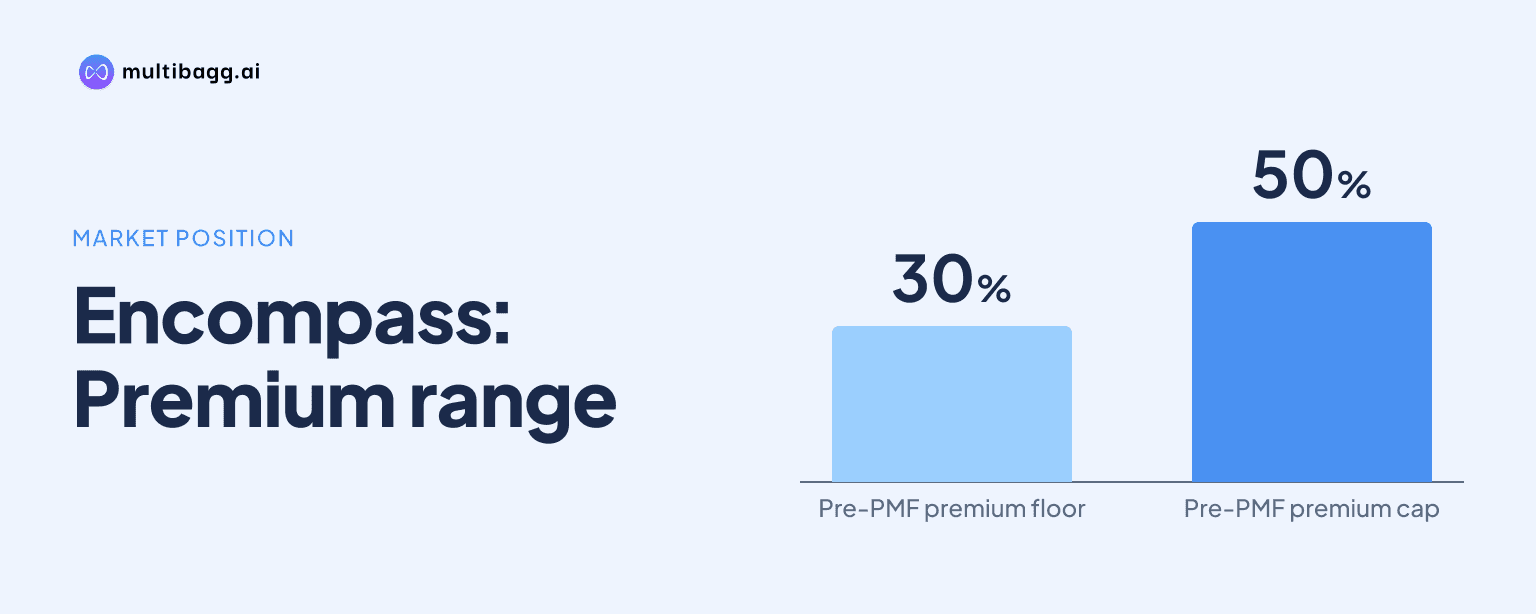
Encompass sets product positioning 30-50% above the market before moving validated brands toward omnichannel distribution, starting with 5-10 stock-keeping units (SKUs) on Amazon and planning an expansion to 50+ SKUs. The sequence combines premium-category selection, customer feedback, pricing tests and daily monitoring of reviews, ratings and returns.
Know Encompass Design India inside out
Results, valuation, peers and who's buying, in one view.
How does Encompass select categories for new brands?
Encompass selects categories using six stated filters: consumer transition, repeat-purchase potential, unit economics, competition intensity, platform fit and strategic buyer interest. Its pre-product-market-fit, or pre-PMF, process starts with high total addressable market (TAM) categories where it identifies premiumisation gaps and underserved affluent consumer segments.
The consumer-transition filter covers evolving needs, unmet gaps and shifting preferences, while repeat-purchase potential considers habit formation and willingness to pay for premium propositions. The commercial assessment covers gross-margin potential and cost to serve, and the competition test seeks manageable competition and clear differentiation.
Encompass identifies Food & Nutrition, Wellness & Personal Care and Home & Living as illustrative focus areas. Food & Nutrition is associated with everyday consumption, premiumisation potential and repeat purchase; Wellness & Personal Care with health, self-care and active lifestyles; and Home & Living with evolving aesthetics, higher willingness to spend and design-led differentiation.
Adjacent opportunities include beverages, pantry staples and mixers, where Encompass says existing capabilities and strategic buyer interest may matter. The platform-fit test is designed to assess whether a category can use shared infrastructure already deployed across the portfolio.
How does Encompass position products before customer validation?
Encompass positions products at a 30-50% premium to the market during the pre-PMF stage. It describes the underlying product approach as design-first, balancing aesthetics and function before moving to Amazon-based customer validation or broader distribution.
The pre-PMF phase also includes emotive brand creation, in which Encompass says it converts the value proposition into a brand identity and storytelling framework. This places product design, premium positioning and communications development ahead of the later testing of messaging and pricing.
The playbook separates pre-PMF work from product-market-fit, or PMF, activity and scale. The stated transition is from identifying category whitespace and creating a brand to testing an initial 5-10 SKUs, followed by a 50+ SKU portfolio and omnichannel expansion.
How does Encompass validate brands on Amazon?
Encompass uses an Amazon launch of 5-10 SKUs for early customer validation. Customer feedback is collected through sampling programmes, providing a smaller initial assortment before the company expands products or commits to quick commerce, strategic retail or international markets.
Its low-cost experiments include pop-up experiences, micro-influencer partnerships and A/B testing of messaging and pricing. A/B testing compares alternative messages or prices, while the presentation does not disclose sales volumes, marketing expenditure, conversion rates or a numerical threshold for moving a brand beyond PMF.
Encompass says it monitors reviews, ratings and returns daily and makes quick product and listing adjustments. This feedback loop links marketplace customer signals to product and ecommerce-listing changes, although the presentation does not state the duration of the Amazon validation period or the number of customer samples distributed.
Amazon is specifically named in the PMF stage, whereas quick commerce, strategic retail and international markets appear in the later scale stage. That ordering means the disclosed playbook uses a marketplace launch for customer learning before its wider channel plan.
Got a follow-up? Ask IRIS
What does Encompass do after product-market fit?
After PMF, Encompass plans to increase a brand’s range from 5-10 SKUs to 50+ SKUs and enter adjacent categories. The disclosed range therefore rises from no more than 10 initial SKUs to at least 50 SKUs, a fivefold increase when measured against the top end of the initial range.
At this scale stage, Encompass says it shifts towards brand-awareness investment through celebrity partnerships and mass media. It cites Mandira Bedi as an example, but the presentation does not identify campaign budgets, timing, sales outcomes or the brands involved.
The planned omnichannel routes are quick commerce, strategic retail and international markets. Encompass does not name retail partners, target countries, outlet numbers or a timetable for these channels, but it places all three after the Amazon-validation and portfolio-expansion steps.
How does Encompass use shared capabilities to scale brands?
Encompass says a shared platform lowers the incremental cost of launching brands. Its illustrative cumulative cost index sets Brand 1 at 100, Brand 2 at 125 and Brand 3 at 148, with disclosed incremental costs of 25% for Brand 2 and 18% for Brand 3.
The illustrative comparison shows the incremental rate falling by 7 percentage points between Brand 2 and Brand 3. Encompass labels the index illustrative, so it is not a reported operating-cost outcome, forecast or disclosure of actual launch expenditure.
Shared capabilities include sourcing, design and testing; social media, creative and brand strategy; performance marketing and retention; and website, marketplace and offline distribution. Encompass also centralises operations, supply chain, finance, human resources, administration, data and analytics across brands.
Encompass lists smallbatch™, stoā, QUIRKLOOM and Blissome as consumer brands and describes established businesses generating cash flows to fund, build and scale those brands. Its wider model also includes strategic exits and capital recycling, although it discloses no sale timetable, valuation target or transaction plan.
Conclusion
Encompass’s disclosed model combines premium pricing of 30-50% above the market with a staged route from 5-10 Amazon SKUs to 50+ SKUs, adjacent categories and additional channels. Category filters, marketplace experiments, daily customer-signal monitoring and centralised capabilities are the mechanisms intended to connect early validation with portfolio expansion.
The next point to watch is whether individual brands move from Amazon validation into the stated 50+ SKU and omnichannel scale stage. Encompass also plans a shift towards awareness spending, including celebrity partnerships and mass media, while leaving PMF thresholds, campaign budgets, retail partners and international-market timing unresolved.