










Entero expects to exceed FY27 targets after 35% H1 growth
Key highlights
- Entero’s H1 FY27 revenue increased 35% year on year to Rs 4,028 crore.
- Entero reported a 5.2% H1 FY27 EBITDA margin, compared with its 5% FY27 target.
- Q2 FY27 revenue rose 32.9% to Rs 2,087 crore and EBITDA increased 78% year on year.
- H1 FY27 operating cash flow was negative Rs 46.5 crore because of delayed government-contract collections.
powered by IRIS
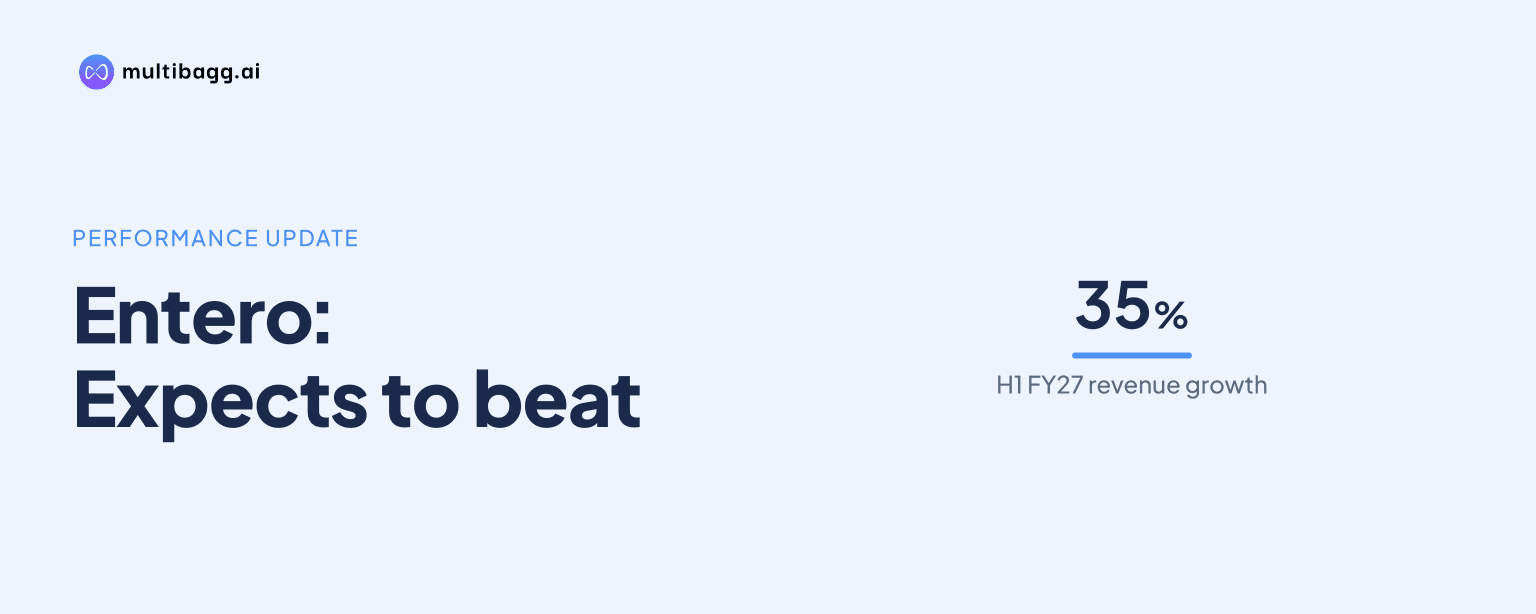
Entero Healthcare Solutions Limited said on November 5, 2026, that it expects to exceed its FY27 guidance after first-half revenue increased 35% year on year to Rs 4,028 crore and earnings before interest, tax, depreciation and amortisation (EBITDA) margin reached 5.2%, above its 5% full-year target.
Know Entero Healthcare Solutions inside out
Results, valuation, peers and who's buying, in one view.
Will Entero exceed its FY27 revenue and margin guidance?
Entero said it expects to do better than its FY27 guidance, although management did not formally raise the targets or provide revised numerical forecasts. Its stated guidance is consolidated revenue growth of about 23%, excluding contributions from new acquisitions, an EBITDA margin of 5%, and conversion of 50% of EBITDA into operating cash flow.
The company’s first-half revenue growth of 35% was 12 percentage points above the approximately 23% FY27 growth benchmark, while its 5.2% EBITDA margin was 20 basis points above the full-year margin target. Managing Director and Chief Executive Officer Prabhat Agrawal said Entero was in a “very, very comfortable position” to better guidance, but said explicitly that he was not issuing new guidance during the call.
Entero completed no acquisitions in the first half of FY27, so management presented the expected outperformance against a target that excludes any new deal contribution. It said it was evaluating multiple acquisition opportunities, but any transaction would be disclosed through a stock-exchange release once it crystallises.
What drove Entero’s H1 FY27 revenue growth?
Entero’s revenue reached Rs 4,028 crore in H1 FY27, while second-quarter consolidated revenue rose 32.9% year on year to Rs 2,087 crore. On a like-for-like basis, adjusting for revenue recognised on a net-margin basis and the divestment of a subsidiary in the base period, Q2 revenue growth was 34.7%.
Organic growth was 18.2% in Q2 FY27, or 20% on the like-for-like basis. Calendarisation of acquisitions completed in the prior year contributed 14.7% of inorganic growth, but management said this effect would taper partly in Q3 and more substantially in Q4 if Entero does not announce new acquisitions.
The company served more than 92,200 retail customers and over 2,900 hospital customers during H1 FY27, covering about 500 districts across more than 20 states and union territories. Its network distributed more than 90,400 stock-keeping units from over 3,200 healthcare-product manufacturers.
MedTech accounted for more than 15% of Entero’s total revenue, according to management. Entero did not disclose MedTech revenue in rupees or segment EBITDA because it said cost allocations differ across businesses, while adding that margin depends on the value-added service provided, including demand generation, rather than solely on product category.
Got a follow-up? Ask IRIS
Why was Entero’s H1 FY27 operating cash flow negative?
Entero reported negative operating cash flow of Rs 46.5 crore in H1 FY27 because collections from certain government contracts were delayed. Management said funds had been reallocated because of the drought situation in Maharashtra and that the collection was received in November 2026.
Net working-capital days were 66 in H1 FY27, compared with 68 days in the comparable prior-year period. In Q2 FY27, net working-capital days were 64, but management said they would have been 61 after adjusting for the November collection, a level similar to the previous quarter.
Management said H1 operating cash flow would have been positive if the government payment had been received on its due date. The transcript does not quantify the delayed collection or provide a revised operating-cash-flow forecast, but it identifies payment timing as the reason the reported cash flow was negative despite the year-on-year reduction in working-capital days.
Return on capital employed was 21.8% and return on equity was 21.3% for H1 FY27. Those ratios increased to 22.0% and 22.4%, respectively, in Q2 FY27, alongside the 66-day H1 working-capital position.
How did Entero improve margins and what changes in H2?
Entero’s Q2 FY27 gross margin rose 126 basis points year on year to 11.5%, while EBITDA margin expanded 135 basis points to 5.3% and EBITDA increased 78%. For H1 FY27, gross profit was Rs 461 crore, gross margin was 11.5%, and EBITDA margin was 5.2%.
Management attributed the margin expansion to procurement economies from scale, a larger MedTech revenue contribution, and exits from certain low-margin accounts. It also said potential maximum retail price revisions or trade-margin caps were not likely to affect Entero’s margin structure because distributors were not receiving most of the gap between manufacturers’ selling prices and maximum retail prices.
Q2 FY27 profit after tax was Rs 61 crore, up 66% year on year, with a profit-after-tax margin of 2.9%. Profit attributable to owners was Rs 46 crore, up 44%, while non-controlling interest was about Rs 15 crore, or approximately 25% of profit before minority interest.
Management confirmed that a provision at a subsidiary reduced Q2 FY27 margin, responding to an analyst’s reference to a Rs 12 crore provision. Group Chief Financial Officer Balakrishnan Kaushik also said repayments on debt raised for an acquisition completed last year would begin in Q3 FY27, and that interest cost should decline as debt is reduced over time.
Conclusion
Entero’s H1 FY27 revenue growth of 35% and EBITDA margin of 5.2% exceeded its stated full-year benchmarks of approximately 23% revenue growth and a 5% margin. Management has not increased its formal guidance, but it said performance to date puts the company in a position to deliver better than those targets, supported by organic growth, prior-year acquisition calendarisation and margin actions.
The next factors to watch are the tapering of acquisition calendarisation in Q3 and Q4 FY27, operating-cash-flow conversion after the November government collection, and debt repayments beginning in Q3. Management is also assessing multiple acquisition opportunities, but has not disclosed a transaction timetable or revised target figures.