










Ester film revenue rises 39.6% as utilisation hits 92%
Key highlights
- Ester’s Q2 FY27 film revenue rose 39.6% year on year to Rs 414.5 crore.
- Consolidated film capacity utilisation increased to 92% in Q2 FY27 from 80% in Q2 FY26.
- VAS film volume grew 25.8% to 6,200 MT and represented 25.3% of total film sales volume.
- rPET sales volume increased 37.4% to 1,437 MT and revenue rose 51% to Rs 18.4 crore.
powered by IRIS
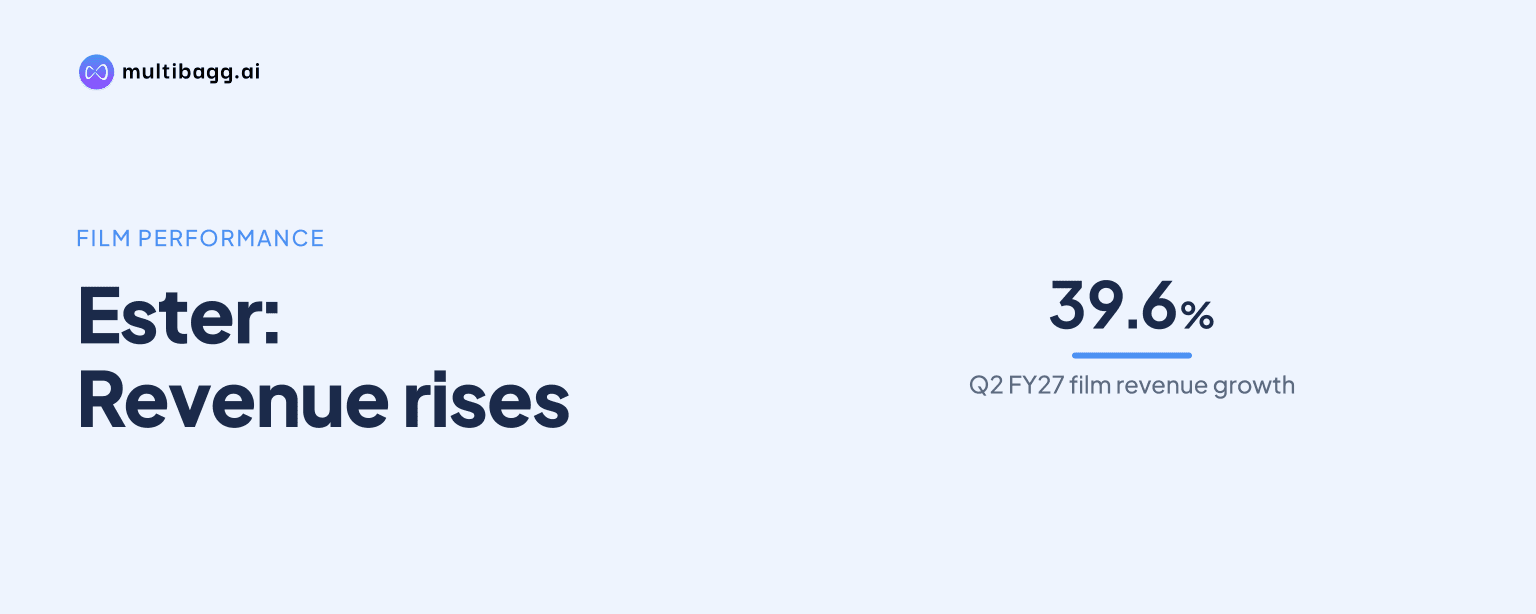
Ester Industries Limited increased film revenue by 39.6% year on year to Rs 414.5 crore in Q2 FY27, as consolidated film capacity utilisation rose to 92% from 80%, sales volume increased 13.9% to 24,291 metric tonnes (MT), and value-added and specialty product volume reached 6,200 MT.
Know Ester Industries inside out
Results, valuation, peers and who's buying, in one view.
How did Ester's film business perform in Q2 FY27?
Ester’s film revenue grew faster than its sales volume in Q2 FY27. Film sales volume rose by 2,962 MT, from 21,329 MT in Q2 FY26 to 24,291 MT, while revenue increased by Rs 117.7 crore, from Rs 296.8 crore to Rs 414.5 crore. Management attributed the revenue growth to improved per-unit realisations following higher petrochemical feedstock prices.
Consolidated film capacity utilisation reached 92% in Q2 FY27, up 12 percentage points from 80% a year earlier. Ester said higher film production at both Ester Industries and Ester Filmtech supported the increase, alongside the 13.9% increase in film sales volume.
The 39.6% increase in film revenue exceeded the 13.9% increase in volume, indicating that realisations contributed materially to sales growth. Ester specifically linked improved per-unit realisations to higher feedstock prices for petrochemical products, but did not disclose a realised price per MT.
What was Ester's value-added film product contribution?
Ester’s value-added and specialty products, abbreviated as VAS, represented 25.3% of total film sales volume in Q2 FY27. VAS volume increased 25.8% to 6,200 MT from 4,927 MT in Q2 FY26, exceeding the 13.9% growth rate in total film sales volume.
The increase in VAS volume made these products a larger component of the 24,291 MT of film sold during Q2 FY27. Management said a higher VAS contribution within the film segment, together with better realisations across the portfolio, supported the improved business mix reported in consolidated earnings.
Ester also reported growth in recycled polyethylene terephthalate, or rPET, products. rPET sales volume increased 37.4% to 1,437 MT, while revenue grew 51% to Rs 18.4 crore in Q2 FY27. The company did not disclose the prior-year rPET revenue figure or a separate rPET realisation.
How did film trends coincide with Ester's consolidated results?
Ester reported consolidated total income of Rs 449.0 crore in Q2 FY27, up 25.7% from Rs 357.2 crore in Q2 FY26. The reported Rs 414.5 crore of film revenue should not be directly compared with consolidated total income because the announcement did not provide a reconciliation between the segment measure and the consolidated measure.
Consolidated earnings before interest, taxes, depreciation and amortisation, or EBITDA, including non-operating income, rose 160.0% to Rs 45.1 crore from Rs 17.3 crore. EBITDA margin increased to 10.0% from 4.9%, while profit after tax turned positive at Rs 7.8 crore compared with a Rs 15.8 crore loss in Q2 FY26.
For H1 FY27, consolidated total income increased 26.5% to Rs 891.0 crore and EBITDA rose 124.6% to Rs 104.0 crore. EBITDA margin was 11.7%, compared with 6.6% in H1 FY26, and profit after tax was Rs 26.5 crore against a Rs 22.9 crore loss a year earlier.
Got a follow-up? Ask IRIS
What risks and developments could affect Ester next?
Ester said the operating environment for biaxially oriented polyethylene terephthalate, or BOPET, films remained stable in Q2 FY27, with US tariff-related disruptions experienced in FY26 largely behind it. However, the company said crude-oil supply disruptions and price fluctuations related to the war in West Asia were raising shipping costs and extending transit times, adversely affecting its working-capital cycle.
Specialty Polymers moved in the opposite direction to films in Q2 FY27, with sales volume falling 38.8% to 711 MT from 1,161 MT in Q2 FY26. Ester attributed the decline to demand erosion in one marquee product, while segment earnings before interest and tax margin was 33.9%, compared with 37.0% a year earlier.
Management said a product pipeline and expected customer approval for a new Specialty Polymers product, following marginal capital expenditure, could partially address lost volume and margin. This is a management expectation, and Ester did not disclose the capital expenditure amount, approval timing or prospective sales volume.
What is Ester's disclosed timeline for the ELITe project?
Ester said implementation work on the ELITe project is progressing, with the project planned for implementation by the last quarter of calendar year 2028. Management expects land acquisition to be completed by Q4 FY27 for the upcoming Gujarat facility.
The company said marketing and offtake arrangements with an anchor customer, as well as a letter of intent from a global sports and athletic brand, would commit a significant part of planned capacity before commercial production. The letter of intent covers Loop PET Fiber Grade resin under a multi-year offtake framework from the Gujarat facility.
Ester characterised these arrangements as early customer validation for its joint venture’s recycled platform and its value-added sustainable products. It did not disclose ELITe’s planned capacity, project cost, commercial-production date, anchor-customer identity or committed offtake volume.
Conclusion
Ester’s Q2 FY27 film performance combined higher throughput, improved realisations and faster VAS growth: utilisation rose to 92%, sales volume reached 24,291 MT and revenue increased 39.6% to Rs 414.5 crore. VAS volume grew 25.8% to 6,200 MT, representing 25.3% of total film sales volume, while consolidated EBITDA margin rose 510 basis points to 10.0%.
The next disclosed milestones are expected ELITe land acquisition by Q4 FY27 and project implementation by the last quarter of calendar year 2028. Investors can also monitor whether crude-related shipping costs, longer transit times and uncertain raw-material pricing affect working capital, and whether expected approval of a new Specialty Polymers product offsets part of the Q2 FY27 volume decline to 711 MT.