










Ester Secures Nike Offtake for 45,000-Tonne Recycling Plant
Key highlights
- Ester plans ELITe to produce 45,000 tonnes of recycled PET chips annually from polyester waste.
- Nike is the anchor customer under a disclosed multi-year offtake agreement for ELITe.
- A separate sports-brand LOI contemplates up to 15,000 tonnes of annual offtake from ELITe.
- Ester plans ELITe commercial operations in the last quarter of calendar year 2028.
powered by IRIS
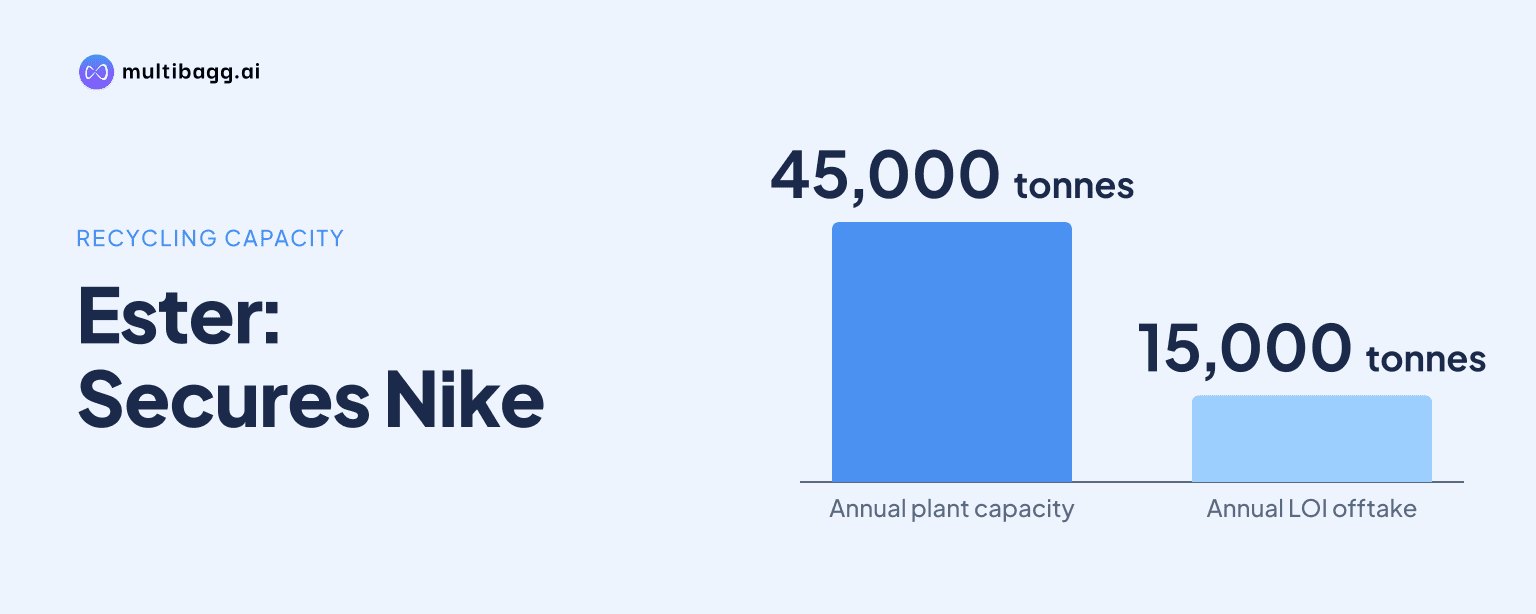
Ester Industries has named Nike as anchor customer for ELITe, its planned chemical-recycling joint venture that is designed to produce 45,000 tonnes of recycled PET chips annually and begin commercial operations in the last quarter of calendar year 2028. A separate multi-year letter of intent contemplates offtake of up to 15,000 tonnes a year.
Know Ester Industries inside out
Results, valuation, peers and who's buying, in one view.
What offtake has Ester secured for ELITe?
Ester has disclosed that Nike signed a multi-year offtake agreement to become the anchor customer for the Infinite Loop India manufacturing facility. The agreement covers Twist, a virgin-quality polyester resin made exclusively from textile waste using Loop Industries’ technology. The presentation also says Loop’s proprietary chemical tracer technology will provide full traceability of textile-to-textile recycled content.
Ester does not disclose the volume, value or duration of Nike’s agreement. That means the disclosed evidence is Nike’s anchor-customer role rather than a quantified portion of the 45,000-tonne annual capacity. ELITe is a 50:50 joint venture between Ester and Loop Industries, which the presentation describes as a US Nasdaq-listed company with more than 10 years of experience in Infinite Loop technology.
A separate multi-year letter of intent, or LOI, has been received from an unnamed leading global sports and athletic brand for Loop PET Fiber Grade resin. The brand intends to take up to 15,000 tonnes a year from ELITe’s upcoming Indian facility. This potential volume equals one-third of planned annual output, although an LOI is not the same as the disclosed Nike offtake agreement.
Ester characterises the Nike agreement and the other brand’s LOI as commitments for a substantial portion of planned capacity before commercial start-up. The presentation does not identify the second brand or say whether its proposed annual volume is firm. It also does not quantify aggregate committed capacity across the Nike agreement and the LOI.
How will ELITe convert textile waste into recycled chips?
ELITe is planned to chemically recycle polyester textile waste into recycled dimethyl terephthalate, or rDMT, and recycled mono-ethylene glycol, or rMEG. These monomers will then be polymerized into 45,000 tonnes a year of recycled polyethylene terephthalate, or PET, chips. Ester says commercial operations are to commence during the last quarter of calendar year 2028.
The facility will use Loop’s patented technology and is intended to accept coloured, dyed and blended polyester waste, including textile waste and bottles. Ester says chemical recycling breaks PET down to its original monomers, allowing polyester waste to be reconstituted into virgin-quality PET in each recycling cycle. The planned output can serve textile, electronics, automotive, cosmetics, rigid-packaging and flexible-packaging applications.
The venture’s stated textile route is textile waste to recycled PET chips, then rDMT and rMEG, and then new textile material. This is textile-to-textile, or T2T, recycling, rather than a route beginning and ending with bottles. Ester says the chemical process can also support bottle-to-bottle and film-to-film applications.
Ester says the proposed facility can cut carbon emissions by up to 81% versus virgin DMT and MEG. This is a projected facility characteristic rather than an operating result because the plant has not yet begun commercial production. The 81% figure is presented alongside the planned 2028 start-up, not alongside measured plant emissions.
Got a follow-up? Ask IRIS
How does ELITe compare with Ester’s current recycling capacity?
ELITe’s proposed 45,000-tonne annual capacity is 17,000 tonnes higher than Ester’s disclosed 28,000 tonnes a year of mechanical-recycling capacity. Ester operates mechanical-recycling facilities with 8,000 tonnes per annum at Sitarganj and 20,000 tonnes per annum at Hyderabad. The planned chemical facility is therefore about 61% larger than the two existing mechanical sites combined.
Ester says its mechanical route uses clear scrap PET bottles and is employed for PET films containing post-consumer recycled, or PCR, content and bottle-to-bottle applications. The company’s mechanical-recycling strategy is focused on the domestic market. It says repeated mechanical recycling may affect material-quality parameters and limit the number of recycling loops.
By contrast, Ester says the chemical route can process coloured, dyed and blended polyester waste that mechanical recycling cannot readily use for T2T recycling because of dyes, pigments, finishes and mixed fibres. The company says much PET textile waste otherwise ends in landfills. ELITe is intended to address international-brand requirements for recycled material that can be converted back into virgin-quality PET.
What demand backdrop does Ester cite for the venture?
Ester cites recycling rules and recycled-content requirements as support for demand ahead of ELITe’s scheduled last-quarter 2028 start-up. The presentation lists the European Union’s Ecodesign for Sustainable Products Regulation, under which separate textile-waste collection became mandatory in January 2025. It also lists a ban on destruction of unsold apparel and shoes for large firms beginning in early 2025.
The same European Union timeline lists finalisation of specific recycled-content percentages for garments by mid-2026 and full enforcement of the guidelines in 2027-2028. Ester says the latter period includes provisions for fees for non-compliant fashion brands. These are regulatory conditions identified in the presentation, not ELITe sales forecasts or disclosed customer-volume commitments.
Ester also cites California requirements for plastic bottles to contain more than 25% PCR in 2025 and 50% by 2030. In India, the company says the Plastic Waste Management Rules require 10% PCR content in flexible packaging. These measures relate to the broader recycled-material market, while ELITe is specifically designed to process polyester textile waste through chemical recycling.
For its existing film business context, Ester estimates India’s 12-micron-equivalent biaxially oriented PET, or BOPET, thin-film capacity at 1,400 kilotonnes in financial year 2027 estimated. The same slide gives production of 1,105 kilotonnes, domestic demand of 950 kilotonnes, exports of 180 kilotonnes and imports of 25 kilotonnes. Those figures concern film supply and demand, whereas ELITe’s commercial support is the Nike agreement and the separate potential 15,000-tonne annual LOI.
Conclusion
Ester has early commercial backing for its planned ELITe chemical-recycling facility through Nike’s role as anchor customer and an unnamed sports brand’s potential offtake of up to 15,000 tonnes annually. The venture’s planned 45,000-tonne annual chip capacity exceeds Ester’s existing 28,000-tonne mechanical-recycling capacity and is designed for harder-to-recycle polyester textile streams.
The next disclosed milestone is commercial operations in the last quarter of calendar year 2028. What to watch is progress towards that start-up, any conversion of the LOI into a binding commitment, and whether Ester discloses Nike’s volume, contract duration or additional customer commitments against the 45,000-tonne annual plan.