










Ester Industries targets 50-60% specialty-film mix in 3 years
Key highlights
- Ester Industries targets a 50-60% value-added and specialty-film volume share within two to three years.
- Polyester-film EBIT reached Rs 34.5 crore in Q2 FY27, compared with a Rs 6.2 crore loss in Q2 FY26.
- Value-added and specialty-film volume increased 25.8% to 6,200 metric tons in Q2 FY27.
- Consolidated EBITDA increased 160% year on year to Rs 45.1 crore in Q2 FY27.
powered by IRIS
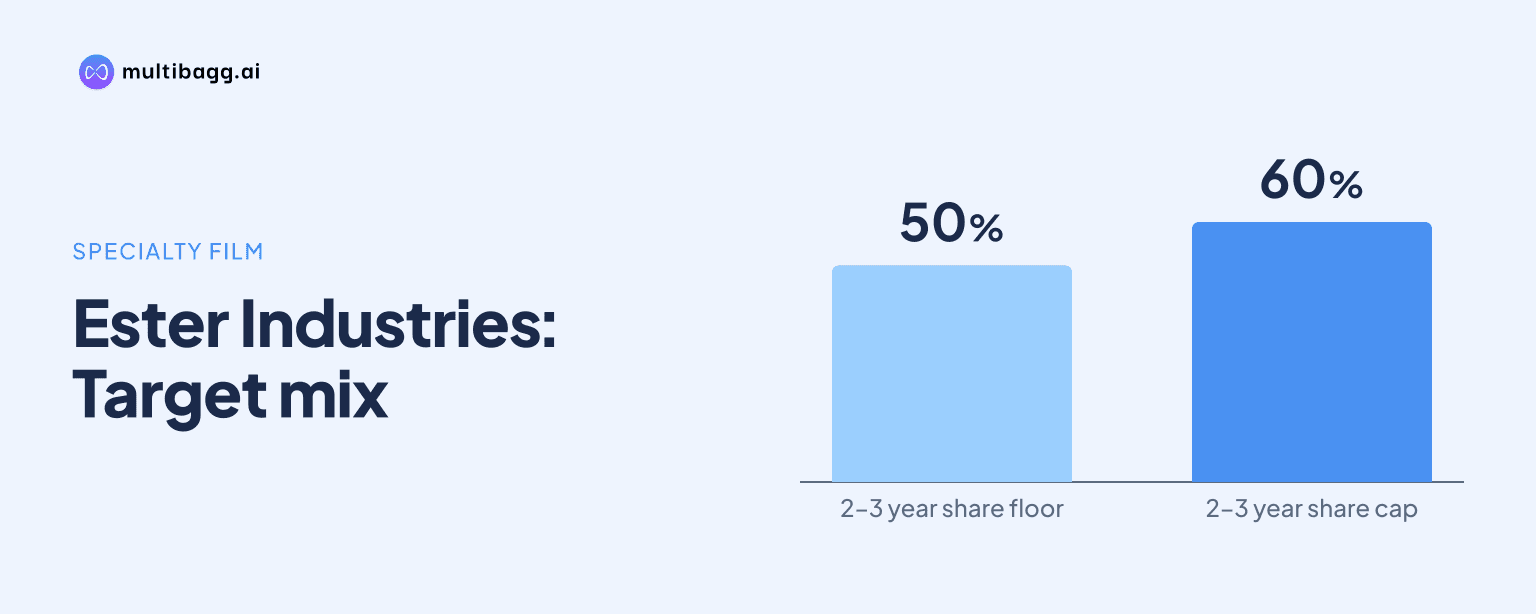
In Q2 FY27, Ester Industries Limited set a target for value-added and specialty films to reach 50-60% of total film volume within two to three years, after polyester-film earnings before interest and tax reached Rs 34.5 crore, reversing a Rs 6.2 crore loss in Q2 FY26.
Know Ester Industries inside out
Results, valuation, peers and who's buying, in one view.
What specialty-film mix is Ester Industries targeting?
Ester Industries targets value-added and specialty films to account for about 35% of film volume by Q4 FY27 and 50-60% within the subsequent two to three years. The company reported that these products accounted for 26% of total film volume in Q2 FY27, when sales reached 6,200 metric tons.
The specialty portfolio expanded faster than the overall film business in Q2 FY27. Value-added and specialty-film volume increased 25.8% from 4,927 metric tons in Q2 FY26, while consolidated film sales volume increased 13.9% to 24,291 metric tons from 21,329 metric tons.
For H1 FY27, Ester Industries recorded its highest value-added and specialty-film volume of 12,568 metric tons, up 24.3% from 10,107 metric tons in H1 FY26. That portfolio represented about 27% of film volume in H1 FY27, while total consolidated film sales rose 8.3% to 46,412 metric tons.
How did Ester Industries' polyester-film business recover in Q2 FY27?
Ester Industries' polyester-film segment recovered to an 8.3% EBIT margin in Q2 FY27, compared with a 2.1% EBIT loss margin in Q2 FY26. Segment revenue, including recycled polyethylene terephthalate, or rPET, and chips, increased 39.6% to Rs 414.5 crore, and EBIT moved to Rs 34.5 crore from a Rs 6.2 crore loss.
Management attributed the difference between 39.6% revenue growth and 13.9% volume growth to higher realizations, pass-through of increased feedstock costs and a better product mix. For H1 FY27, film-segment revenue rose 38.7% to Rs 813.9 crore and segment EBIT reached Rs 73.6 crore, compared with Rs 0.8 crore in H1 FY26.
The recovery also extended to Ester Filmtech, the wholly owned subsidiary. Its Q2 FY27 total income increased 40.5% to Rs 168.2 crore, while EBITDA rose to Rs 16.9 crore from Rs 4 crore and profit after tax turned to Rs 2.2 crore from a Rs 10.3 crore loss in Q2 FY26.
Can a larger specialty-film mix reduce cyclicality?
Management said a 50-60% specialty-film mix is needed to achieve its internal objective of a sustainable EBITDA margin of around 15%. This is a management target, not a forecast for a specified period, and Ester Industries reported consolidated EBITDA margin of 10% in Q2 FY27.
Management expects Indian demand for biaxially oriented polyethylene terephthalate, or BOPET, films to grow 8-10% annually from a market of about 900,000 to 950,000 metric tons. It said no new domestic capacity had been added in the preceding year and forecast only two or at most three new lines over the next two years, leading management to expect the earlier overcapacity situation not to recur for eight to 10 quarters.
The company also cited plastic-waste-management rules requiring 10% post-consumer recycled content in flexible packaging as a structural driver. Ester Industries has rPET capacity of 28,000 metric tons a year across Sitarganj and Hyderabad, and uses most of its output internally for recycled-content BOPET films; Q2 FY27 rPET sales rose 37.4% to 1,437 metric tons and revenue increased 51% to Rs 18.4 crore.
Got a follow-up? Ask IRIS
What could delay Ester Industries' specialty-film transition?
Customer approvals are the main constraint on Ester Industries' specialty-film expansion, according to management. The company said products need to complete customer qualification processes before volumes can scale, making approvals central to its move from a 26% specialty share in Q2 FY27 to the 35% target for Q4 FY27.
Higher crude-linked petrochemical prices, freight costs and longer transit times increased working-capital needs in H1 FY27. Trade receivables increased to Rs 264.3 crore at September 2026 from Rs 184.9 crore in March 2026, while inventories rose to Rs 245.2 crore from Rs 208.7 crore.
Net working capital increased Rs 66.7 crore in H1 FY27 and short-term bank borrowings increased by Rs 51.7 crore to partly fund that requirement. Total consolidated borrowings stood at Rs 748.8 crore at September 2026, compared with Rs 729 crore in March 2026, despite Rs 53.5 crore of term-loan repayments during the half year.
How do Ester Industries' other businesses affect the strategy?
Ester Filmtech supported the group film recovery as its H1 FY27 capacity utilisation rose to 85.3% from 78.4% in the prior-year period. The subsidiary reported H1 FY27 EBITDA of Rs 36.4 crore at an 11.1% margin and profit after tax of Rs 6.9 crore, compared with a Rs 26.8 crore loss in H1 FY26.
Specialty polymers moved in the opposite direction in Q2 FY27 because demand declined for one high-margin specialty product. Segment volume fell to 711 metric tons from 1,161 metric tons and revenue declined 49% to Rs 29.3 crore, although EBIT remained Rs 9.9 crore, producing a 33.9% margin.
Management expects new specialty-polymer products, including one awaiting customer approval and requiring marginal capital expenditure, to partly replace lost volumes and margins in Q4 FY27 and the following financial year. It said it is working with 27 customers on eight to nine products at different approval stages, with those opportunities expected to mature over the next six to eight quarters.
Conclusion
Ester Industries' Q2 FY27 turnaround in films reflected higher realizations, 13.9% volume growth and a 25.8% increase in value-added and specialty-film volume. The planned 50-60% specialty mix is therefore the central mechanism management is using to make film earnings less dependent on commodity pricing and capacity conditions.
The next measures to watch are the 35% specialty-film volume share targeted for Q4 FY27, customer-approval progress and working-capital efficiency in H2 FY27. Management also expects specialty-polymers recovery to begin in Q4 FY27, while it continues to target about Rs 100 crore of term-loan repayments for FY27.