










Ester Industries Receivables Reduce H1 Operating Cash Flow
Key highlights
- Ester Industries reported Rs 94.34 crore of operating profit before working-capital changes in the six months ended 30 September 2026.
- Trade receivables increased by Rs 79.23 crore in H1 2026, versus a Rs 21.41 crore increase a year earlier.
- Net operating cash flow was Rs 15.57 crore in H1 2026, down from Rs 25.68 crore in H1 2025.
- Financing activities generated Rs 63.95 crore, including Rs 79.50 crore of share-warrant proceeds.
powered by IRIS
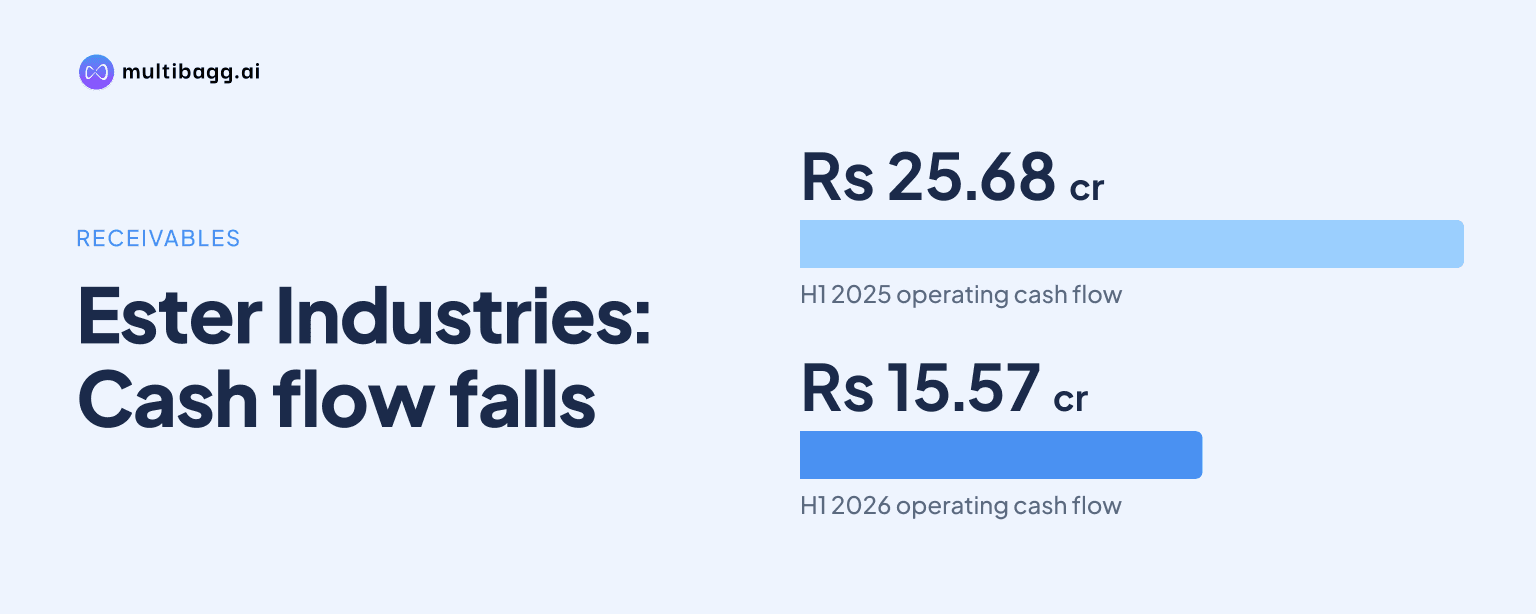
Ester Industries Limited generated Rs 94.34 crore of operating profit before working-capital changes in the six months ended 30 September 2026, but a Rs 79.23 crore increase in trade receivables and a Rs 36.45 crore inventory increase limited net operating cash flow to Rs 15.57 crore.
Know Ester Industries inside out
Results, valuation, peers and who's buying, in one view.
Why did Ester Industries' operating cash flow decline despite higher profit?
Ester Industries generated lower operating cash flow because working-capital movements absorbed more cash in the six months ended 30 September 2026 than its higher pre-working-capital operating profit supplied. Operating profit before working-capital changes rose to Rs 94.34 crore from Rs 57.09 crore in the corresponding 2025 period, an increase of Rs 37.25 crore. Consolidated profit before tax was Rs 33.41 crore, compared with a loss before tax of Rs 21.04 crore a year earlier.
Working-capital movements absorbed Rs 69.78 crore in the latest half-year, compared with Rs 28.17 crore in the previous-year period. Cash flow from operations after working-capital changes was Rs 24.56 crore, below Rs 28.92 crore a year earlier despite the higher operating-profit figure. After Rs 9 crore of income-tax payments net of refunds, net cash flow from operating activities was Rs 15.57 crore, versus Rs 25.68 crore in the six months ended 30 September 2025.
Ester Industries reported consolidated net profit after tax of Rs 26.46 crore for the six-month period, compared with a net loss of Rs 22.93 crore a year earlier. The cash-flow statement nevertheless records higher receivables and inventories as cash uses, which reduced the amount of reported operating profit converted into operating cash during the period.
How much did trade receivables increase at Ester Industries?
Ester Industries' trade receivables increased by Rs 79.23 crore during the six months ended 30 September 2026, according to the consolidated cash-flow statement. That was larger than the Rs 21.41 crore increase in the corresponding 2025 period, raising the year-on-year cash absorption from receivables by Rs 57.82 crore.
The consolidated balance sheet reported trade receivables of Rs 264.31 crore at 30 September 2026, up from Rs 184.94 crore at 31 March 2026. This balance-sheet increase was Rs 79.37 crore, compared with the Rs 79.23 crore movement shown in the cash-flow statement. Receivables were the largest individual negative working-capital movement in the half-year cash flow.
Inventories were the second-largest cash use among the disclosed working-capital movements. Ester Industries recorded a Rs 36.45 crore increase in inventories in the cash-flow statement, compared with a Rs 39.33 crore increase in the prior-year six months. The inventory balance rose to Rs 245.17 crore at 30 September 2026 from Rs 208.71 crore at 31 March 2026.
Got a follow-up? Ask IRIS
Which working-capital items offset Ester Industries' cash absorption?
Ester Industries partly offset the receivables and inventory build-up through higher payables and other liabilities in the six months ended 30 September 2026. Trade payables increased by Rs 34.78 crore, compared with an increase of Rs 30.66 crore in the prior-year period, while other financial and non-financial liabilities increased by Rs 13.43 crore.
Provisions provided Rs 1.31 crore of cash support, while other non-current and current financial assets absorbed Rs 4.43 crore. Other non-current and current assets generated Rs 76.20 lakh, compared with cash absorption of Rs 3.61 crore a year earlier. Those items moderated but did not offset the Rs 115.68 crore combined cash use from higher receivables and inventories.
Current trade payables on the balance sheet rose to Rs 101.11 crore at 30 September 2026 from Rs 66.53 crore at 31 March 2026. Dues to micro enterprises and small enterprises were Rs 24.92 crore, while dues to other creditors were Rs 76.19 crore. Current borrowings also rose to Rs 389.47 crore from Rs 338.29 crore over the same period.
How did Ester Industries fund its cash position?
Ester Industries' cash position increased mainly through financing inflows during the six months ended 30 September 2026. Net cash from financing activities was Rs 63.95 crore, including Rs 79.50 crore from share warrants and Rs 51.75 crore of net proceeds from short-term borrowings. These financing inflows exceeded the Rs 15.57 crore generated from operating activities.
The financing statement also records Rs 53.46 crore of repayments of long-term borrowings, against Rs 18.89 crore of fresh long-term borrowings. Finance costs paid were Rs 30.21 crore and dividend payments were Rs 2.51 crore. At 30 September 2026, non-current borrowings were Rs 359.28 crore, down from Rs 390.70 crore at 31 March 2026, while current borrowings increased by Rs 51.18 crore.
Investing activities used Rs 48.44 crore, lower than Rs 77.47 crore in the previous-year six months. The outflow included Rs 15.10 crore for property, plant and equipment, capital work-in-progress and intangible assets, Rs 42.57 crore of net investment in bank deposits, and Rs 7.10 crore invested in the joint venture. Sales of mutual funds and commercial papers generated Rs 23.88 crore, while investments in them used Rs 15.80 crore.
Cash and cash equivalents ended the period at Rs 32.25 crore, up from Rs 1.17 crore at 31 March 2026 but below Rs 36.21 crore at 30 September 2025. Ester Industries also reported bank balances other than cash and cash equivalents of Rs 148.15 crore at 30 September 2026, compared with Rs 103.69 crore at the March 2026 year-end. The net increase in cash and cash equivalents during the half-year was Rs 31.08 crore.
Conclusion
Ester Industries reported higher consolidated profitability for the six months ended 30 September 2026, but working-capital movements restricted the resulting operating cash flow. The Rs 79.23 crore receivables increase was the largest cash use, and the Rs 36.45 crore inventory increase added to the requirement. Higher trade payables and other liabilities provided only a partial offset, leaving operating cash flow below the prior-year level.
The unresolved balance-sheet issue for subsequent reporting periods is whether receivables and inventories decline after their increases at 30 September 2026, while current borrowings stood at Rs 389.47 crore. Ester Industries also recorded Rs 79.50 crore of warrant proceeds in financing cash flow, and disclosed the allotment on 12 May 2026 of 67,08,851 equity shares following conversion of fully convertible warrants at an issue price of Rs 158 per share.