










Exato targets 60% export revenue mix within two to three years
Key highlights
- Exato targets export revenue of 60% of total revenue within two to three years, versus 23.50% in FY26.
- The target requires a 36.50-percentage-point increase in export revenue mix from FY26.
- Exato plans dedicated sales teams across the United States, Australia and India.
- Exato reports more than 150 clients worldwide, retention above 97% and an order book of Rs 681 crore.
powered by IRIS
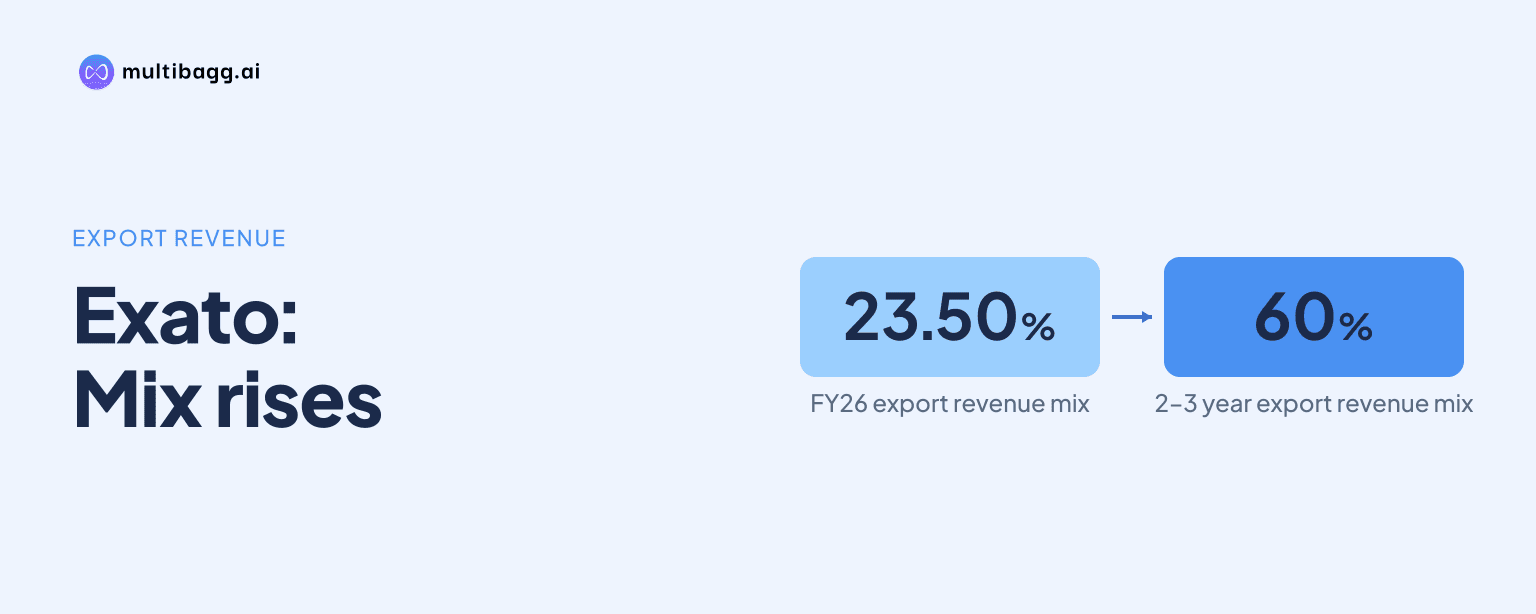
Exato Technologies Limited is targeting export revenue of 60% of total revenue over the next two to three years, up from 23.50% in FY26, through dedicated global sales teams, overseas partnerships and a proposed wholly owned subsidiary in Mainland Dubai, United Arab Emirates, subject to approvals.
Know Exato Technologies inside out
Results, valuation, peers and who's buying, in one view.
How does Exato plan to reach 60% export revenue?
Exato’s plan is to increase overseas sales capacity while winning both additional business from current customers and new clients in global markets. Management says it is building a global sales organisation with dedicated teams across the United States, Australia and India, supported by leadership spanning the chief revenue, artificial intelligence, operating and technology officer roles.
The export target represents a 36.50-percentage-point change in revenue mix from FY26’s 23.50% level to 60%. The presentation does not disclose export revenue in rupees, annual revenue, or individual country targets. It instead identifies three operating mechanisms for the change: expanded international presence through original equipment manufacturer, or OEM, partnerships; customer references; and participation in global industry events.
Management also identifies stronger wallet share among existing customers as part of the international go-to-market approach. That means the stated 60% goal is not presented solely as a new-client acquisition plan: it also depends on expanding the range or value of work with the installed customer base while pursuing overseas accounts.
What role would the proposed Dubai subsidiary play?
The proposed Mainland Dubai, UAE, entity would be a wholly owned subsidiary intended to strengthen Exato’s overseas market reach. Its incorporation remains subject to requisite approvals, so the presentation describes it as a proposal rather than an operating subsidiary or a completed expansion.
Dubai is one component of a broader international plan rather than the only overseas route named by management. The sales-team footprint covers the United States, Australia and India, while the Dubai proposal is paired with OEM relationships, customer references and industry-event participation. The source gives no planned incorporation date, investment amount, employee count or revenue contribution for the UAE entity.
The distinction matters because the 60% export objective has a two-to-three-year timetable, whereas the Dubai subsidiary has no disclosed launch date. Progress therefore cannot be measured from the presentation through a single facility opening or a stated country-level target. It will depend on execution across multiple channels, including the proposed UAE presence and the dedicated sales teams.
Which offerings support Exato’s overseas sales strategy?
Exato is pairing international expansion with a move from point solutions to end-to-end business solutions and managed services. Its integrated offer includes contact-centre, enterprise resource planning (ERP), customer relationship management (CRM) and artificial intelligence (AI) solutions, along with an expansion of its Acumatica Cloud ERP practice.
The roadmap prioritises Healthcare, banking, financial services and insurance (BFSI), particularly Insurance, and business process outsourcing and knowledge process outsourcing (BPO/KPO). These verticals align with the company’s existing deployment areas: healthcare patient engagement and claims processing; telecom customer-churn and workforce tools; manufacturing supply-chain and contract-management models; and BPO/KPO contact-centre modernisation and sentiment analysis.
Exato also cites ExaFone as an enterprise-engagement product combining Voice, WhatsApp, Digital and Analytics capabilities. The product illustrates the integrated approach behind the roadmap, because it joins communications channels with analytics rather than being presented as a standalone AI model. The source does not allocate export targets by ExaFone, Cloud ERP, contact-centre solutions or managed services.
AI-led development is another stated support for the overseas plan. Exato says it is building across AI Software, AI-as-a-Service and AI Infrastructure, and it has certification in the Claude Partner Network through certified delivery teams and Claude-powered client use cases. The roadmap also notes the appointment of Mr. Abhijeet Kumar as Chief Technology & Growth Officer and Senior Management Personnel.
Got a follow-up? Ask IRIS
What existing customer base can Exato build on internationally?
Exato reports more than 150 clients worldwide and retention above 97%, providing an installed base from which management says it can seek greater wallet share. It also says it serves 9 of India’s 10 leading banks, a concentration of enterprise references relevant to its BFSI-focused strategy, although the presentation does not identify how many of these customers generate export revenue.
The company’s customer list spans BFSI, BPO/KPO, IT and IT-enabled services, telecom, media and other enterprises. Its stated products include ExatoIQ, CompliCall, OnBoardX, ShiftWise, CallSense, Prompt Base Dialer and agentic middleware. Management describes these products as embedded within customer workflows, alongside telephony, routing, CRM, recording, analytics and AI integrations.
Exato reports that more than 1,50,000 agents are enabled by its systems, indicating the scale of its contact-centre and customer-experience deployments. The company says a customer-experience entry engagement targeted at Rs 1 crore can scale towards relationships worth Rs 9 crore to Rs 10 crore through managed services, AI and infrastructure. This is a management target for account expansion, not a disclosed average contract value.
The presentation also reports an order book of Rs 681 crore. It does not split that order book between domestic and export customers, nor does it state conversion timing, margin or cancellation terms. As a result, the reported order book provides context for the company’s land-and-expand model but does not quantify the revenue that would be needed to meet the 60% export mix target.
What should investors measure as Exato pursues export growth?
The clearest measure is Exato’s disclosed export share of total revenue: 23.50% in FY26 versus management’s 60% objective in the next two to three years. Because the goal is a revenue-mix target, exports can rise in absolute terms without reaching 60% if domestic revenue expands faster; equally, the mix can change through a different pace of domestic and international growth.
Investors can also track the execution markers explicitly listed in the roadmap: formation of dedicated teams in the United States, Australia and India; progress on the approval-dependent Dubai subsidiary; OEM partnerships; global industry-event participation; and new client acquisition. The presentation gives no quarterly milestones for these items, so updates would need to show whether those mechanisms are translating into export revenue.
A second measure is the composition of the enterprise offer. Management is seeking to move from point solutions towards managed services and integrated Contact Center, ERP, CRM and AI deployments, while targeting Healthcare, BFSI Insurance and BPO. Evidence of cross-selling products such as ExaFone or Cloud ERP into overseas accounts would be consistent with the stated wallet-share strategy, though no such sales data is supplied here.
Conclusion
Exato’s roadmap sets out a substantial intended shift in its revenue mix: export revenue is targeted to rise from 23.50% in FY26 to 60% within two to three years. The plan combines sales coverage in the United States, Australia and India with customer expansion, OEM partnerships, global references and integrated AI, customer-experience and ERP offerings.
The next items to watch are approval and incorporation of the proposed Dubai subsidiary, the build-out of the global sales organisation, and reported movement in export revenue share. Management’s two-to-three-year target, together with its emphasis on Healthcare, BFSI Insurance and BPO, provides the disclosed framework against which future international-expansion updates can be assessed.