










Mahamaya Lifesciences targets 50 lakh-litre liquid capacity
Key highlights
- Mahamaya plans to raise solid formulation capacity from 1,040 MTPA to 2,000 MTPA by March 2027.
- Mahamaya targets liquid formulation capacity of 50 lakh litres per annum, compared with 13 lakh litres currently.
- The formulation expansion has planned investment of approximately Rs 3.75 crore.
- Mahamaya separately plans 250 MTPA of technical manufacturing capacity by 2028 with approximately Rs 30 crore of IPO proceeds.
powered by IRIS
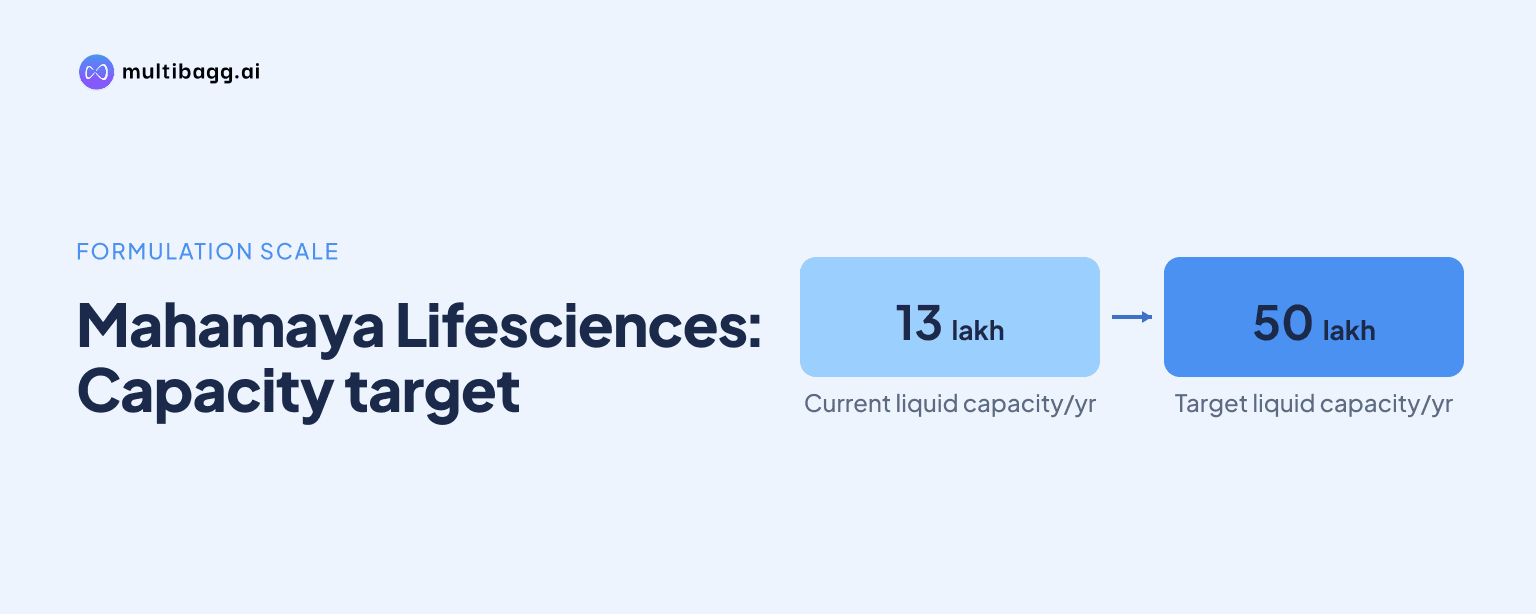
Mahamaya Lifesciences plans to increase liquid formulation capacity to 50 lakh litres per annum by March 2027 from 13 lakh litres, while raising solid formulation capacity from 1,040 metric tonnes per annum (MTPA) to 2,000 MTPA through an approximately Rs 3.75 crore expansion at Dahej, Gujarat.
Know Mahamaya Lifesciences inside out
Results, valuation, peers and who's buying, in one view.
How much formulation capacity will Mahamaya add by March 2027?
Mahamaya plans to add 960 MTPA of solid formulation capacity and 37 lakh litres per annum of liquid formulation capacity by March 2027. The project would take solid capacity from 1,040 MTPA to 2,000 MTPA, an increase of about 92%, and liquid capacity from 13 lakh litres to 50 lakh litres annually, an increase of about 285%. The presentation identifies March 2027 as the target completion date rather than a commissioning date.
The planned formulation expansion requires investment of approximately Rs 3.75 crore. Mahamaya says the added capacity is intended to support growing formulation volumes, allow greater in-house manufacturing and improve production flexibility. Management also says the project could create scope for better capacity utilisation and operating efficiencies as volumes rise; these are stated objectives, not reported financial outcomes.
Why is Mahamaya expanding both solid and liquid formulations?
Mahamaya is expanding both lines after reporting different operating conditions in financial year 2026 (FY26). Solid formulation capacity utilisation exceeded the installed 1,040 MTPA capacity during FY26, and the company used contract manufacturing to meet additional demand. By contrast, the liquid line, with installed capacity of 13 lakh litres per annum, operated at 38.6% utilisation in FY26.
The differing FY26 utilisation figures mean the solid expansion follows reported volumes above installed capacity, while the liquid expansion follows a line with unused capacity. The planned 960-MTPA addition almost doubles solid capacity, whereas the 37-lakh-litre liquid addition takes liquid capacity to nearly four times its present level. The source does not disclose volumes by formulation format or sales channel, so it does not quantify how the new capacity would be allocated.
Mahamaya’s solid-formulation capabilities include water-dispersible granules, soluble granules, granules and wettable powders. Its liquid capabilities include emulsifiable concentrates, suspension concentrates, oil dispersions and soluble liquids. These formats support agrochemical products sold through bulk formulation, domestic branded and export channels, according to the company’s description of the Dahej facility.
What does the Dahej facility currently manufacture?
Mahamaya operates its formulation manufacturing facility at Dahej, Gujarat, which was commissioned in 2021. The plant produces agrochemical formulations for bulk formulation sales, branded products and exports. It has 1,040 MTPA of existing solid capacity and 13 lakh litres per annum of existing liquid capacity before the planned March 2027 expansion.
The company lists bulk formulation products including acetamiprid 20% soluble powder, buprofezin 25% suspension concentrate, imidacloprid 17.8% soluble liquid and 30.5% suspension concentrate, paraquat dichloride 24% soluble liquid, and pretilachlor 50% emulsifiable concentrate and 37% emulsion in water. The presentation does not link individual products to planned incremental capacity, but these listed formulations show the product types produced for bulk sales.
The Dahej site also includes testing and research and development functions. Mahamaya says testing supports quality checks against applicable specifications, including standards of the Bureau of Indian Standards and the Food and Agriculture Organization. Its laboratory equipment includes a Dyno Mill, fluidized-bed dryer, vertical extruder, air-jet mill, reaction vessels, and filtration and drying systems, covering formulation development and technical-process work.
Got a follow-up? Ask IRIS
Which product registrations can support Mahamaya’s formulation expansion?
Mahamaya reports 300 approved formulation registrations and two formulation registrations in its pipeline. It separately reports 199 approved registrations for formulations exclusively for export, with 15 registrations in that export-specific pipeline. The registration figures provide a disclosed product base for its formulation activity, although the presentation does not state which registrations will use the incremental capacity planned for March 2027.
In the company’s category-wise registration data, insecticides account for 49.7%, fungicides for 26.4% and herbicides for 19.1%. Plant growth regulators account for 1.7%, while other categories account for 3%. The three conventional crop-protection categories therefore account for 95.2% of registrations in the disclosed category split, compared with 4.7% for plant growth regulators and other categories combined, subject to rounding.
Mahamaya describes a portfolio of more than 45 branded products, including MAYAMECTIN50, VOLENO50, MAYASHIELD SUPER, UCHIT EW 370, MAYAMRIT GR and JINJOTH. Beyond insecticides, fungicides and herbicides, its wider portfolio includes biostimulants, biopesticides, biofertilizers and adjuvants. Its listed export formulations include sulphur 80% water-dispersible granules, pendimethalin 50% emulsifiable concentrate, imidacloprid 20% suspension concentrate and glufosinate ammonium 20% soluble liquid.
What is Mahamaya’s planned technical-manufacturing project?
Mahamaya plans to establish 250 MTPA of in-house technical manufacturing capacity at its existing Dahej facility, with target commissioning in 2028. The company describes the project as backward integration and says it will use approximately Rs 30 crore of initial public offering proceeds. This investment is eight times the approximately Rs 3.75 crore planned for the formulation-capacity project.
Management says the 250-MTPA project is intended to support raw-material requirements and improve control over raw-material sourcing, availability and procurement costs. The presentation further says the facility could capture greater value across the manufacturing chain and potentially improve gross margins. Those potential effects depend on project execution and operating outcomes, neither of which is reported in the presentation.
Mahamaya already reports 33 approved technical-manufacture registrations and 19 registrations in the technical-manufacture pipeline. It also reports 24 approved technical-import registrations and 19 registrations in the technical-import pipeline. The company lists technical products such as acetamiprid with 99% minimum purity, atrazine and imidacloprid with 95% minimum purity, and pretilachlor and bispyribac sodium with 98% minimum purity.
Conclusion
Mahamaya’s disclosed manufacturing plan has two stages at Dahej. The first is an approximately Rs 3.75 crore formulation expansion targeted for March 2027, lifting solid capacity by 960 MTPA and liquid capacity by 37 lakh litres annually. It follows FY26, when solid utilisation exceeded installed capacity and required contract manufacturing, while liquid utilisation was 38.6%.
The next points to watch are whether the March 2027 formulation project reaches its stated capacity targets of 2,000 MTPA for solids and 50 lakh litres for liquids, and how utilisation develops after completion. Management has also set a 2028 target for commissioning the separate 250-MTPA technical-manufacturing project, funded with approximately Rs 30 crore of initial public offering proceeds.