










Vibhor Steel Tubes targets about 50% revenue growth by FY28
Key highlights
- Vibhor expects about 50% upside in overall revenue by FY28, subject to execution of its strategic priorities.
- Vibhor had 377,000 MTPA of installed capacity in FY26 and H1FY27, up from 221,000 MTPA in FY25.
- GI pipe generated Rs 325.51 crore in H1FY27, Vibhor’s largest disclosed product category.
- The West region generated Rs 315.53 crore in H1FY27, compared with Rs 230.57 crore in the South.
powered by IRIS
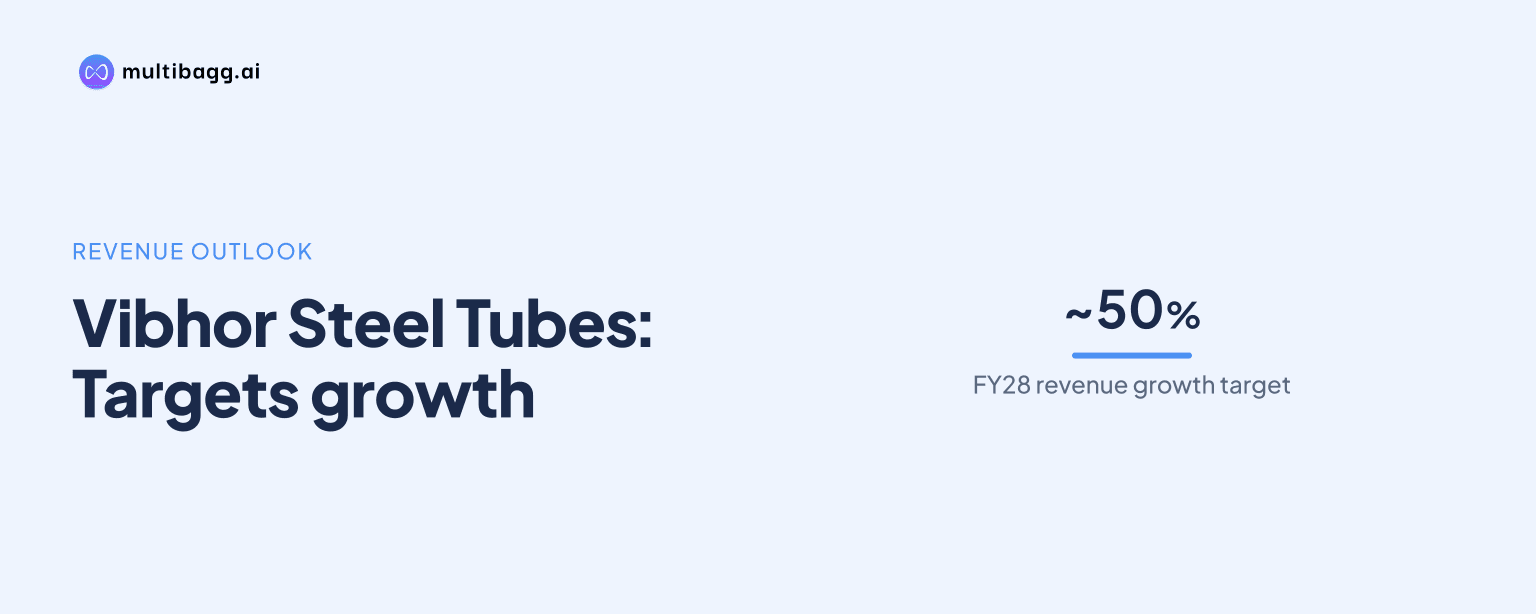
Vibhor Steel Tubes Limited expects execution of its strategic priorities to deliver about 50% upside in overall revenue by FY28, supported by 377,000 metric tonnes per annum of installed capacity and Rs 651.49 crore across its disclosed H1FY27 product categories. The company also says it is focused on improving EBITDA and PAT margins.
Know Vibhor Steel Tubes inside out
Results, valuation, peers and who's buying, in one view.
What is Vibhor’s FY28 revenue growth target?
Vibhor’s stated ambition is about 50% upside in overall revenue by FY28, conditional on executing its strategic priorities. The August 2026 vision slide also identifies a focus on improving EBITDA, or earnings before interest, tax, depreciation and amortisation, and PAT, or profit after tax, margins. It does not disclose a FY28 revenue value, the revenue base used for the calculation, annual growth milestones or margin targets.
The plan is linked to infrastructure demand in roads, railways, transmission lines and housing. Vibhor cites the National Infrastructure Pipeline, Pradhan Mantri Awas Yojana and Gati Shakti among the relevant government programmes, and says India is poised to add more than 191,000 circuit kilometres of transmission lines by FY32. That estimate is sector context rather than a disclosed order book or sales forecast for Vibhor.
Vibhor also points to its long-term manufacturing and supply relationship with Jindal Pipes Limited for the Jindal Star brand. The presentation says the agreement includes minimum assured annual order flow and supports capacity utilisation and revenue visibility. However, it gives no committed tonnage, contract duration, pricing terms or revenue share associated with Jindal Pipes.
Which products generated Vibhor’s H1FY27 revenue?
Vibhor’s largest disclosed H1FY27 product category was GI, or galvanised iron, pipe at Rs 325.51 crore, followed by black pipe at Rs 201.85 crore. Metal beam crash barriers and C posts produced Rs 80.53 crore, while the others category contributed Rs 43.60 crore. The four disclosed categories total Rs 651.49 crore for H1FY27.
GI pipe revenue exceeded black pipe revenue by Rs 123.66 crore in H1FY27, making pipes the main disclosed sales lines. Crash barriers added an infrastructure-related category, although their Rs 80.53 crore contribution was below the two pipe categories. The presentation does not give separate H1FY27 revenue for towers, monopoles, octagonal poles or high-mast lighting poles.
Vibhor’s product range spans electronic resistance welded pipes for water transport, oil and gas, and non-toxic fluids; hot-dipped galvanised pipes for agriculture, infrastructure and telecom; and hollow-section tubes for offices, factories and hotels. Its Odisha unit also makes transmission towers and poles, while its Telangana unit makes crash barriers for railways, highways and roads. The source does not disclose sales or profitability by these newer infrastructure products.
Got a follow-up? Ask IRIS
Which regions generated Vibhor’s H1FY27 revenue?
Vibhor’s West region was its largest disclosed H1FY27 market at Rs 315.53 crore, ahead of the South at Rs 230.57 crore and the East at Rs 105.39 crore. The North region was reported at Rs 0.00 crore. The three revenue-producing regions total Rs 651.49 crore, matching the total of the disclosed product categories.
The West generated Rs 84.96 crore more than the South, while the East was Rs 125.18 crore below the South. Vibhor’s Maharashtra Unit I supplies Maharashtra, Gujarat and Madhya Pradesh, and the company says all export revenue is derived from this plant because of its location. Vibhor describes its export footprint as spanning about eight countries but does not disclose export revenue or country-level sales.
Vibhor’s Telangana Unit II is around 70 kilometres from Hyderabad in Mahabubnagar district and produces black pipes, galvanised pipes and crash barriers. Its warehouse in Hisar, Haryana has storage capacity of about 300 metric tonnes across about 1,944 square yards for North India distribution. The presentation does not explain why the reported North-region revenue was nil in H1FY27 despite that warehouse footprint.
How much capacity does Vibhor have for its FY28 plan?
Vibhor had installed manufacturing capacity of 377,000 metric tonnes per annum, or MTPA, in FY26 and H1FY27, compared with 221,000 MTPA in FY24 and FY25. The 156,000-MTPA Odisha unit accounts for the increase between FY25 and FY26. Built at an investment of Rs 119.83 crore, the Odisha facility began production in June 2025.
Capacity utilisation fell by 5,928 metric tonnes from FY24 to FY25, then increased by 25,685 metric tonnes in FY26 as installed capacity rose by 156,000 MTPA. H1FY27 utilisation was 91,033 metric tonnes, a partial-period figure that is not directly comparable with full-year utilisation volumes. The source does not provide a utilisation percentage.
In H1FY27, Unit I produced 44,271 metric tonnes, Unit II produced 30,787.18 metric tonnes and Unit III produced 15,975.05 metric tonnes. Maharashtra has 125,000 MTPA capacity, while a galvanising expansion doubled Telangana’s capacity to 96,000 MTPA. Odisha is located near what Vibhor calls India’s largest iron market and is intended to serve North-East and Visakhapatnam-South markets with transmission towers and pole products.
Conclusion
Vibhor’s FY28 revenue ambition combines about 50% upside with expanded manufacturing scale and a broader infrastructure portfolio. Its H1FY27 disclosures show GI pipe as the largest product category at Rs 325.51 crore and the West as the largest region at Rs 315.53 crore, while the Odisha unit added 156,000 MTPA of capacity for towers and poles.
The next items to watch are execution toward FY28, utilisation of the Odisha facility that started production in June 2025, and development of the North-East and Visakhapatnam-South markets identified in the plan. Vibhor has not disclosed a FY28 revenue base, interim revenue targets, Jindal Pipes order volumes or product-level sales for its tower and pole lines.