










Vegorama H1 FY27 revenue was 91.58% from e-commerce sales
Key highlights
- Vegorama reported Rs 91.63 crore of e-commerce revenue in H1 FY27, equal to 91.58% of total revenue.
- Delhi contributed 47.98% of H1 FY27 geographical revenue and Haryana contributed 29.55%, for a combined 77.53%.
- Zomato and Swiggy represented 49.5% and 40.5% of Vegorama revenue, respectively, under the disclosed channel split.
- Vegorama targets 10 new cloud kitchens in FY28 and a longer-term network of more than 50 kitchens.
powered by IRIS
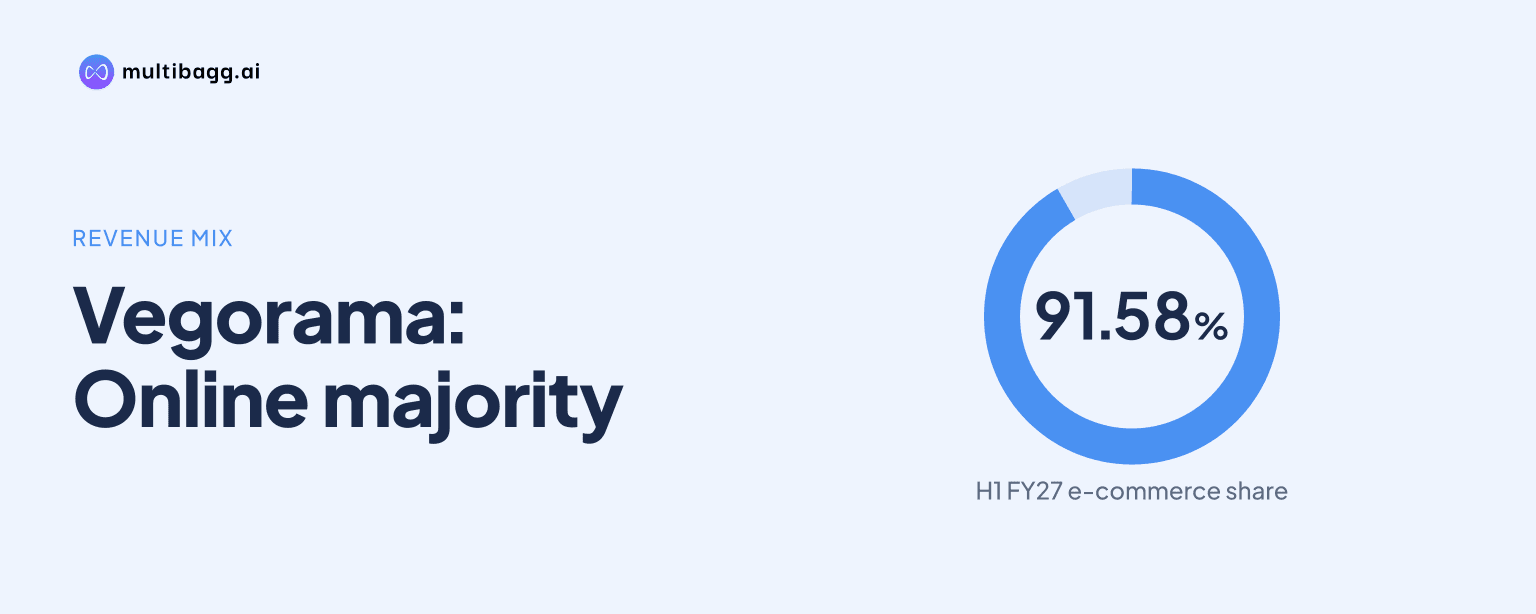
Vegorama generated Rs 91.63 crore, or 91.58%, of H1 FY27 revenue through e-commerce, making online ordering its principal sales channel. Delhi and Haryana supplied a combined 77.53% of the Rs 100.06 crore geographical revenue total, concentrating more than three-fourths of disclosed sales in those two markets.
Know Vegorama Punjabi Angithi inside out
Results, valuation, peers and who's buying, in one view.
How reliant was Vegorama on e-commerce in H1 FY27?
Vegorama relied on e-commerce for Rs 91.63 crore of H1 FY27 revenue, representing 91.58% of the reported Rs 100.06 crore total. The presentation separately describes the business as digital-first and says 91.72% of revenue was generated through online ordering channels, which is 0.14 percentage points higher than the e-commerce segment contribution.
The presentation does not explain the difference between the 91.58% e-commerce contribution and the 91.72% online-ordering statement. It does disclose a related channel split in which Zomato accounted for 49.5% of revenue and Swiggy for 40.5%, together representing 90.0%, while offline sales contributed 10.0%. This indicates that the disclosed digital-channel exposure is primarily linked to the two food-delivery platforms.
Which channels contributed revenue besides e-commerce?
Vegorama’s largest non-e-commerce line was takeaway and catering, which generated Rs 7.05 crore, or 7.05%, in H1 FY27. Dine-in generated Rs 98.19 lakh and represented 0.98%, while corporate thali generated Rs 39.02 lakh and represented 0.39%; the three non-e-commerce lines together accounted for 8.42% of revenue.
E-commerce revenue of Rs 91.63 crore was about 13 times the Rs 7.05 crore recorded by takeaway and catering. Vegorama identifies cloud kitchens, takeaway, catering and dine-in as its multi-channel formats, but the disclosed revenue mix shows that delivery-led sales contributed substantially more than physical dining and corporate-thali activity during H1 FY27.
Vegorama describes its model as asset-light and cloud-kitchen based, with about 90% of revenue generated through Zomato and Swiggy. Management says timely platform settlements support the working-capital cycle, while digital sales reduce cash handling and improve transaction visibility. These are stated operating mechanisms supporting the delivery-focused model, rather than evidence of an even split between sales channels.
Which states generated Vegorama’s H1 FY27 revenue?
Vegorama generated its largest state contribution from Delhi, at Rs 47.99 crore and 47.98% of H1 FY27 geographical revenue, followed by Haryana at Rs 29.56 crore and 29.55%. The two states’ disclosed contributions totalled 77.53%, exceeding three-fourths of the Rs 100.06 crore geographical revenue total.
Uttar Pradesh was the third-largest disclosed market, contributing Rs 19.48 crore, or 19.46%, while Uttarakhand contributed Rs 3.02 crore, or 3.02%. Delhi alone accounted for more revenue than Uttar Pradesh and Uttarakhand combined, whose stated contributions totalled 22.48%. Vegorama calls Uttar Pradesh a high-potential market and says it is expanding in Uttarakhand, but provides no earlier state-level figures to measure changes in either market’s share.
Got a follow-up? Ask IRIS
What could change Vegorama’s channel and geographic mix?
Vegorama’s disclosed kitchen-expansion programme could broaden its geographic base, although H1 FY27 revenue was concentrated in Delhi and Haryana. Its FY26–27 roadmap proposes two additional cloud kitchens each quarter, showing four kitchens in Q2, six in Q3 and eight in Q4; the Q3 and Q4 additions are marked proposed.
Four new cloud kitchens commenced operations between 17 June 2026 and 14 September 2026 in Noida, Gurugram and Delhi, while a Dwarka kitchen recommenced on 27 June 2026. For FY28, Vegorama targets 10 new kitchens through regional expansion, naming Chandigarh, Mohali, Jaipur, Bahadurgarh and Sohna Road as focus locations. Its longer-term vision is for more than 50 cloud kitchens, though the presentation gives no city-level revenue targets.
Vegorama also says its Gurgaon pure-vegetarian fine-dine and celebration-hall project is in planning and development, with commercial operations expected to commence early in FY 2027–28. The 16,400-square-foot project is intended to add premium dining, event management, catering, takeaway and cloud-kitchen delivery revenue verticals. Management also targets a 1.5% to 2.0% operating-margin improvement from its automated central kitchen, expected to commence operations in Q4, through manpower optimisation, raw-material utilisation and lower food wastage.
Conclusion
Vegorama’s H1 FY27 disclosures show a revenue base led by e-commerce, which supplied Rs 91.63 crore and 91.58% of the Rs 100.06 crore reported total. Delhi and Haryana accounted for 77.53% of geographical revenue, while takeaway, catering, dine-in and corporate thali together made up 8.42%, leaving the business dependent on delivery-led sales and its core NCR markets.
The next disclosures to watch are the proposed Q3 and Q4 FY26–27 kitchen additions, the FY28 target of 10 regional kitchens and the expected early FY 2027–28 launch of the Gurgaon project. Management’s Q4 target of a 1.5% to 2.0% operating-margin improvement from the automated central kitchen will also indicate whether the planned infrastructure changes affect profitability and the disclosed channel or state revenue mix.