










Vegorama Targets 50-Plus Kitchens, Up to 2-Point Margin Gain
Key highlights
- Vegorama reports 27 cloud kitchens and a long-term target of more than 50 kitchens.
- Vegorama targets 10 new cloud kitchens in FY28 across five named focus locations.
- An automated central kitchen is expected to reach COD in Q4 and targets a 1.5% to 2.0% operating-margin improvement.
- E-commerce contributed 91.58% of Vegorama’s H1 FY27 segment revenue.
powered by IRIS
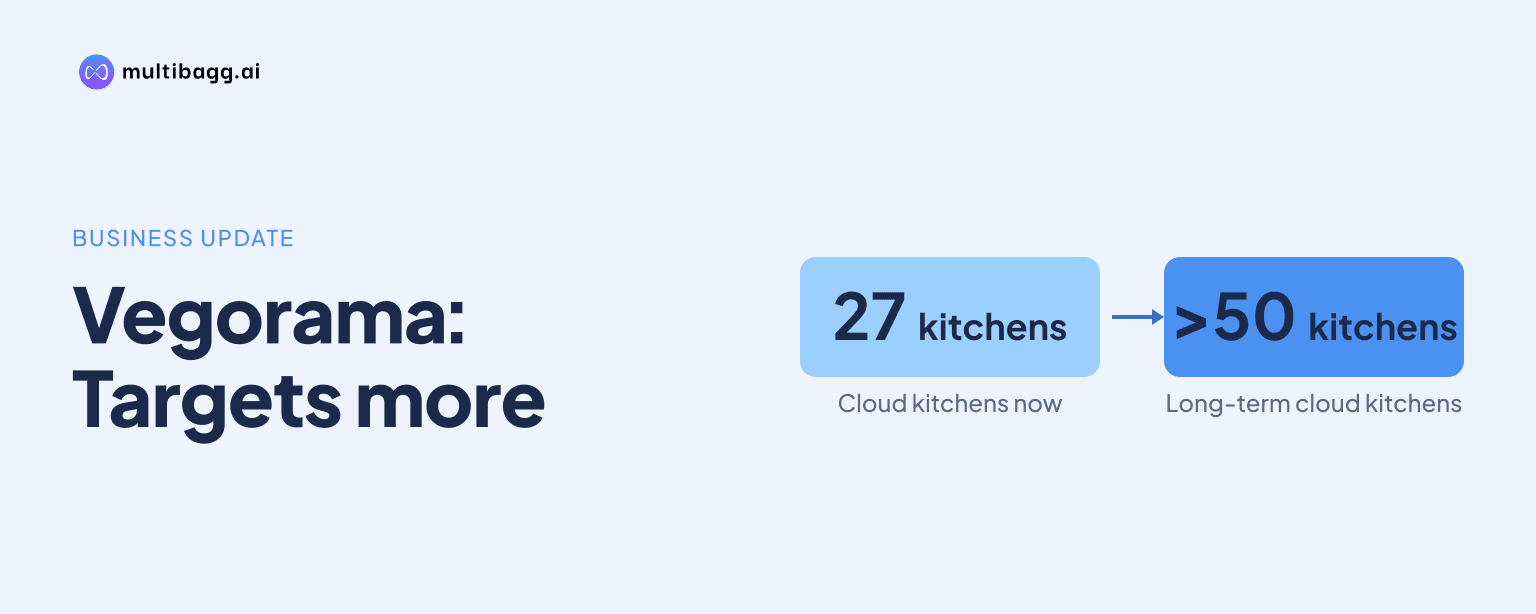
Vegorama Punjabi Angithi Limited plans to build 50-plus pure vegetarian cloud kitchens and targets a 1.5% to 2.0% operating-margin improvement from an automated central kitchen expected to reach commercial operations date, or COD, in Q4. The plan starts from 27 cloud kitchens and includes a target of 10 new kitchens in FY28.
Know Vegorama Punjabi Angithi inside out
Results, valuation, peers and who's buying, in one view.
How many cloud kitchens does Vegorama plan to operate?
Vegorama’s long-term target is 50-plus pure vegetarian cloud kitchens, compared with 27 cloud kitchens in its current key facts and figures. Its roadmap identifies FY28 as a regional-expansion phase targeting 10 new kitchens, while the presentation does not provide a date for achieving the longer-term 50-plus network objective.
Vegorama names Chandigarh, Mohali, Jaipur, Bahadurgarh and Sohna Road as FY28 focus locations. The company also identifies the next two quarters for planned outlet launches, although it does not assign a kitchen-opening number to that shorter period.
Vegorama’s site-selection framework combines high population density, online food demand, corporate presence and kitchen-level unit economics. The company reports more than 17,000 daily orders, an average order value of Rs 380 to Rs 420, and an approximately 65% repeat-customer base, which are the disclosed operating measures alongside the planned network expansion.
How does Vegorama’s hub-and-spoke model support growth?
Vegorama says one base kitchen can support five to 10 satellite kitchens through bulk procurement, quality control and recipe standardisation. The model is intended to lower setup costs at satellite kitchens, speed rollout and maintain consistent pure vegetarian recipes and processes across several locations.
The structure centralises procurement and production instead of duplicating these functions at every outlet. Vegorama says this can reduce operational duplication, improve delivery efficiency across multiple micro-markets and raise order density within a kitchen cluster.
Vegorama describes the cluster structure as replicable across cities, supporting its stated pan-India expansion plan. Its current footprint includes 27 cloud kitchens and two fine-dining restaurants, while its four business formats are cloud kitchens, takeaway, catering and fine dining.
The network carries five brands: Punjabi Angithi, Dilli Tawa Parantha, Chinese Veg Crunch, Food of Dreams and Swaad of Punjab. Vegorama describes its offering as 100% pure vegetarian, with no frozen food and live cooking, and presents recipe standardisation as the mechanism for retaining consistency as it adds outlets.
What margin improvement does Vegorama expect from automation?
Vegorama targets a 1.5% to 2.0% operating-margin improvement through a fully automated central kitchen expected to reach COD in Q4. Management attributes the target to manpower optimisation, improved raw-material utilisation, lower food wastage and production capacity that can support additional outlets without proportional operating-cost growth.
The automated central kitchen is distinct from the base-and-satellite arrangement because it is specifically presented as an automation-led operating-leverage project. Vegorama says centralised food production is intended to standardise quality and consistency across outlets while reducing labour intensity and operating costs.
The 1.5% to 2.0% figure is a management target rather than a reported result. Vegorama links the expected cost efficiencies to improved outlet-level unit economics and earnings before interest, taxes, depreciation and amortisation, or EBITDA, margins, but does not disclose a current operating-margin baseline.
The presentation provides no capital-expenditure amount, automation-equipment detail or production-capacity figure for the central kitchen. Its stated strategic role is to create scalable production infrastructure for future outlet expansion and lower incremental operating costs as the network grows beyond 27 kitchens.
Got a follow-up? Ask IRIS
What does Vegorama’s revenue mix show about the strategy?
Vegorama’s H1 FY27 segment revenue was led by e-commerce at 91.58%, compared with 7.05% from takeaway and catering. Dine-in contributed 0.98% and corporate thali contributed 0.39%, placing the cloud-kitchen expansion behind the company’s largest disclosed revenue channel.
Vegorama separately says that online ordering channels generated 91.72% of revenue in H1 FY27. The presentation does not explain the 0.14-percentage-point difference between online ordering and e-commerce segment revenue, so the two disclosures are separately labelled measures.
E-commerce generated Rs 91.6341 crore in H1 FY27, while takeaway and catering generated Rs 7.0534 crore. Dine-in generated Rs 98.19 lakh and corporate thali generated Rs 39.02 lakh, illustrating the gap between the delivery-led segment and the other disclosed channels.
What are Vegorama’s next operating priorities?
Vegorama’s next stated milestones are the automated central kitchen’s Q4 COD, planned outlet launches over the next two quarters and 10 new kitchens in FY28. Its roadmap also calls for expansion across key metros and Tier I and Tier II cities to increase delivery reach and market penetration.
Vegorama plans to strengthen an omnichannel model combining cloud kitchens, fine dining and direct ordering. The company has two fine-dining restaurants and intends to expand that format while also developing a direct-ordering platform, customer relationship management, or CRM, and loyalty programmes.
The company links procurement efficiencies, higher kitchen utilisation and operating leverage to its sustainable-profitability objective. However, the presentation does not provide projected revenue, order growth, revenue per new kitchen or a payback period for the central kitchen or the FY28 rollout.
Conclusion
Vegorama’s plan combines a long-term target of 50-plus cloud kitchens with a cluster model in which one base kitchen supports five to 10 satellite kitchens. The strategy is directed at a delivery-led business where e-commerce accounted for 91.58% of H1 FY27 segment revenue and where the company reported more than 17,000 daily orders.
The next disclosed events are Q4 COD for the automated central kitchen, planned launches during the next two quarters and the FY28 target of 10 new kitchens. The key reported outcomes to watch are completion of those milestones and whether the targeted 1.5% to 2.0% operating-margin improvement is reflected in later results, as Vegorama has not provided a margin baseline or capital-spending figure.